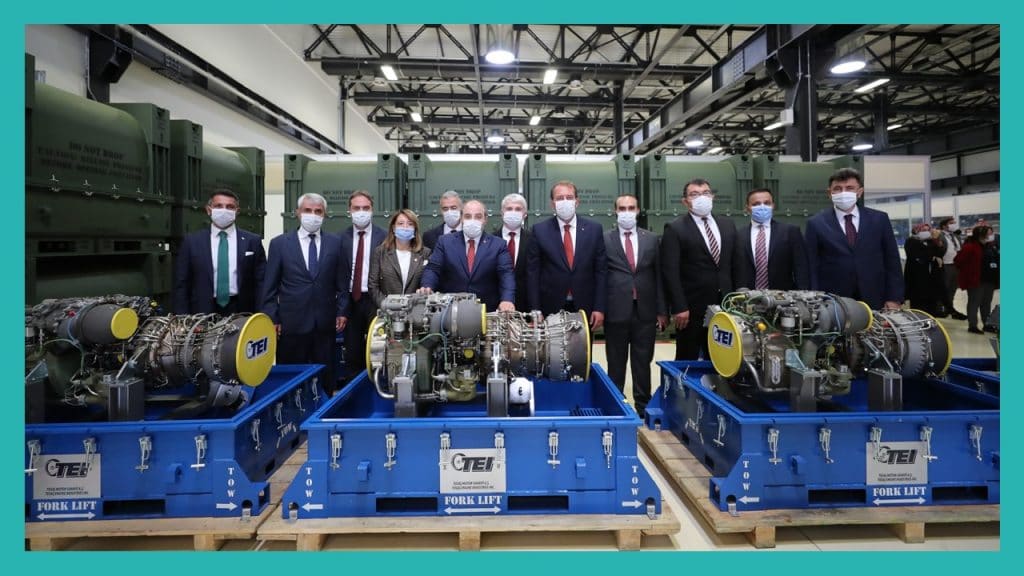
On 19 June 2020, Turkey’s Tusaş Engine Industries (TEI) announced that it successfully tested its domestic TJ300 miniature turbojet engine at Turkish Aerospace Industries’ (TAI) facilities. TEI also tested the “core” of its TS1400 turboshaft engine, and is aiming to deliver the prototype to TAI in 2020.[1]
Turkey intends to power its anti-ship cruising missiles (ASCM) and land-attack cruise missiles (LACM) with homegrown engines. It currently imports miniature air-breathing engines from Microturbo to power its domestically developed cruise missiles. The TJ300 reportedly offers a thrust rating of 1.3 kN, which would not be enough for its larger ASCM/LACM designs, such as the Atmaca and SOM.[2] Rather, TEI will steer the TJ300 for a shorter-range application – TEI labels the TJ300 as the “Medium Range Anti-Ship Missile.”
Turkey also developing a larger miniature turbojet engine called the KTJ-3200. It will use the KTJ-3200 to power the Atmaca ASCM and SOM LACM/ASCM. Interestingly, the Turkish private sector – led by Kale – is driving the development of the KTJ-3200.[3] The KTJ-3200 will offer a thrust of 3.2 kN.[4]
The TS1400 is intended for the TAI T625 Gökbey utility and transport helicopter, which flew for the first time in September 2018, but with the CTS-800A turboshaft engine supplied by the joint-Honeywell and Rolls-Royce venture Light Helicopter Turbine Engine Company (LHTEC). The TS1400 will offer an output of 1,400 shp, potentially making it comparable to the engine Turkey is seeking to replace.[5]
Ankara has been working to end its reliance on overseas suppliers – especially Europe – for critical inputs, especially engines. In recent years, Ankara found that the governments of its critical suppliers leveraged Turkey’s reliance on those inputs to hamper its defence export sales and overseas military activities.
For example, the United States’ reluctance to release permits for the re-sale of the CTS-800A froze TAI’s contract to supply 30 T129 ATAK attack helicopters to the Pakistan Army. Likewise, Ankara must regularly contend with cabinet and parliament-level discussions about sanctioning Turkey each time the latter tries exerting its security interests, especially with regards to the Kurdistan Workers’ Party (PKK).
Though TEI has made significant developmental in-roads with its aero engines, it is still at least some years away from integrating, testing, certifying, manufacturing, and supplying them at-scale. But the recent test runs are markers of progress, which is significant considering these are Turkey’s first attempts to designing and producing its own engines. To-date, Turkey has manufactured such engines under license.
Currently, TEI intends to complete the TS1400 program by 2024 to 2025. In 2017, Turkey’s Presidency of Defence Industries (SSB) commissioned TEI to develop the TS1400 under a multi-phase program. With at least a starting cadre of 250 engineers, TEI was to develop the TS1400’s air-breathing core in two years, build the prototype in four-and-a-half years, and complete certification in one-and-a-half years.[6]
The starting application of the TS1400 will be the TAI T625, Turkey’s first homegrown utility and transport helicopter. Comparable in specifications and role to the Leonardo AW139, TAI intends to market the T625 for both civilian and military roles. However, to push ahead with military applications, TAI will likely need to wait for the TS1400. Thus, the T625 will kick-off in earnest after 2025 and, by 2030, could emerge in a number of variants, including a tandem-seat, dedicated attack helicopter, the T629.
Quwa Plus
Go Beyond the Headlines on Pakistan’s Defence and Security.
Quwa Plus gives you deeper reporting, briefings, and analysis on Pakistan’s defence programs, foreign policy, national security, and regional strategy. Follow the developments that matter to professionals, analysts, and serious readers tracking Pakistan’s security landscape.
Join ($29.99/Year) Already a subscriber?Sign in