
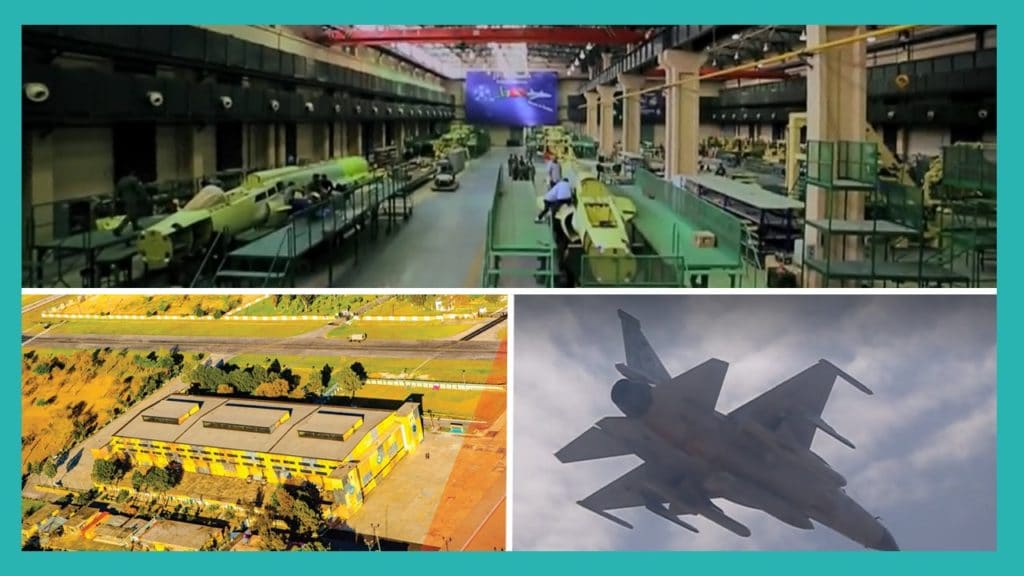
The impetus for manufacturing fighter aircraft at Pakistan Aeronautical Complex (PAC) was instigated by the Pressler Amendment, i.e. US legislation that was designed to discourage Pakistan from developing and deploying nuclear weapons. Pressler was brought into force in the early 1990s and, by 1995, the Pakistan Air Force (PAF) signed onto a proposal by Chengdu Aircraft Corporation (CAC) to pursue the Super-7, which would – in 2003 – be re-designated as the JF-17.[1] Today, the JF-17 flies with six PAF squadrons.
However, the PAF’s pursuit of domestically manufacturing fighters did not originate with the JF-17. In fact, Pakistan’s interest in the matter extends to as early as 1949 when an industrialist and advisor to Pakistan’s Ministry of Defence – Mir Laiq Ali – broached the matter with the US. Ali had opened talks with Lockheed Martin to initially supply, assemble and eventually manufacture the F-80 in Pakistan.[2] The initiative failed (due to apparent pressure from Britain on the Pakistani government).[3]
Granted, in hindsight the F-80 might not have been a prudent idea. The 1950s and 1960s saw very rapid development and iteration in terms of jet fighters. The F-80 was essentially the single-seat variant of the T-33 trainer, which did join the PAF later as its fighter conversion system. If Pakistan committed to the F-80, it might have been stuck with an antiquated design in only a few years. However, one might argue that the effort could have infused Pakistan with the knowledge to manufacture aircraft decades earlier.
As it had with the nuclear weapons program, a domestic fighter could have been sought as a strategic asset in parallel. Nonetheless, the PAF’s jet fighter needs were addressed with the acquisition of 36 Supermarine Attackers from the UK.[4] Until the mid-1950s, the PAF – alongside the Pakistan Army and Pakistan Navy – maintained the course with surplus British equipment. This changed (permanently) with the infusion of American hardware provided to Pakistan through military aid.
The expansive US military aid program of the 1950s saw the PAF induct 120 F-86F Sabres, which had built the mainstay of the PAF fighter fleet through the 1950s and 1960s. This was followed by the Shenyang F-6 – i.e. China’s MiG-19 derivative – in the 1970s and, by the 1990s, the Chinese MiG-21 derivative, F-7P. In the decades between 1950 and 2010, the PAF’s backbone fighter was not only a low-cost – and widely manufactured and adopted – platform, but a generation behind the ‘current’ design.
Quwa Plus
Go Beyond the Headlines on Pakistan’s Defence and Security.
Quwa Plus gives you deeper reporting, briefings, and analysis on Pakistan’s defence programs, foreign policy, national security, and regional strategy. Follow the developments that matter to professionals, analysts, and serious readers tracking Pakistan’s security landscape.
Join ($29.99/Year) Already a subscriber?Sign in