Note: This article is a partial re-write of an older Quwa Premium piece – “Pakistan’s Mirages: Specialists Enduring Out of Necessity.” However, the latter half of this article delves into how the PAF used the Mirage III/5 during Swift Retort as well as how the PAF may configure the JF-17 to support the Mirages and how the lessons of using the Mirages in strike and maritime operations for decades could confirm Project AZM.
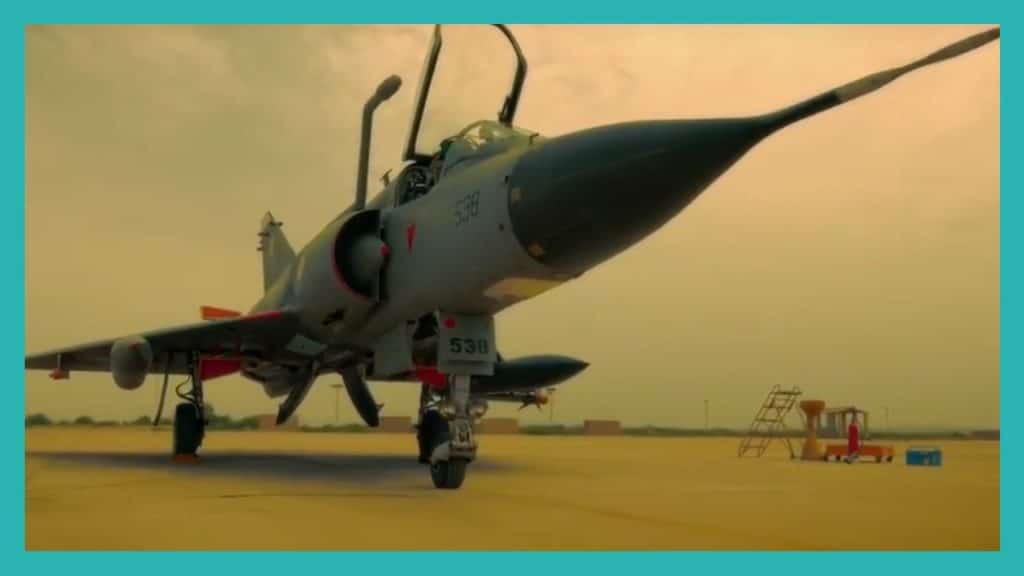
In April 2018, the AFP News Agency published an article detailing its visit to the Mirage Rebuild Factory (MRF) at Pakistan Aeronautical Complex (PAC).[1] The complete AFP article is available on Dawn News, but it provides an insight into the MRF’s activities in keeping the Pakistan Air Force’s (PAF) Dassault Mirage III and 5 fighters serviceable, especially with much of the fleet averaging 50 years in terms of airframe age.[2]
Interestingly, AFP was able to extract the reason why the PAF persists with operating the Mirage III/5, i.e. its continuing value as an effective strike aircraft, which the PAF Air Commodore Tariq Yazdani described as a “very agile aircraft capable of penetrating deep into the enemy’s territory without being detected by radar, which makes its sole mission — to drop bombs on the enemy’s position — quite easy.”[3]
Since its introduction to the PAF fleet in the 1968, the Mirage III/5 has transitioned from being the PAF’s mainstay high-tech fighter in the 1970s to a complementary asset to the newer F-16 in the 1980s. Today, the Mirage III/5 may not command as much attention as the F-16 and JF-17 as an air-to-air asset, but it is significantly more than just a valuable strike fighter – it is the PAF’s prime strike asset.
This prominence stems from two factors.
First is the straightforward reality that the PAF has not yet been able to secure a suitable successor. The cause primarily stems from a lack of funding (i.e., cash on-hand or financing mechanisms such as a supplier line-of-credit), but also a limited pool of willing suppliers with aircraft that can substantively improve upon the Mirage III/5 to warrant the costly shift to a new platform.
Second, the Mirage III/5 is the PAF’s sole delivery platform for key stand-off weapons (SOW), namely the H-2 and H-4 glide-bombs (which are derived from the Denel Dynamics Raptor I and Raptor II – ranges of 60 km and 120 km, respectively) and Ra’ad I and Ra’ad II air-launched cruise missiles (ALCM), which have ranges of 350 km and 600 km, respectively. The Mirage 5PA3 can also carry the MBDA AM39 Exocet anti-ship missile (AShM). Prior to the C-802-equipped JF-17, the Mirage 5PA3 was the PAF’s only anti-ship warfare (AShW) asset. It still operates from Masroor Air Base under the No. 32 Tactical Wing.
The Mirage Rebuild Factory
The PAF established the MRF in 1978. In the subsequent 40 years, the MRF has serviced (as of November 2017) a total of 350 aircraft and 2,280 engines.[4] The PAF has invested considerably in the MRF, essentially building a robust infrastructure base to stretch airframe lives beyond the lifespan intended by Dassault.
However, the extent to which MRF is undertaking depot-level maintenance, repair and overhaul (MRO) work today is the culmination of four decades of gradual capacity growth at PAC. When it began its MRO work, PAC relied on imported parts – originally from the original equipment manufacturer (OEM) and then from surplus Mirage III/5 aircraft from Australia, France, Libya and other places – to ensure and/or extend airframe lives.[5] PAC reduced this reliance (albeit, not entirely) by undertaking some manufacturing work, particularly of wing components and parts for the Atar-09C turbojet engine.[6]
It appears that since the 1980s, PAC accumulated a series of turnkey repair facilities from Dassault – i.e. Wing Refurbishing Facility, Fuselage Structural Repair and Engine Overhaul Wing.[7] Granted, the Mirages are old platforms, but compared to other aging platforms – such as the C-130B/E, AH-1F/S and in time the F-16A/Bs – PAC is essentially the best place to replenish certain aerostructures (such as the wings’ ribs).[8]
Don't Stop Here. Unlock the Rest of this Analysis Immediately
To read the rest of this deep dive -- including the honest assessments and comparative analyses that Quwa Plus members rely on -- you need access.