
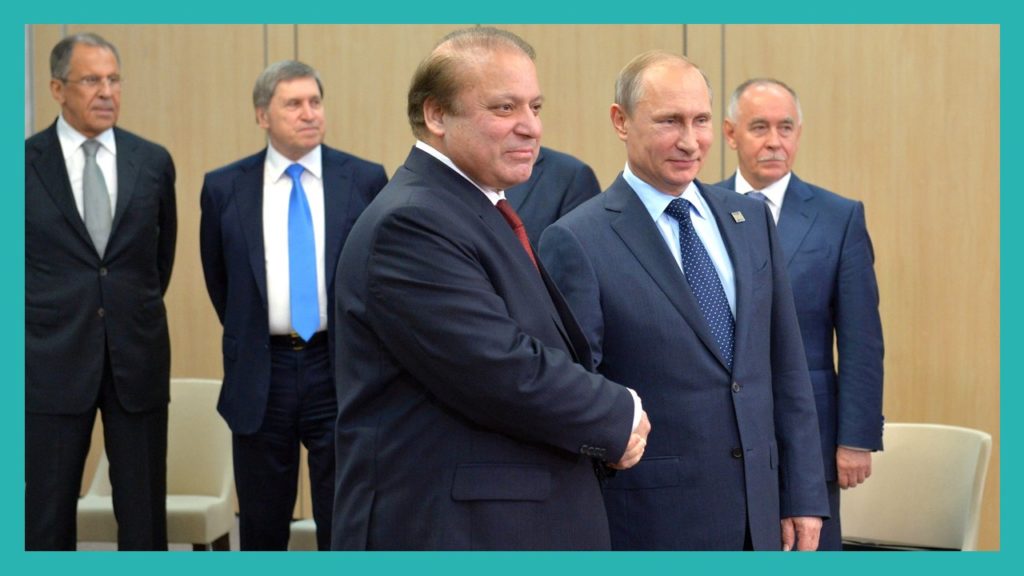
Since 2015, Russia has emerged in Pakistani foreign relations and defence discourses as an alternative to the U.S., with whom Pakistan has been allied under the War on Terror since 2001-2002. Indeed, Pakistan’s Minister of Defence (MoD) Khurram Dastgir Khan listed Russia, along with China and Europe, as alternative sources for weapons and as a “regional recalibration of Pakistan’s foreign and security policy.”[1]
Following the thaw in bilateral ties and Russia lifting its nominal restrictions on supplying arms to Pakistan, various reports emerged of Pakistan expressing interest in big-ticket Russian hardware such as the Almaz-Antey S-400 Triumf long-range surface-to-air missile (SAM) system, Sukhoi Su-35 Flanker-E multi-role fighter and Mil Mi-28NE Night Hunter attack helicopter.[2][3][4] However, the only contract to emerge thus far has been a Pakistan Army order for four Mil Mi-35M assault helicopters from Russian Helicopters.[5]
In fact, despite the attention paid to the prospect of growth in bilateral defence ties, there has not been any substantive growth in this department. Recently, Russia’s new Ambassador to India, Nikolay Kudashev outlined that Russia’s ties “with Pakistan in the military sphere are of a very minimum nature … are strictly limited to anti-terrorism operations and are not comparable in any way to the scope of our relations with India.”[6] Granted, there is the aspect of Kudashev conveying an amenable message to New Delhi and need not reflect the Kremlin’s thoughts, but the current reality does not detract from Kudashev’s statements.
In fact, capacity-building for counterinsurgency (COIN) and counterterrorism (CT) operations has been the anchor of Russia’s engagement with Pakistan, with the Russian Foreign Minister Sergei Lavrov stating at a press conference in New Delhi in December 2017: “Yes, we understand Pakistan’s interest in solving this [terrorism], to get rid of terrorist groups which use its territory and we would be ready to support the Pakistani government in this regard.”[7] This cooperation has materialized in the annually-held bilateral CT/COIN-focused exercise – ‘Friendship’ – and the sale of Mi-35M assault helicopters. In November 2016, Russia’s state-owned armaments trading arm Rosoboronexport attended IDEAS (International Defence Exhibition and Seminar), Pakistan’s biennially-held defence exhibition, with an exhibit overtly tailored for internal security and CT/COIN. Lauding Rosoboronexport’s first foray into IDEAS, the company’s Head of Analysis and Long-Term Planning Boris Simakin stated: “We aim at broadening antiterrorist cooperation with Pakistan and other countries in the region. Rosoboronexport will provide materials proving [the] effectiveness of Russian products deployed against this global threat.”[8]
For Russia, presenting its relationship with Pakistan through the CT/COIN paradigm enables it to maintain its strong relations with India. Russia can argue – and seems to have successfully done so – that bringing Pakistan into the mix (in multilateral bodies such as the Shanghai Cooperation Organization) is necessary for propelling regional interests. In a sense, CT/COIN is being presented as a transcendant interest, one where all countries ought to be concerned in irrespective of other disputes. However, this avenue offers Russia access to the Pakistani market in a way that does not interfere with Russian interests in New Delhi. Besides CT/COIN-relevant hardware and services, it is unlikely that Russia is banking on Pakistan to become a customer of its marquee items, such as the S-400 and Su-35, in the foreseeable future.
Rather, it appears that Russia is chiefly pushing its energy interests in Pakistan. In December 2017, Russia and Pakistan had a $10 billion U.S. liquified natural gas (LNG) deal on the table.[9] Besides national bids, the Russian side also appears to be interested in Pakistan’s various provincial energy programs, as shown by a visit to Khyber-Pakhtunkhwa by Inter RAO in January 2018.[10] It is unclear if the China Pakistan Economic Corridor (CPEC) can be of direct benefit to Russian businesses as it appears that Chinese companies are at the forefront of constructing CPEC’s programs. However, the indirect benefit of CPEC’s infrastructure and energy glut – i.e. supra-CPEC economic activity borne through new industries, investors and markets – may present opportunities for the Russians. However, it is currently too early to place such a bet.
Quwa Plus
Go Beyond the Headlines on Pakistan’s Defence and Security.
Quwa Plus gives you deeper reporting, briefings, and analysis on Pakistan’s defence programs, foreign policy, national security, and regional strategy. Follow the developments that matter to professionals, analysts, and serious readers tracking Pakistan’s security landscape.