
Key Pakistan Navy (PN) surface combatant programs have started materializing, namely its Babur-class (MILGEM) corvette and Yarmouk-class Batch-II offshore patrol vessel (OPV) programs.
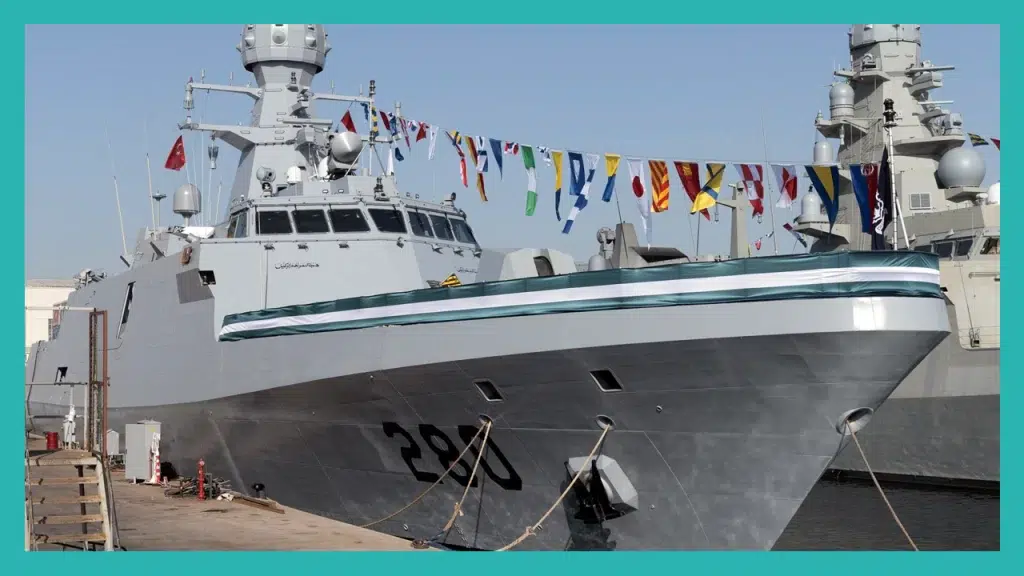
On September 23, the PN commissioned its first of four Babur-class multi-mission corvettes, PNS Babur, at Istanbul Shipyard. The corvettes were ordered as part of a $1.5 billion USD contract with ASFAT A.Ş. signed in July 2018. Under the contract, ASFAT A.Ş. agreed to both customize and co-produce the MILGEM Ada-class anti-submarine warfare (ASW) corvette for the PN’s needs and help the PN design and produce its own original frigate (i.e., the Jinnah-class frigate program). Two of the ships were to be built at the Istanbul Shipyard, while Karachi Shipyards & Engineering Works (KSEW) in Pakistan was to build the other two.
The PN was slated to receive its first two ships in 2023, and its last two by 2025. In addition to PNS Babur, the second, third, and fourth ships – i.e., PNS Khaibar, PNS Badr, and PNS Tariq, respectively – are currently undergoing sea trials in Turkey and Pakistan. Based on the photos available, the Babur-class corvette does not seem to be equipped with all of its weapon systems (e.g., anti-ship cruising missiles or short-range air defence systems), so these may be fitted at a later date, likely in Pakistan.
On September 12, Damen Shipyards Galati launched the first of the PN’s Yarmouk-class Batch-II OPVs, the PN Hunain. This is a continuation of the PN OPV program, which started in 2017 as part of a contract with the Netherlands’ Damen Shipyards for two ships with an option for two more. Damen delivered the initial pair – i.e., PNS Yarmouk and PNS Tabuk – to the PN in February and May of 2020.
The first pair of ships were based on Damen’s OPV 1900 design, while the second batch were based on the larger OPV 2600. Damen’s OPV-series of ships are generally built according to commercial standards, hence giving the ships a lower acquisition cost compared to other designs. However, Damen Shipyards is willing to customize the ships according to the requirements of the customer.
The PN opted to configure both the OPV 1900 and OPV 2600 for conventional warfare roles, such as anti-ship/anti-surface warfare (AShW/ASuW), that would typically belong to corvettes and frigates. Indeed, the PN is referring to the OPVs as ‘corvettes’ within its own service.
The Babur-class corvette and Yarmouk-class corvette/OPV programs are pieces of the PN’s vision to build a 50-ship surface fleet, of which 20 ships would be ‘major surface vessels.’ Both platforms are customized with major changes to the baseline platform, especially in terms of anti-air warfare (AAW) and AShW.
For example, the Babur-class corvette has a heavier displacement (2,926 tons) compared to the standard Ada-class (2,400 tons), with the inclusion of a vertical launch system (VLS) being a major feature addition. Likewise, the PN’s OPV 1900 and OPV 2600 differ in key respects to their baseline versions, e.g., inclusion of AShW weapons and, in the case of the OPV 2600, dedicated AAW via a VLS.
In 2019, the then PN Chief of Naval Staff (CNS), Admiral Zafar Mahmoud Abbasi, revealed that the MILGEM and OPV programs would spawn into two additional projects, i.e., the Jinnah-class frigate and, potentially, six OPVs of “larger tonnage” compared to the OPV 1900, which was on order at the time.
It appears that the OPV program is expanding; at the time of the then CNS’ announcement, the PN ordered only the OPV 1900s. However, it ultimately did procure two OPV 2600 ships, thus fulfilling the vision for a ship of “larger tonnage” within the OPV project framework. Thus, the PN could potentially acquire up to four additional OPVs, but customized for AShW, AAW, and/or ASW.
Don't Stop Here. Unlock the Rest of this Analysis Immediately
To read the rest of this deep dive -- including the honest assessments and comparative analyses that Quwa Plus members rely on -- you need access.