
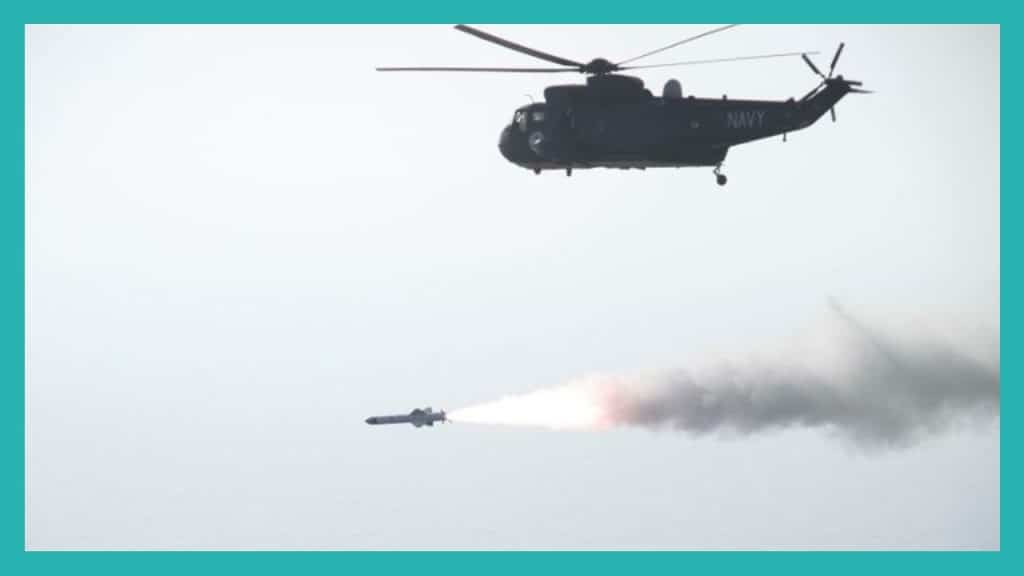
The Pakistan Navy (PN) Chief of Naval Staff (CNS), Admiral Zafar Mahmood Abbasi, outlined in an interview that the PN is working to acquire long-range maritime patrol aircraft (LRMPA), unmanned aerial vehicles (UAV), and multi-mission helicopters.[1] The CNS did not reveal the status of any of these programs, or the expected procurement timeline. However, the PN rarely seems to comment on potential acquisitions prior to signing a contract or starting a project. Thus, all three programs are likely active at this stage.
Supporting New Surface Warships With Helicopters
The PN currently has four Type 054A/P frigates, four MILGEM corvettes, and two Yarmouk-class corvettes on order. The PN is aiming to procure its 10 new ships by the mid-2020s, which will join its four Zulfiquar-class/F-22P frigates and, likely, replace its three remaining Babur-class/Type-21 frigates.
However, in terms of shipborne anti-submarine warfare (ASW) helicopters that can operate from ships in the 2,000-ton to 4,000-ton displacement range, the PN relies on only six Z-9ECs.[2] These currently operate with the PN’s four F-22P frigates. Thus, the PN will need additional ASW helicopters to support its 10 new ships, which could necessitate 10-14 new aircraft. However, the PN could also look to supplant its legacy Alouette III, which could see a scope of an additional four to six similarly sized helicopters.
For the PN, the benchmark for an optimal ASW helicopter is likely the UH-60, which it originally sought in the late 2000s alongside six FFG-7 Oliver Hazard Perry (OHP)-class frigates from the US. However, getting any of the Black Hawk-variants is untenable for multiple reasons.
First, Pakistan is reluctant to finance big-ticket items from the US with its own funding, preferring instead to rely on Coalition Support Funds (CSF) and Foreign Military Financing (FMF). Second, the cost of new-generation versions is outside of the PN’s budget, e.g., India agreed to pay $108 million per MH-60R. Third, the US may not agree to release all of the subsystems the PN would be interested in from such a platform.
The PN could potentially look at exploring surplus or used airframes under Excess Defence Articles (EDA), but with US-Pakistani defence ties still in a precarious state, these aircraft may not be available. Thus, the PN will likely gauge options in China, Europe and, potentially, Turkey.
In terms of China, the simplest route would be to acquire additional Z-9ECs. This option would extend the use of pre-existing maintenance, logistics and training infrastructure, thus resulting in a lower acquisition cost and, potentially, quicker induction timeframe. Though China is manufacturing newer designs, notably the Z-20, it does not seem as though these models are available for export at this time.
In Europe, the most willing supplier to the PN is Leonardo, which has offered its AgustaWestland-series of helicopters. An industry representative at the 2018 International Defence Exhibition and Seminar (IDEAS) told Quwa that the AW101 and AW159 were on offer to the PN.
However, the AW101 and AW159 are both high-cost platforms (i.e., $107 million, and $54 million per unit, respectively).[3][4] Thus, even if the PN is interested in either aircraft, it will not be able to order them in the numbers necessary to keep-up with its surface-fleet expansion. Finally, the presence of ITAR equipment, at least in the AW159 (which, like the T129 ATAK, uses an LHTEC turboshaft engine), is another roadblock as it could draw a third-party denial from Washington.
Quwa Plus
Go Beyond the Headlines on Pakistan’s Defence and Security.
Quwa Plus gives you deeper reporting, briefings, and analysis on Pakistan’s defence programs, foreign policy, national security, and regional strategy. Follow the developments that matter to professionals, analysts, and serious readers tracking Pakistan’s security landscape.
Join ($29.99/Year) Already a subscriber?Sign in