Quwa Premium

Pakistan Defence Review: News/Procurement Updates Plus

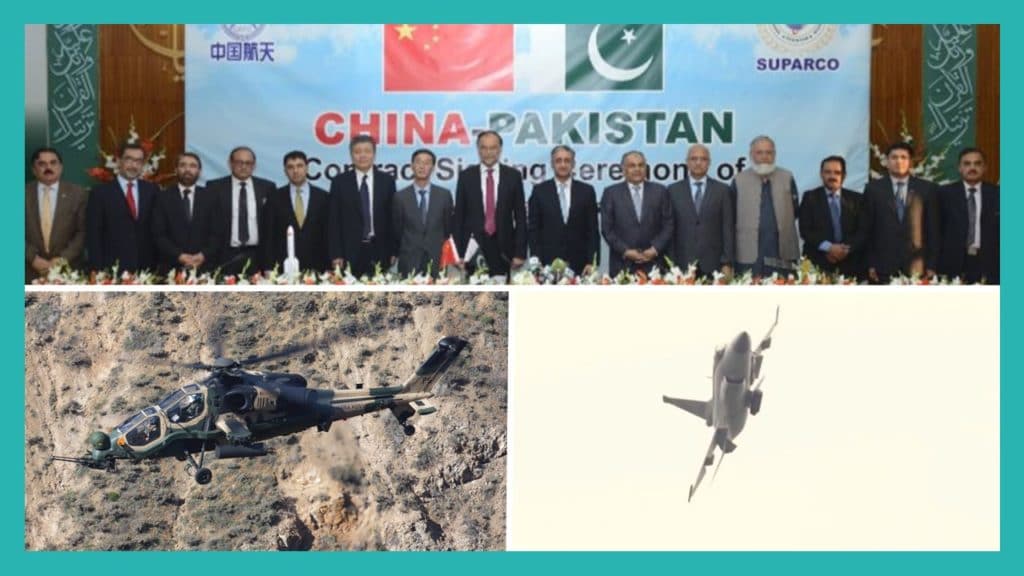
This is a review of ancillary Pakistani defence news topics with short-hand analysis to provide clarity and context. In March 2018: 3 Turkish T129 attack helicopters took part at the Pakistan Day Parade; ASELPOD spotted on the JF-17; the JF-17 participating in Gulf Shield; a sign of SUPARCO’s Space Vision 2040 being in full-swing; and how Pakistan’s naval deterrence efforts are still a work-in-progress

This is a review of ancillary Pakistani defence news topics with short-hand analysis to provide clarity and context. In March 2018: 3 Turkish T129 attack helicopters took part at the Pakistan Day Parade; ASELPOD spotted on the JF-17; the JF-17 participating in Gulf Shield; a sign of SUPARCO’s Space Vision 2040 being in full-swing; and how Pakistan’s naval deterrence efforts are still a work-in-progress

3 TAI T129 ATAKs at March 23rd Parade

The Turkish Army sent three of its T129 ATAK attack helicopters to participate in the Pakistan Day military parade on 23 March. However, it would be premature to connect the gesture to Pakistan inking its long-awaited contract for 30 T129s with Turkish Aerospace Industries (TAI).

Like the MILGEM Ada corvette deal, the T129 deal is contingent on the availability of a line-of-credit from Turkey to back the sale. Basically, Pakistan will use the loan to get the production process started and, in turn, repay the loan over fixed installments over a mutually agreed-upon time-period. However, a Turkish analyst stated that TAI and Pakistan are still waiting for approval from Turkey’s Export-Import Bank.[1]

However, the Daily Sabah reports – citing an anonymous, but well-placed source – that the Pakistani T129 deal is “months, if not weeks” away from being inked in earnest. Originally, Alan Warnes learned that TAI was aiming to announce this contract as a firm deal at the 2018 Farnborough Air Show in July.[2] However, once the deal is inked, TAI promised that it will begin delivering the helicopters relatively soon.

If inked, there are several key ‘treads’ emanating from this deal. First, TAI invited Pakistan Aeronautical Complex (PAC) to support the T129 with some parts manufacturing work (which will feed TAI).[3] Second, it will complete Pakistan’s recapitalized high-altitude helicopter fleet, which saw the Airbus Helicopters H125M and Leonardo AW139 assume the scout/light-utility and medium-utility roles, respectively.[4]

The T129 – which Pakistan apparently praised for its performance in high-altitude environments – would provide the attack element for Pakistan’s high-altitude forces. The Pakistan Army lamented about the AH-1F/S Cobras being unable to operate above 8,000 ft,[5] the T129 was test-flown in Pakistan at 14,000 ft.[6]

ASELPOD Spotted on JF-17 Block-I/II

Footage from Pakistan’s Inter Services Public Relations (ISPR) showed a JF-17 Block-I or Block-II equipped and flying with an Aselsan ASELPOD targeting pod. The Pakistan Air Force (PAF) received three deliveries of the ASELPOD from 2016-2018.[7] Currently, it appears that eight are in use with the PAF, it is unclear if or when additional pods will be ordered, though Aselsan confirmed talks were underway (in 2016).[8]

In terms of targeting pods, it is true that the Block-III is expected to have a dedicated hardpoint for special mission pods. However, the PAF sought the ASELPOD to equip the JF-17 for its counterinsurgency (COIN) operations,[9] so seeing this capability emerge ahead of the Block-III is not surprising. As for whether this is a Block-I or Block-II, it is unclear because the PAF is fielding mixed or composite units with the JF-17. The No. 16, for example, was raised with the Block-I, but it has also been shown with in-flight refueling (IFR)-equipped Block-IIs.[10] Logically, the IFR-equipped Block-II would make sense because IFR frees the JF-17 to use its six remaining hardpoints for munitions instead of fuel-pods.

However, it should also be noted that there has been a relative drawing down of COIN air operations; the switch to continual low-intensity operations could see a greater reliance on armed drones than the JF-17. In this sense, the ASELPOD footage could simply be an indication of testing, integration and qualification more so than trying to fulfill an immediate operational requirement. It may also explain why the PAF has yet to ink another ASELPOD order, despite commencing such talks in late 2016.

It will be interesting to see if the PAF adds other special mission pods to the JF-17. A PAF official told Quwa that the ASELPOD could be used for intelligence, surveillance and reconnaissance (ISR) purposes, but the ASELPOD’s capability-set is not analogous to a traditional ISR pod. For example, the UTC DB-110 photo-reconnaissance pod can relay images to other assets through data-link. This capability is not present in the ASELPOD. In fact, Aselsan was working on a dedicated reconnaissance pod with the Belgian company Terma in 2015.[11] Thus, the PAF could look to expand its special mission pod inventory, especially the Block-III, which will benefit from a dedicated hardpoint for such pods.

Quwa Plus

Don't Stop Here. Unlock the Rest of this Analysis Immediately

To read the rest of this deep dive -- including the honest assessments and comparative analyses that Quwa Plus members rely on -- you need access.

Join Today

USD $29.99/Year