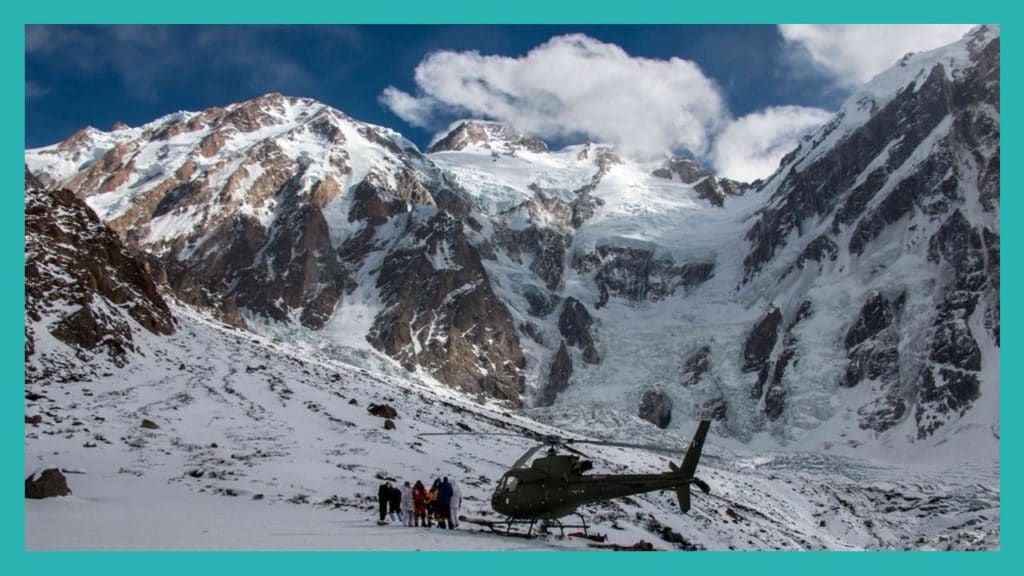
On 25 January 2018, two European climbers – Elisabeth Revol of France and Tomasz Mackiewicz of Poland – were trapped on Nanga Parbat, the ninth-highest peak in the world, following an attempt to climb the summit ‘alpine style’ (i.e. with bare/minimal equipment – including supplementary oxygen – and support). The following day, a Pakistan Army Aviation Corps (PAA) unit equipped with two Airbus Helicopters H125M (previously known as the AS550 C3e Fennec) was deployed by Force Command Northern Areas (FCNA) to support rescue operations.[1] Ultimately, the rescue team (spearheaded by four Polish rescuers) could only retrieve Revol, failing to recover Mackiewicz due to deteriorating weather conditions.
For the PAA, the rescue operation required the H125Ms to operate at altitudes of 4,000 m to 5,560 m (i.e. 13,000+ ft to 18,000+ ft). Specific tasks included landing and taking-off from the base camp of K2’s peak, which was at 18,000 ft above sea level. During the rescue effort for Revol, a PAA H125M was required to land at a camp on Nanga Parbat at 13,000 ft to drop-off the rescuers. During the retrieval of the rescuers, not only did the H125M unit land at 14,107 ft, but they had opted to stay at the site, but they had turned-off their engines to conserve fuel – this is not typically done in high-altitude rescue operations.[2]
This search-and-rescue (SAR) role is simply one among many for the PAA, even with the comparatively newer H125M (which has the capability to fly as high as 23,000 ft or 7,000 m).[3] However, the question of whether a prospective or existing aviation asset can effectively function in hot-and-high conditions, such as that of the Himalayas, weighs heavily on the Pakistan Army and the Pakistan Air Force (PAF). The ability to reach areas-of-interest, conduct logistical tasks, lift troops and execute combat operations in Pakistan’s hot-and-high environments are key to the country’s security interests.
Pakistan’s High-Altitude Operational Environments
The terrain and environmental realities of Pakistan’s northern regions, namely Gilgit-Baltistan, Kashmir, Siachen and the Federally Administered Tribal Areas (FATA), necessitate aircraft with effective hot-and-high flight capabilities. First, these operating environments constitute key regions in terms of Pakistan’s national security interests: FATA is directly tied to a longstanding counterinsurgency (COIN) campaign and, potentially, interest in interdicting activity from Afghanistan; the Northern Areas are tied to border control with China (i.e. the Karakoram Range); and Kashmir is tied to conventional security interests vis-à-vis India.
Thus, these regions cannot be ignored, but the realities of the terrain, such as the lack of accessibility due to limited logistics infrastructure (by land) necessitate aircraft tailored to take-off from unprepared and semi-prepared runways and/or purely remote surfaces (e.g. mountain peaks). Regarding fixed-wing aircraft, the PAF and PAA leverage the low-speed handling and efficiency of turboprop planes, such as the Harbin Y-12, Textron Cessna Grand Caravan EX and Airbus CN235, in hot-and-high conditions. Besides being optimized for short-take-off-and-landing (STOL), turboprop aircraft are also more resistant to damage from debris, a key risk when operating from unprepared or semi-prepared runways.
Besides serving essential logistics functions (e.g. transporting troops and supplies), the PAF is also able to deploy marquee intelligence, surveillance and reconnaissance (ISR) capabilities from within hot-and-high environments. These ISR assets include the Saab 2000/Erieye airborne early warning and control aircraft, a critical piece to the PAF’s high-level air defence coverage net and situational awareness for its fighters.
The ‘Hot-and-High’ Helicopter Fleet
The PAA and the PAF have made effective hot-and-high operations a design requisite for their respective helicopter procurement efforts, especially in recent years. It is not clear how many H125Ms the PAA has in service, but the H125 had replaced the PAA’s venerable SA315 Lama helicopters for high-altitude flight operations by 2013.[4] In fact, the Lama still holds the absolute record for high-altitude flight, registering a ceiling of 40,820 ft in 1972.[5] However, the scarcity of spare parts and dwindling after-sale support by the original equipment manufacturer (OEM) – i.e. today, Airbus Helicopters – had made the Lama increasingly costly to operate. Airbus has positioned the H125M as the Lama’s successor for high-altitude operations.[6]
Pakistan currently has nine additional H125Ms on order (for $37.63 million U.S.) from 2015-2016.[7] Prior, media reports had pegged Pakistan ordering an initial batch of 20 H125M with an additional aircraft in 2009 – i.e. a total of 21. Based on these figures, Pakistan would have a total fleet of 30 H125Ms. However, the PAA has also begun complementing the H125M with the Leonardo AW139 and – if the order is signed – the Turkish Aerospace Industries (TAI) T129 in the utility and attack roles, respectively. In their respective trials, both helicopters were examined – and lauded for – hot-and-high performance capability.
The AW139 is a six-to-seven-ton utility helicopter powered by two Pratt & Whitney Canada PT6C-67C turboshaft engines. It has a passenger capacity of 15 (plus two flight-crew), endurance of five hours, ferry range of 1,061 km and service ceiling of 20,000 ft.[8] As per the Ministry of Defence Production (MoDP)’s report for 2015-2016, four AW139s were ordered for $78.94 m (split between the PAA and PAF).[9] As per Leonardo, Pakistan made two additional batch orders in February and March 2017 for the AW139.[10][11] The AW139 was flown to Pakistan for trials in 2016, in which its hot-and-high performance was tested through flights over the Karakoram Range. Leonardo states that the AW139 flew at 20,000 ft (above sea-level) and conducted take-off and landings on unprepared surfaces at 16,300 ft.[12]
Don't Stop Here. Unlock the Rest of this Analysis Immediately
To read the rest of this deep dive -- including the honest assessments and comparative analyses that Quwa Plus members rely on -- you need access.