
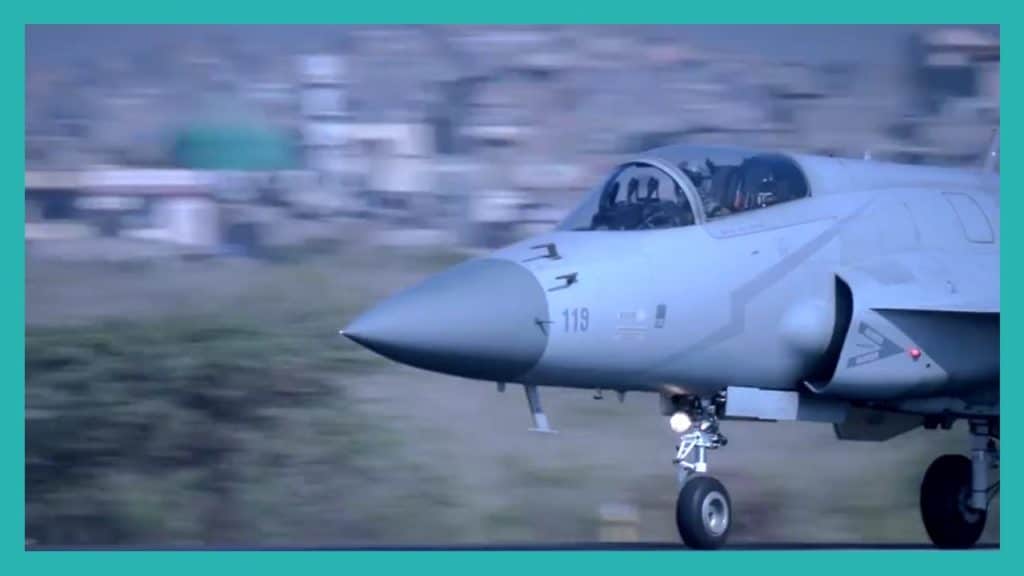
In an interview with IHS Jane’s Defence Weekly, the Pakistan Air Force (PAF) Chief of Air Staff (CAS), Air Chief Marshal (ACM) Mujahid Anwar Khan, laid-out the PAF’s upcoming procurement plans.[1] These center on the procurement of additional JF-17 Thunder multi-role fighters alongside a new lead-in-fighter trainer (LIFT) as well as defining the PAF’s fifth-generation fighter aircraft (FGFA) program.[2]
First, the PAF is in the process of concluding the JF-17 Block-II program, with the last three aircraft (out of an order of 62) slated for June 2019. Second, for the forthcoming JF-17 Block-III, the PAF will choose one of two active electronically scanned array (AESA) radars: the KLJ-7A by the Nanjing Research Institute of Electronics Technology (NRIET) or the LKF601E by Leihua Electronic Technology Research Institute (LETRI).
The PAF is aiming to induct the AESA radar-equipped JF-17 by March 2020.
Originally, the PAF opted to procure 150 JF-17s split across three equally sized tranches (i.e., Block-I, Block-II, and Block-III). However, to keep Pakistan Aeronautical Complex’s (PAC) production line warm, the PAF added 12 Block-IIs to its order. Now as per the CAS’ most recent statements, the PAF will also add 26 twin-seat JF-17Bs to its fleet[3], thus bringing the JF-17 roadmap to 188 fighters.
Having first flown in April 2017, the JF-17B was not only intended as the twin-seat training variant of the JF-17, but it was also the basis of the JF-17 Block-III. It introduced a new three-axis fly-by-wire (FBW) flight control system (replacing the hybrid FBW of prior variants) and purportedly longer wingspan.
However, the primary goal of the JF-17B was to meet the needs of certain overseas users, while the PAF was satisfied with using simulators. It now appears that the PAF has pivoted to backing the JF-17B as well. It is likely that the PAF will configure these aircraft along identical lines to the JF-17 Block-III. Thus, the PAF will induct 76 new AESA radar-equipped JF-17s, and it may add more in lieu of an interim off-the-shelf jet.
Quwa Plus
Go Beyond the Headlines on Pakistan’s Defence and Security.
Quwa Plus gives you deeper reporting, briefings, and analysis on Pakistan’s defence programs, foreign policy, national security, and regional strategy. Follow the developments that matter to professionals, analysts, and serious readers tracking Pakistan’s security landscape.