
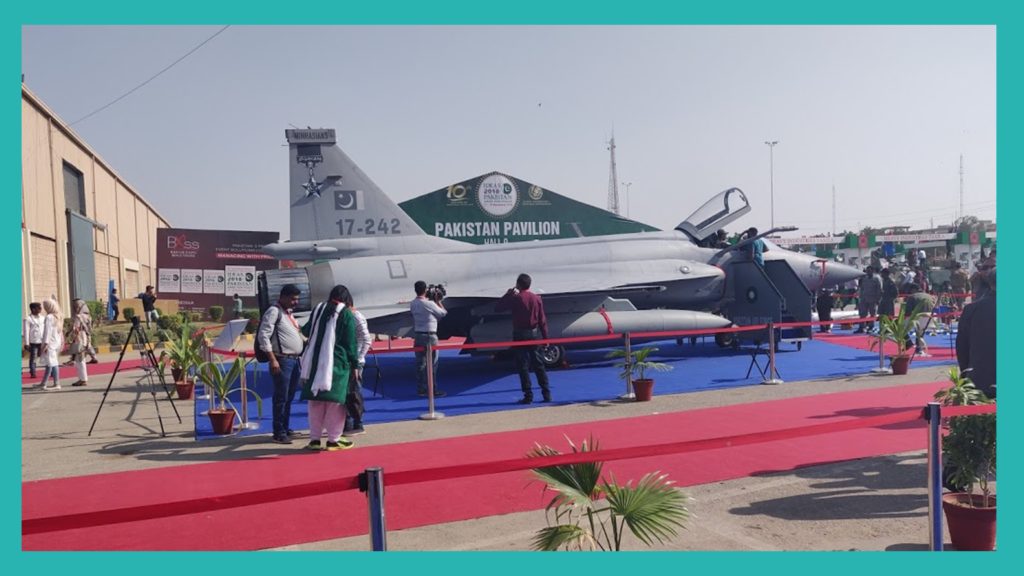
On 08 April 2019, Pakistan Aeronautical Complex (PAC) released a tender requiring the “establishment of warehouse for JF-17 MRO (maintenance, repair, and overhaul).
The tender can be viewed on PAC’s official website.
Besides stating that the MRO warehouse is “a turnkey project”, PAC did not provide specific timelines for the project in the bid. However, the bidder is required to have previously done warehouse construction work in at least two Pakistan Air Force (PAF) bases. It must also offer a warranty of items for 12 months.
In November 2017, China Aviation News (CAN) reported that the PAF sent a JF-17 to the Aviation Industry Corporation of China’s (AVIC) Aircraft Maintenance Factory in Chengfei for a major overhaul. The project was a joint pilot program between PAC and AVIC ahead of setting-up a MRO facility in Pakistan.
It appears that PAC’s JF-17 MRO facility project is now in motion.
The PAF inducted its first JF-17s (via the No. 26 Squadron) in 2010. In other words, its first JF-17s are now nearing 10 years of operational service. According to AVIC (via Air International), the JF-17 has an airframe life of 3,000 hours.[1] If each JF-17 is flown for 150 to 200 hours per year, that would equate to a total life-cycle of 15 to 20 years. Thus, the JF-17 Block-I is reaching its ‘mid-life’ point.
In that respect, it would be interesting if the PAF would entertain a ‘mid-life update’ (MLU) of the Block-I and, in time, the Block-II. Granted, it might not be able to cost-effectively integrate every component of the Block-III (such as its three-axis fly-by-wire system), but an active electronically-scanned array (AESA) radar appears to be doable, in technical terms at least.
For example, AVIC is marketing the Leihua Electronic Technology Research Institute (LETRI) LKF601E air-cooled AESA radar as being readily compatible with the JF-17. Combining a MLU with a depot-level MRO would not only ensure the JF-17 completes its lifespan, but that it would be equipped to address threats of the next decade, such as the Dassault Rafale and an AESA radar-equipped Tejas.
The LKF601E would enable the JF-17 Block-I/II to detect “fighter-sized” targets up to a range of 170 km as well as track 15 of them and engage 4 at once. It would also enable the JF-17 to detect sea-based targets at up to 200 to 220 km. Finally, it would also give the JF-17 a SAR/GMTI (synthetic aperture radar/ground moving target indicator) capability of up to 1m2. The PAF could pair the radar with a radar-guided air-to-ground missile (AGM) such as the YJ-9E, thus enabling the JF-17 to precisely strike armour and artillery.
However, while the PAF (and AVIC) could control the airframe and electronics, it is unclear how far PAC has progressed in securing a depot-level MRO site for the Klimov RD-93 turbofan engine. In 2015, PAC had said that it intended to set-up a complete MRO facility for the RD-93. It is unclear how far that work has progressed. If it is proceeding, then it should be built within the next 1-2 years.
Don't Stop Here. Unlock the Rest of this Analysis Immediately
To read the rest of this deep dive -- including the honest assessments and comparative analyses that Quwa Plus members rely on -- you need access.