

On April 20, a retired Indian Army officer – Col. Vinayak Bhat – provided a detailed insight of the Pakistan Air Force’s (PAF) new main operating base (MOB), PAF Bholari. Available on The Print, Bhat’s analysis of PAF Bholari surmises that the burgeoning MOB will ultimately house the PAF’s nuclear assets.[1]
Currently, the PAF’s deterrence assets center on the Dassault Mirage III/5-based Retrofit of Strike Element (ROSE) strike fighters configured to carry the Ra’ad I and II air-launched cruise missiles (ALCM). However, while Bhat’s perspectives on deterrence are important, Bholari’s value is much more significant.
Rather, PAF Bholari is a strategic asset for enabling significant air support coverage for Pakistani land and naval forces, especially through the long-term when the PAF is expected to procure longer range combat aircraft through Project Azm and/or an interim multi-role fighter platform.
Reinforcing Interior Sindh
In peacetime, the PAF stations each of its assets in MOBs, such as PAF Bholari (Thatta), PAF Peshawar, PAF Masroor (Karachi), PAF Minhas (Kamra) and others. In parallel, the PAF also has forward operating bases (FOB) for temporary deployment – be it in wartime, crisis or exercises – of its combat assets.
In its inauguration of PAF Bholari, the previous Chief of Air Staff (CAS) of the PAF – Air Chief Marshal (ACM) Sohail Aman – stated: “Indeed, PAF Base Bholari is…of strategic significance for capacity enhancement of Pakistan Air Force in operational domain both overland as well as at sea”.[2] Located northeast of Karachi, PAF Bholari is located 125-150 km away from the coastline and 200-250 km from the Thar Desert.
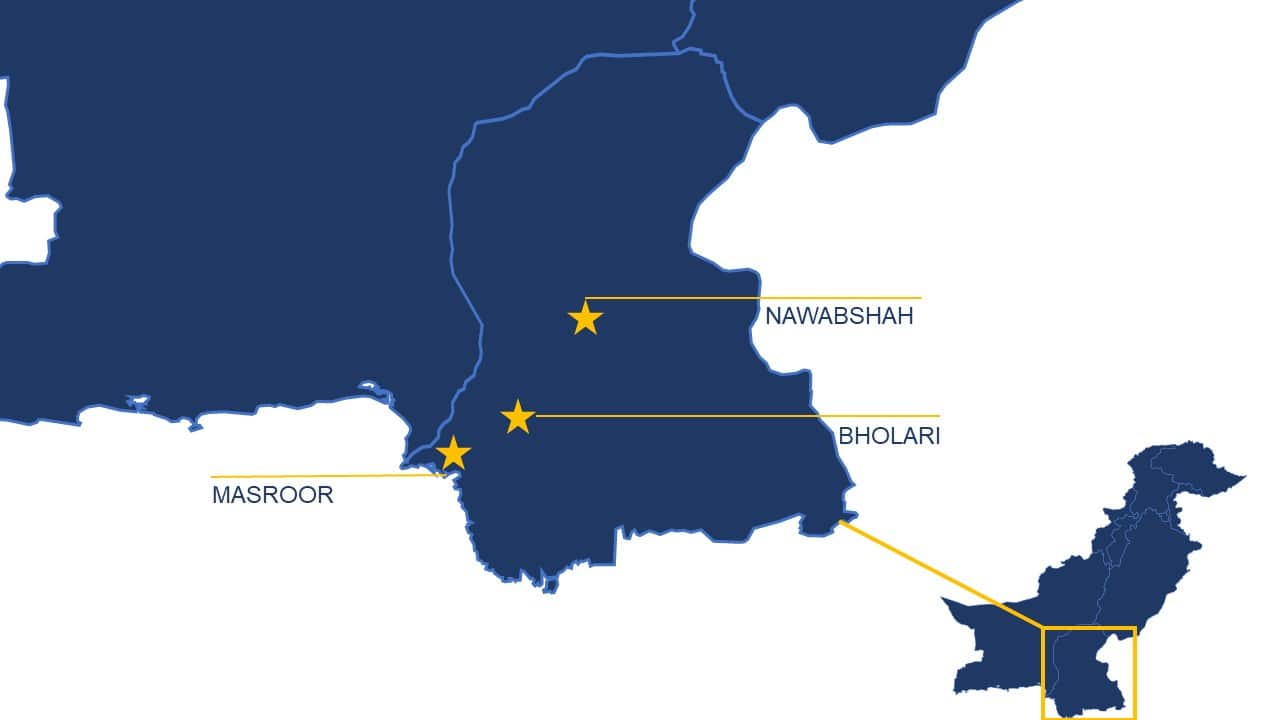
Bholari’s stated purpose is to increase Pakistan’s airpower presence in Sindh, enabling for air support for both maritime and land operations. However, in terms of maritime responsiveness, the No. 32 Tactical Wing (32 TW) based at PAF Masroor in Karachi is better positioned than PAF Bholari’s units. Likewise, PAF Nawabshah (a FOB) is closer to the Thar Desert than PAF Bholari.
Thus, PAF Bholari is not at the center of either maritime or land operations; rather, it is located well behind those operational theatres. In one respect, it could serve to feed other PAF MOBs and FOBs in wartime by deploying its combat units to the front. Strategically, PAF Bholari contributes to the overall distribution of PAF assets, thus ensuring that it has redundancy should other assets be lost at another MOB. It also seems that the PAF is leveraging Bholari’s distance from the desert and maritime theatres as a buffer.
Currently, PAF Bholari hosts the PAF’s No. 19 Squadron, an operational conversion unit (OCU) operating the F-16A/B Block-15 Air Defence Fighter (ADF). It is unclear if the No. 19 will be reinforced by the PAF’s other F-16 units, especially one of No. 9 or No. 11 at Mushaf which fly the Block-15 Mid-Life Update (MLU). It makes technical sense: First, it enables the PAF to scale the logistics it has in place for supporting its ADF units – the MLU has the same airframe. Second, the MLU and ADF are (relative to the PAF’s fleet) medium-weight fighters, thus possessing the inherent range and payload to readily operate from Bholari.
However, stationing No. 19 at Bholari does not necessarily mean that the PAF will station No. 9 or No. 11 there as well. Since the ADFs were not upgraded to the same standard as the PAF’s MLUs – which include several restricted technologies – the PAF has flexibility in where it can station those fighters. The US had required that it have security personnel in proximity to the Block-52+ and MLUs so as to prevent the risk of leaks to China (for at least one five-year period).[3] On the other hand, the potential entry of the S-400 long-range air defence system pressures PAF Mushaf; an interior MOB enables the PAF to deploy its F-16s without facing an invasive high-altitude air defence threat.
Nonetheless, one can identify two major implications with PAF Bholari. First – uncertain, but plausible – is the allocation of a F-16 MLU unit, i.e. placing a credible air-to-air capability through the AIM-120C5 and Link-16 tactical data-link (TDL) connectivity with the Erieye airborne early warning and control (AEW&C) aircraft. Second, the range/proximity buffer between Bholari and the forward combat areas require the PAF to operate medium-to-heavyweight fighters from its new MOB.
Don't Stop Here. Unlock the Rest of this Analysis Immediately
To read the rest of this deep dive -- including the honest assessments and comparative analyses that Quwa Plus members rely on -- you need access.