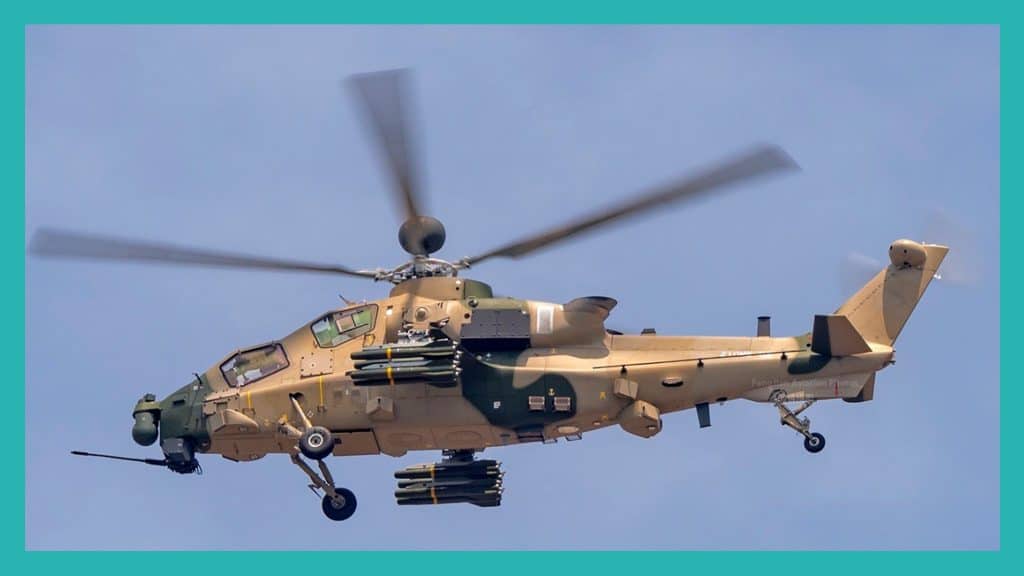
New photos emerged through Weibo of the Z-10ME attack helicopter, an improved variant of the Changhe Aircraft Industries Corporation (CAIC) Z-10.
Revealed in 2018, the Z-10ME delivered several changes over the Z-10, most notably additional armour, new sand filters for the engines, infrared suppression, and crash-resistant seats for the pilots. Reportedly, CAIC implemented these changes in response to the Pakistan Army’s requirements.
The latest photos of the Z-10ME now show it sporting additional features and new subsystems, including: a top-rotor-mounted sensor, potentially a millimeter wave (mmW) radar; armour plating near the canopy and under the fuselage; a revised engine exhaust; possibly a new defensive aid suite that may include an electronic countermeasures (ECM) system capable of radar jamming.
Pakistan had tested the original Z-10E between 2015 and 2016. However, it opted for the Bell AH-1Z and Turkish Aerospace Industries (TAI) T129 for its future attack helicopter requirements instead.
Since 2017, Pakistani-U.S. defence ties underwent a chill that resulted in Washington withholding Foreign Military Financing (FMF) and Coalition Support Funds (CSF) to Islamabad.
Pakistan wanted to use the FMF and CSF vehicles to finance the AH-1Z program. But with the CSF/FMF no longer available, the AH-1Z deal fell through. Moreover, the T129 deal fell through as well due to the U.S. refusing the release export permits for the CTS800 turboshaft engine, which powers that helicopter.
In 2020, the then Corps Commander of the Pakistan Army Aviation (PAA), Major Gen. Syed Najeeb Ahmed, said that the PAA would consider the Z-10ME as an alternative platform.
Background: Pakistan’s Attack Helicopter Requirements
Since 2012, the PAA had been seeking successors for its aging Bell AH-1F/S Cobra attack helicopters. While the AH-1F/S is a legacy design, it has also seen heavy use through the 2000s and 2010s as part of Pakistan’s counterinsurgency (COIN) operations. Moreover, the PAA said that the AH-F/S are also limited in a number of areas, such as their inability to effectively operate in high-altitude operational environments.[1]
Under the original modernization plan, the PAA had settled on two different platforms.
First, it acquired the AH-1Z Viper as its “heavyweight” attack helicopter. Second, it followed up with a bid for a secondary, “lightweight” platform, i.e., the T129 ATAK. In total, the PAA had 12 AH-1Zs and 30 T129s on order. However, these may have been initial tranches of a larger program.
Don't Stop Here. Unlock the Rest of this Analysis Immediately
To read the rest of this deep dive -- including the honest assessments and comparative analyses that Quwa Plus members rely on -- you need access.