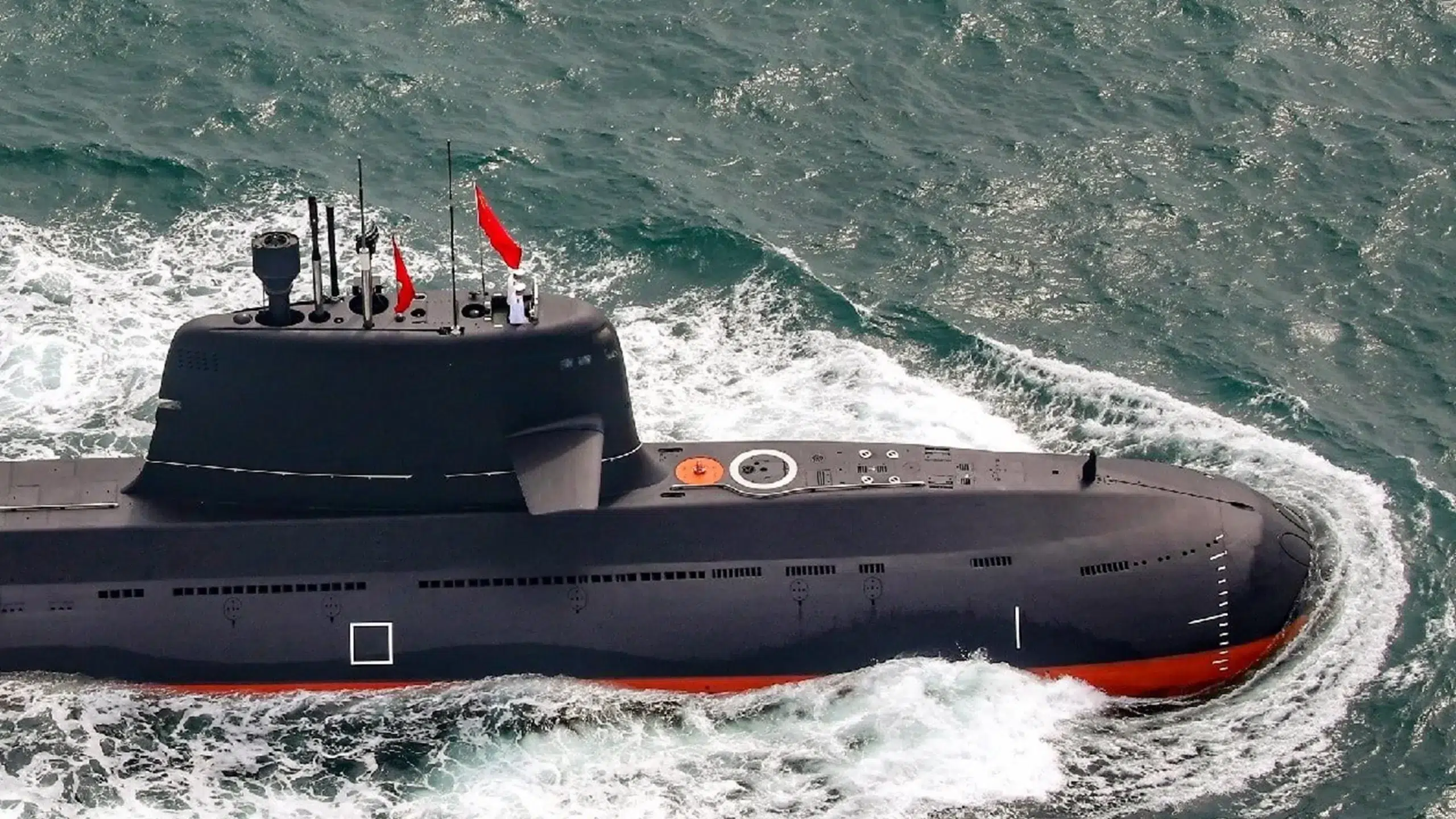
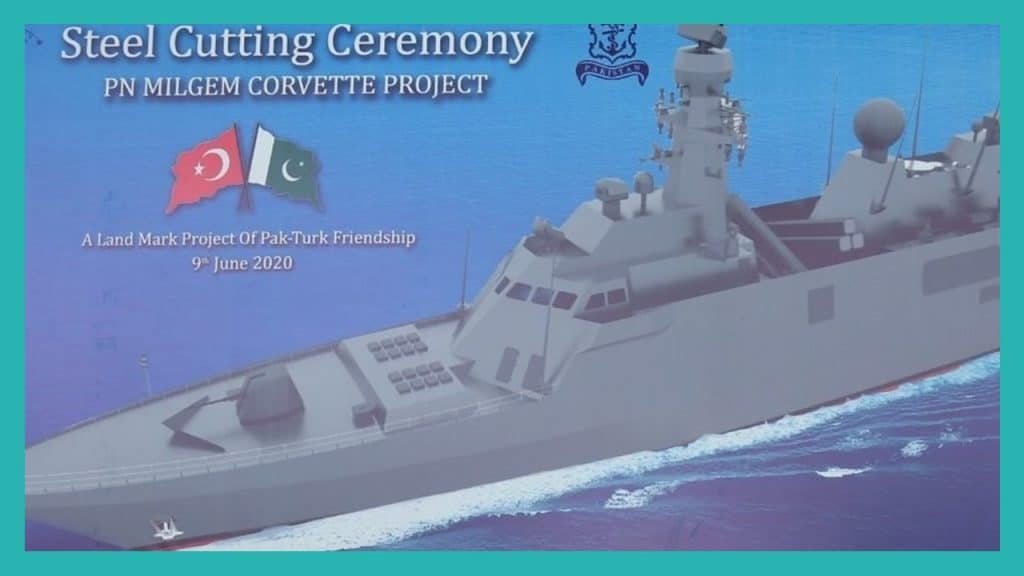
On 09 June 2020, Karachi Shipyard & Engineering Works (KSEW) cut the steel for the Pakistan Navy’s (PN) second (of four) MILGEM corvettes. During the steel cutting ceremony, KSEW displayed an impression or illustration of the corvette that showcased a number of reported changes in the PN’s MILGEM design.
The most notable of these changes was the inclusion of 16 vertical-launch system (VLS) cells towards the bow and a dual triple-cell configuration for anti-ship cruising missiles (ASCM) and/or land-attack cruising missiles (LACM). The hull of the PN’s MILGEM also seems longer than the standard Ada-class corvette.
Based on its weapon systems configuration alone, the PN MILGEM corvette is more capable than the PN’s currently serving F-22P frigates. However, the PN is still referring to the MILGEM as corvettes, though the displacement of this design exceeds that of older frigates, such as the Type 21.
In line with the original contract, which was signed in 2018, the PN was to receive three corvettes and a frigate – the latter would be a joint-design. The implication was that the fourth ship would be different in specifications and capabilities to the preceding three vessels. This made sense as the MILGEM Ada lacked several key features, such as VLS. But this is not the case with the PN MILGEM design.
In fact, the PN MILGEM ‘corvette’ design is already similar in size and capability to the I-Class frigate (the latter has a larger ASCM/LACM load-out). It is unclear how much farther the PN or the main contractor – Turkey’s Military Factory and Shipyard Corporation (ASFAT A.Ş.) – can stretch the design without basically duplicating the I-Class. Thus, the PN may have opted to standardize the ‘frigate’ design on all four ships.
Standardizing one design for all four ships makes sense in that the alternative would have had KSEW build a one-off of two highly customized ships. Producing a one-off MILGEM Ada while starting a new line for a frigate was plausible because the Ada was an existing design, so KSEW could simply acquire the material kits (KoM) from Turkey and assemble the ship (as it had with other vessels in the past).
But if the ‘corvette’ is a custom design, then it would mean two sets of non-recurring engineering (NRE) costs for development and testing work. It is unlikely the PN would duplicate this overhead. It would either take three Ada corvettes as-is and add a new ship design, or spread the overhead of developing the frigate to the first three ships as well. The PN may have opted for the latter route.
Committing to the Design and Expanding the Fleet
The PN MILGEM design will deliver modern anti-ship warfare (AShW), anti-submarine warfare (ASW), and anti-air warfare (AAW) capabilities. The design fulfils current and future naval needs. Thus, it would make sense for the PN to acquire additional vessels of this class after the first four ships.
Ideally, the PN would have standardized its modernization plans on this design (i.e., pursue eight MILGEMs instead of splitting the requirement with four Type 054A/P frigates from China). Such a move would have driven economies-of-scale for the project and distribute the design/development overhead across more units sooner. The PN could have also allocated part – or most – of the shipbuilding contract to the private sector. The opportunity to build the PN’s future mainstay ship might have incentivized the private sector to buy into initiatives such as Gwadar Shipyard (which the government is trying to get off the ground) and, possibly, lead to investment in ship inputs such as steel, composites, electronics, weapons, etc.
That said, the Type 054A/P frigate likely came as a result of flexible financing/credit resources from China, and an expedited delivery schedule. But if the move was made to supplant the Type 21 and maintain the PN’s sea-control/sea-policing capability in peacetime, then it could have sought more commercial-grade offshore patrol vessels (OPV) instead. These OPVs would have come at a lower cost ($60-70 million US per ship) and maintain that baseline capability as the MILGEMs roll-out. Likewise, the PN could have tied an OPV requirement of six to eight ships to offsets and local manufacturing, i.e., encourage the private sector.
Don't Stop Here. Unlock the Rest of this Analysis Immediately
To read the rest of this deep dive -- including the honest assessments and comparative analyses that Quwa Plus members rely on -- you need access.