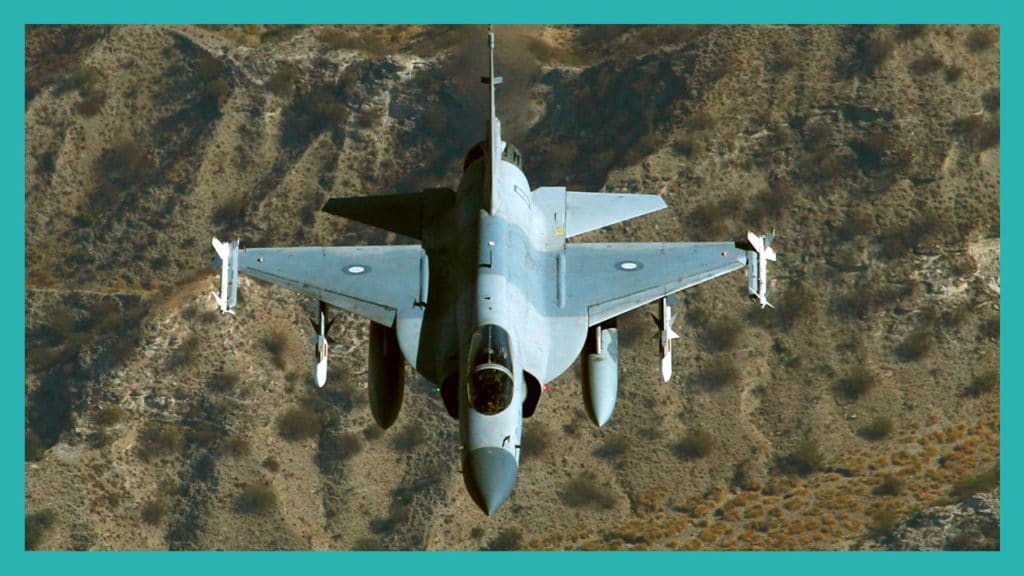
Quwa Premium’s Monthly Report for February 2018 provides a detailed overview of the leading events affecting the development of the Pakistan Air Force’s (PAF) JF-17 Thunder multi-role fighter program. It starts with discussing the factors that led to the development of the JF-17, providing context of the PAF’s rationale and interests in its decision-making. This is joined by an outline of pertinent JF-17-related events in 2017, such as the raising of the No. 14 Squadron, maiden test-flight of the JF-17B, deliveries of Aselsan ASELPOD targeting pods and others. Context is provided (using open-source references) in regards to the PAF’s subsystem, weapon and powerplant selections, which had all steered the JF-17 to its current form. This report concludes with an outlook of the JF-17 program in 2018 along with an overview of potential interests for the industry in regards to the forthcoming JF-17 Block-III.
Background on the JF-17
The Pakistan Air Force (PAF) embarked on the process of domestically manufacturing a multi-role fighter in the aftermath of recurring sanctions, most notably by the US through the Pressler Amendments, which resulted on a hold of 28 F-16A/B Block-15 OCU (Operational Capability Upgrade) fighters ordered and paid for by Pakistan. However, through the 1990s it was also apparent that there was a paucity of affordable fighters that could be procured in relatively sizable numbers, i.e. to supplant the PAF’s aging Shenyang F-6s. The Peace Gate III/IV F-16s (i.e. 71 in total) were supposed to assume that task, but Pressler firmly put an end to that prospect, and the alternatives – i.e. the Mirage 2000 and JAS-39A/B Gripen – were either too costly or simply untenable due to political challenges.
Interestingly, Pakistan had toyed with the idea of domestically manufacturing a fighter much earlier than taking on the JF-17. In 1949, an advisor to the Pakistani Ministry of Defence – Mir Laiq Ali – had apparently begun negotiations with Lockheed Martin to supply – along with assembly and eventually manufacturing – F-80 fighters to Pakistan.[1] However, this effort was scuttled amid pressure from Britain on the Pakistani government, resulting in the transfer of 36 Supermarine Attackers to the then Royal Pakistan Air Force.[2] In 1987, the PAF awarded Northrop Grumman and the Chengdu Aerospace Corporation (CAC) a contract to study a significant upgrade of CAC’s F-7 involving a solid nose, side-intakes, the General Electric (GE) F-404 turbofan engine and modern Western radar and avionics.[3] However, US sanctions on China following the Tiananmen Square incident along with mounting costs shelved that program (Sabre II).
In 1992, CAC offered the PAF an opportunity to support a clean-sheet design, which the PAF accepted in 1994, resulting in a memorandum-of-understanding (MoU) being signed in 1995.[4] The design of the fighter was frozen in 1996, with a co-development contract being signed in 1999.[5] Russia’s Mikoyan was also contracted by CAC to provide consultation support, while Klimov was sought to supply its RD-93 turbofan engine. Furthermore, a workshare production contract was signed which would see Pakistan Aeronautical Complex (PAC) manufacture 58% of the fighter, particularly the airframe.[6]
Quwa Plus
Go Beyond the Headlines on Pakistan’s Defence and Security.
Quwa Plus gives you deeper reporting, briefings, and analysis on Pakistan’s defence programs, foreign policy, national security, and regional strategy. Follow the developments that matter to professionals, analysts, and serious readers tracking Pakistan’s security landscape.
Join ($29.99/Year) Already a subscriber?Sign in