
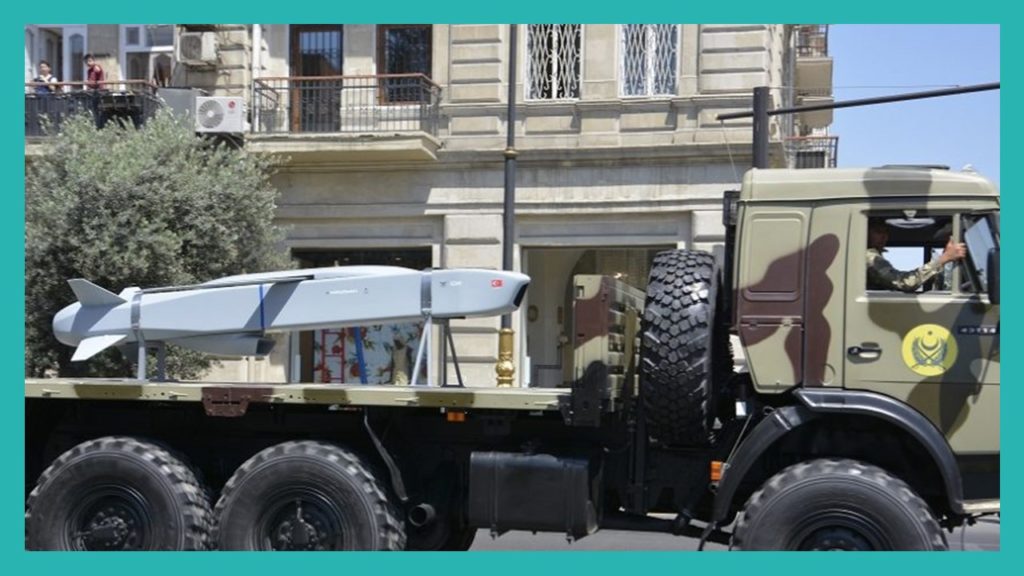
On 26 June 2018, Azerbaijan showcased a Roketsan SOM air-launched cruise missile (ALCM) as part of its annual military parade in its capital, Baku.[1] Operational since 2012, the SOM is a near-600 kg ALCM with a range of more than 250 km (but certainly less than the 300 km limit set by the Missile Technology Control Regime or MTCR). Currently, the Turkish Air Force (TuAF) deploys the SOM from its F-16C/Ds and F/A-4s, though a compact variant – i.e. SOM-J – is also being readied for deployment from the F-35 Lightning II.
Azerbaijan had reportedly ordered the SOM from Turkey in November 2017.[2] The Azerbaijani Air and Air Defence Force (AAF) is expected to deploy the SOM from its existing platforms, notably the MiG-29.[3] The SOM will offer the AAF with strong stand-off range strike capabilities against fixed and, potentially, moving targets alike. The SOM-A and SOM-B1/B2 rely on satellite (GPS)-aided inertial navigation systems (INS) for guidance, though the SOM-B1/B2 also have imaging infrared (IIR) seekers (ostensibly for moving targets).[4]
Besides imbuing Azerbaijan with long-range attack capabilities, the AAF’s procurement of the SOM ALCM could be of relevance to Pakistan Aeronautical Complex (PAC) and the JF-17. In 2016, the AAF reportedly stated that it was interested in procuring the JF-17 from PAC. If PAC is still courting the AAF on the JF-17, then it follows that integrating the SOM to the JF-17 would make sense, at least from a commercial basis.
It would make very limited sense for the AAF to invest in a new fighter platform, only for it to be incapable of using one of the AAF’s marquee munition assets. However, integrating the SOM ALCM to the JF-17 will also have the added impact of providing the Pakistan Air Force (PAF) with another stand-off range weapon (SOW) option for use from its burgeoning JF-17 fleet. Granted, this was possible in theory, but Azerbaijan now possessing the SOM opens the prospect into a plausible scenario from several accounts.
Turkey Can Freely Export the SOM
The SOM sale to Azerbaijan is evidence that Turkey has sufficient control – or sufficiently strong licensing – of the SOM’s subsystems to export the ALCM. In fact, Azerbaijan is a notable case because it is not only a buyer of Russian armaments, but it is not a traditionally close ally of the US and/or Western Europe as the Middle Eastern (especially in the Arabian Peninsula) or Pacific Asian states.
Quwa Plus
Go Beyond the Headlines on Pakistan’s Defence and Security.
Quwa Plus gives you deeper reporting, briefings, and analysis on Pakistan’s defence programs, foreign policy, national security, and regional strategy. Follow the developments that matter to professionals, analysts, and serious readers tracking Pakistan’s security landscape.