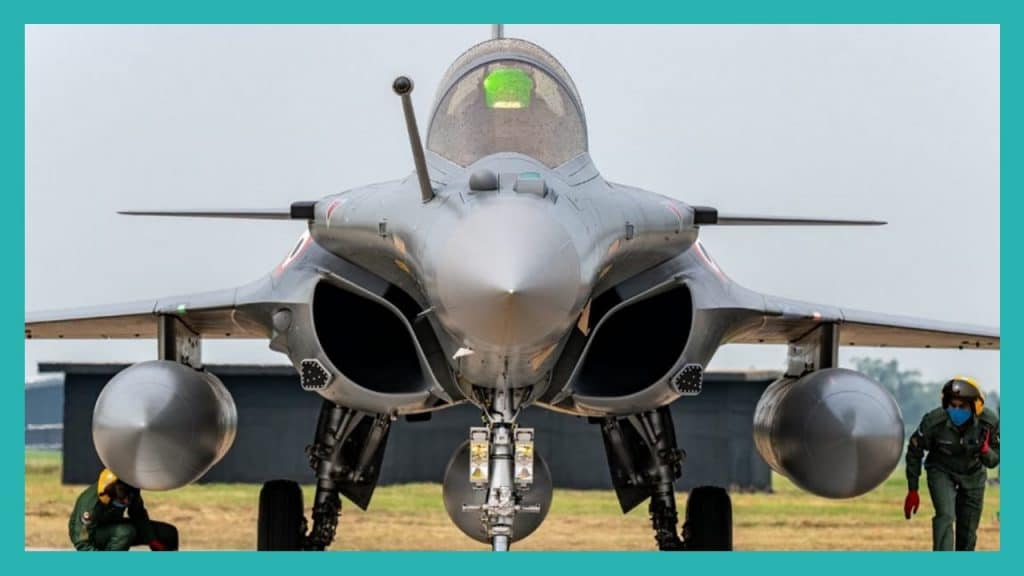
On 30 July 2020, India took delivery of its first five Dassault Rafale combat aircraft from France. This is the first batch from an order of 36 aircraft, which India ordered under a €7.87 billion deal in 2016 ($8.85 billion US at the time). Roughly 50% of the contract went towards the aircraft and an assortment of air-to-ground and air-to-air munitions, while the rest is split between a maintenance package and customizations. The contract also includes an offset clause that would see Dassault spend 50% of the contract value in India.
The Indian Air Force (IAF) assigned its first Rafale aircraft to the No. 17 ‘Golden Arrows’ Squadron, which the IAF deployed at Ambala Air Force Station in Haryana, a state in northern India. The IAF is expected to station its second Rafale unit in West Bengal at Hasimara Air Force Station. Collectively, the IAF is staging its two Rafale units to cover India’s north/northwest and east/northeast sectors.
Though the scope of this Rafale contract is not as expansive as IAF’s original Medium Multi-Role Combat Aircraft (MMRCA) tender, it still a significant program in its own right. Not only does the Rafale introduce a credible – if not qualitatively leading air warfare solution – to South Asia, but it also incorporates several tangible benefits to India’s economy, defence industry, and defence research and development (R&D).
Dassault partnered with Reliance Group to implement the bulk of the Rafale program’s offset package. In addition, Dassault has a chance at securing follow-on orders in India. The IAF is looking to acquire another 114 medium-weight multi-role fighters, while the Indian Navy is seeking a new carrier-borne platform. In other words, the Rafale is well positioned to form a sizable portion of India’s fighter fleets.
Overview of India’s Rafale Combat Aircraft
The IAF selected the Rafale F3R, but it got Dassault to incorporate a number of modifications. The bulk of these changes center on integration with third-party systems and weapons, notably from Israel. However, the core Rafale OEMs added a few of their own iterative improvements as well.
The IAF’s Rafale F3Rs use a newer version of the Front Sector Optronics (FSO) suite, which Thales markets as a “multi-sensor” system incorporating an infrared search-and-track (IRST) and forward-looking infrared (FLIR) system. Safran supplies the IRST and FLIR inputs. The end-user can use the FSO to track both air and surface targets, and across multiple modes (optical, infrared, and laser).[1]
The IAF is also using the active electronically scanned array (AESA) version of the Thales RBE2, but with a number of software modifications. In addition, the IAF got its Rafale fighters optimized for operations in high-altitude and mountainous environments via a modified radar altimeter and cold engine-start.[2]
In terms of custom subsystems, the IAF Rafale fighters use the Display and Sight Helmet System (DASH), a helmet-mounted display and sight (HMD/S) system from Israel’s Elbit. The IAF already uses Elbit HMD/S solutions in other fighters, such as the Tejas. The DASH may signal an intent to eventually add the Python 5 high off-boresight (HOBS) air-to-air missile (AAM), among other Israeli-origin munitions.
The IAF Rafale also incorporates a number of standard – but valuable – features, such as operability with the Thales TALIOS targeting pod and SPECTRA, an integrated suite comprising of both electronic warfare (EW) and electronic countermeasures (ECM) systems. Thales says that the SPECTRA offers both situational awareness building (the EW suite can detect radar, laser, and infrared-based threats) and radar jamming and spoofing. It also includes self-protection measures against infrared and radar-guided missiles.[3]
Optimized for Deterring Pakistan
Collectively, the standard features and custom additions of the IAF’s Rafale program show a focus on high-altitude take-off and mountainous flight operations. In addition, the Rafale is well-equipped for both long-range precision-strikes and interdicting aerial threats at beyond-visual-range (BVR).
Don't Stop Here. Unlock the Rest of this Analysis Immediately
To read the rest of this deep dive -- including the honest assessments and comparative analyses that Quwa Plus members rely on -- you need access.