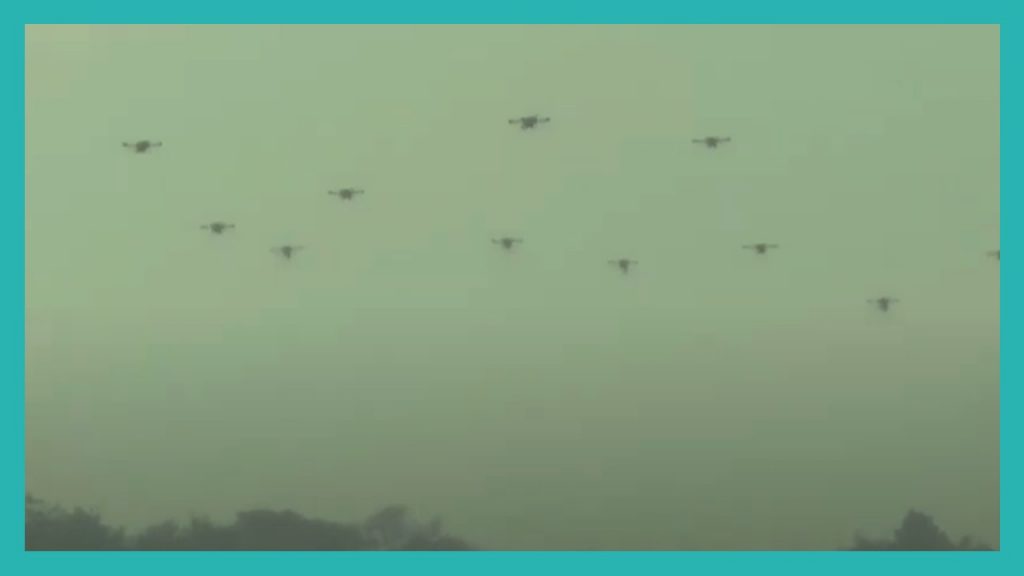
On 16 January 2021, the Indian Army (IA) showcased a newly acquired drone swarming capability during its annual parade. Using 75 locally developed drones, the IA demonstrated multiple mission applications, such as anti-armour attacks, ground strikes, humanitarian and disaster relief, and logistics support.[1]
The IA is developing its drone swarming capability in partnership with a private sector player, NewSpace Research and Technologies. In the long-run, India intends to build the capacity to deploy 1,000 drones in a swarming formation at the same time. Its current capability allows it to strike at targets 100 km away.
However, India’s drone ambitions are far-reaching. In fact, it even intends to build an air-launched swarm capability under the Combat Air Teaming Systems (CATS) initiative. One CATS project, for example, would see the Indian Air Force (IAF) configure its Jaguar strike aircraft with 24 loitering munition-type drones.
It seems that India will integrate drone swarming to its air and land-based capabilities. The latter can result in vehicle-based tube-launchers armed with loitering munitions. In turn, India can invest in boosting the range of its loitering munitions and quadcopter drones. It could even look at using them in additional ways – e.g., electronic countermeasures (ECM) jamming and top-attack anti-armour strikes, among others.
Drone swarming will be a significant addition to India’s capabilities. Not only is the capability itself a clear sign of India maturing its drone technologies, but it could impact Pakistan.
Why Drone Swarms Are a Threat to Pakistan
Drone swarming introduces an asymmetrical element to conventional warfare. These aircraft are small in size, incredibly low-cost and, most importantly, disposable. Disposability frees the end-user to use these drones in high-risk scenarios without worrying about the loss of its own operators. The main way the end-user measures the success of these drones is whether they hit their targets. The only constraint is the cost of sustaining the numbers necessary to continually deploy drone swarms.
Quwa Plus
Go Beyond the Headlines on Pakistan’s Defence and Security.
Quwa Plus gives you deeper reporting, briefings, and analysis on Pakistan’s defence programs, foreign policy, national security, and regional strategy. Follow the developments that matter to professionals, analysts, and serious readers tracking Pakistan’s security landscape.