During the 15th International Defence Industry Fair (IDEF 2021) in Istanbul, Turkey’s top defence industry vendors showcased an impressive lineup of projects. Its known ‘staples’ – i.e., the MILGEM corvette, Altay main battle tank (MBT), T129 ATAK attack helicopter, and Anka drone – were both present and showing growth in terms of technical improvements, new variants, and overseas market interest. However, Turkey also showed off an array of new projects that are putting the country at the forefront of emerging military technologies, such as unmanned surface vessels (USV) and miniature air-launched cruise missiles (ALCM). It is also working to end the Turkish Armed Forces’ (TSK) dependency on specific imported systems, such as the Rolling Airframe Missile (RAM) and 76 mm main naval guns.
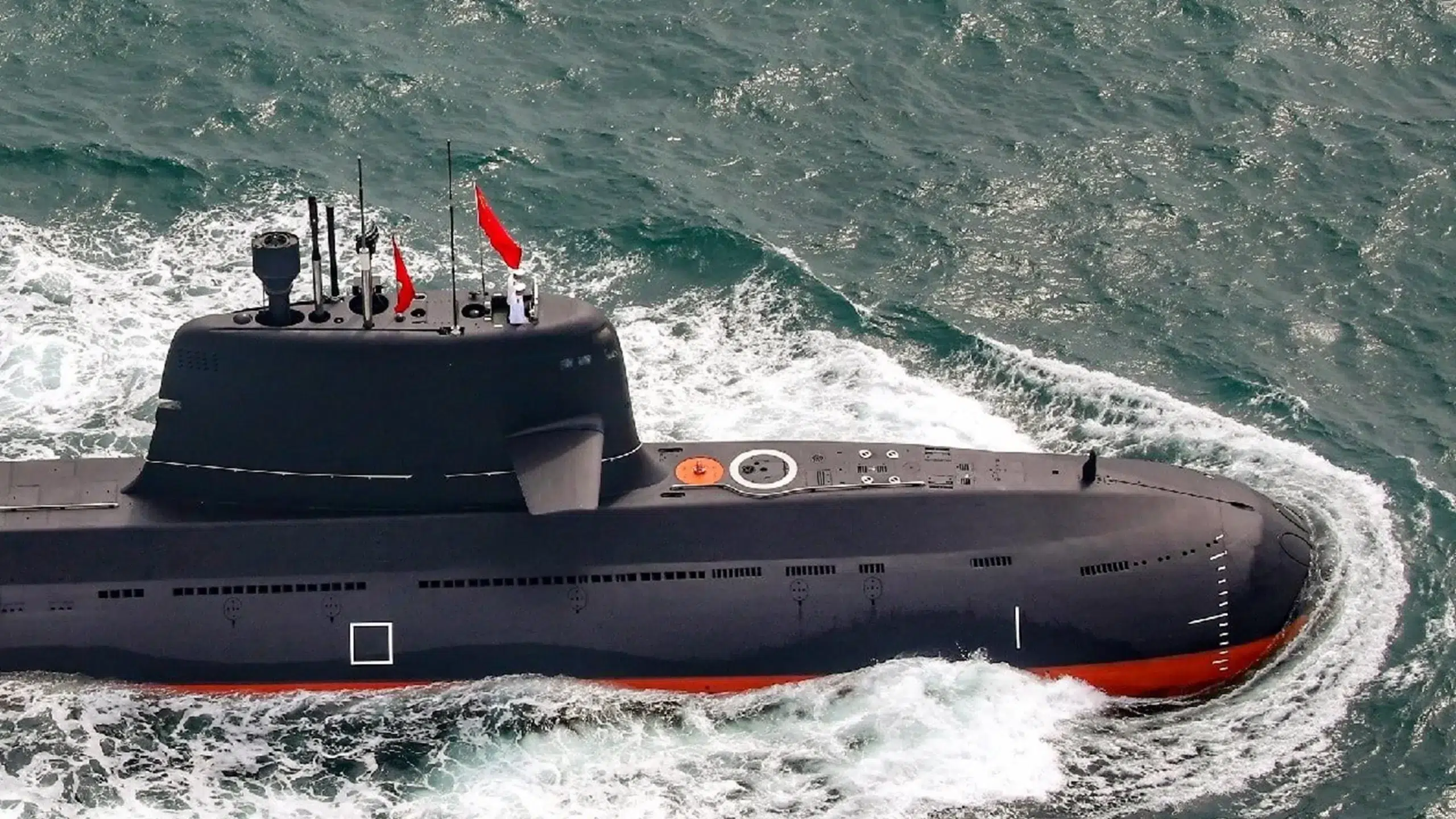
In the backdrop of IDEF 2021, the Turkish industry also engaged with Pakistan, its leading export market, across a number of fronts. The most notable development was ASFAT A.Ş. (Military Factor and Shipyard Management Inc.) unveiling the design of the Jinnah-class frigate. In 2018, Pakistan signed a contract with ASFAT A.Ş. for four customized MILGEM corvettes. Under the deal, ASFAT A.Ş. agreed to transfer both the know-how and intellectual property (IP) of the newly christened Babur-class corvettes and assist Pakistan design its own warship. In addition, Savunma Teknolojileri Mühendislik ve Ticaret AŞ (STM) confirmed that it will work on upgrading the Pakistan Navy’s (PN) Agosta 90B submarine, thus rounding off the platform’s modernization roadmap.[1] Finally, there are reports that Pakistan is in talks with Turkey about the purchase of a miniature submarine.[2][3] Interestingly, Turkey has multiple miniature submarine programs – a shallow-water attack (SWAT) submarine known as the STM500 by STM and another platform (potentially more of a special forces boat) by Dearsan. It is unclear which of these the PN is interested in as it is looking for new SWAT boats and a replacement for its Cosmos MG110 miniature submarines for special operations.
Pakistan’s growing cooperation with Turkey is not limited to naval platforms. Turkish Aerospace Industries (TAI) announced that it signed a deal with National Engineering and Scientific Commission (NESCOM) that will see NESCOM undertake some production work for TAI’s Anka unmanned aerial vehicle (UAV).[4][5] TAI’s general manager, Temel Kotil, said that TAI and NESCOM will collaborate to further develop the Anka. In turn, NESCOM will also market the Anka to other markets.[6] Interestingly, the Anka will be the third major UAV program in Pakistan, joining the Pakistan Aeronautical Complex (PAC) 1.5-ton UAV and Air Weapon Complex’s (AWC) Shahpar II (which is similar in size to the Bayraktar TB2).
Jinnah-Class Frigate
ASFAT A.Ş. revealed a scale model of the Jinnah-class frigate at IDEF 2021. According to ASFAT A.Ş.’s own product brochure, the Jinnah-class will have a displacement of 3,300 tons, maximum speed of 26 knots, a cruise speed of 17 knots, and a range of 4,000 nautical miles. The design has an overall length of 119.45 m and an overall beam of 15.40 m. In comparison to the Babur-class corvette, the Jinnah-class is about 11 m longer and a little over 300 tons heavier in terms of displacement. Interestingly, the Jinnah-class seems to be in a similar size and weight category as Turkey’s I-Class frigate, but with key internal differences.
Jinnah class frigate #IDEF2021 pic.twitter.com/dxS0c1O7Or
— Arda Mevlütoğlu (@orko_8) August 18, 2021
Unlike the Babur-class corvette (and other MILGEM variants such as the I-Class), the Jinnah-class will use a combined diesel-and-diesel (CODAD) propulsion system. Moreover, it will rely on a relatively large crew of 200 personnel, i.e., 40 officers and 160 ratings. In contrast, the I-Class frigate will have a crew of 125 or less. It is unclear why the PN is opting for significant crew capacity. However, the Jinnah-class design will be able to support a 10-ton helicopter (e.g., Sea King) and a UAV in its hangar.
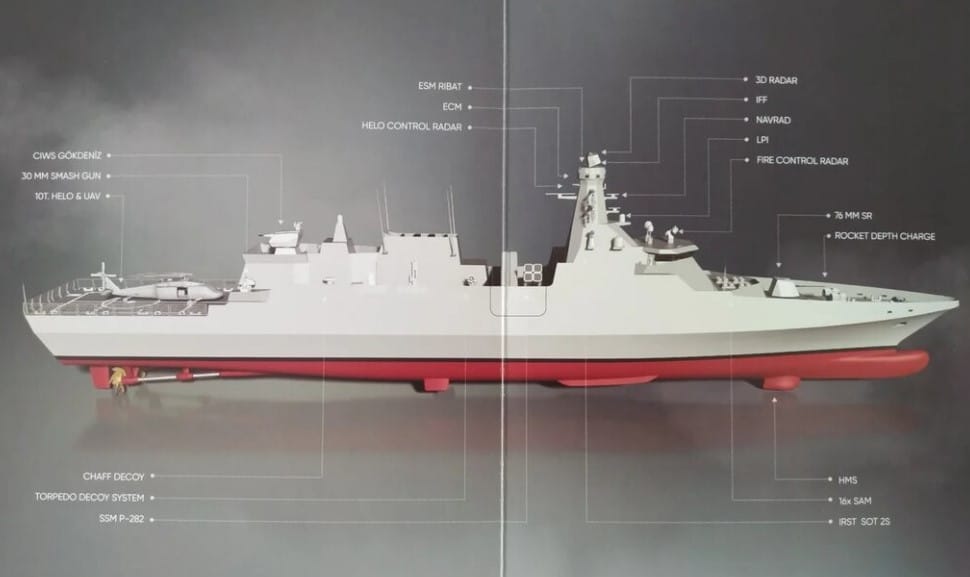
In terms of armament, the Jinnah-class will have a 16-cell vertical launch system (VLS) behind the 76 mm main gun. The current VLS is the same GWS onboard the Babur-class corvette, which could indicate that the PN is intending to use the MBDA Albatros-NG. The Albatros-NG utilizes the Common Anti-Air Modular Missile Extended Range (CAMM-ER) surface-to-air missile (SAM), which offers a range of over 40 km. The Jinnah-class frigate’s VLS capacity is a relatively small increase over the Babur-class corvette (i.e., increase of four VLS cells between the two ships). However, the PN has shown a willingness to change its weapon configurations as late the ship construction phase. With the Jinnah-class frigate being in the design stage, it is possible that the PN could change the VLS to another platform (e.g., SYLVER or Turkey’s MDAS).
Don't Stop Here. Unlock the Rest of this Analysis Immediately
To read the rest of this deep dive -- including the honest assessments and comparative analyses that Quwa Plus members rely on -- you need access.