In one of the surprise news items during the 2018 International Defence Exhibition and Seminar (IDEAS), the Pakistan Air Force (PAF) revealed plans for a new lead-in fighter-trainer (LIFT).
Since 2015, the PAF leadership had continually maintained that it did not require a LIFT, often stating that such platforms are too expensive to operate or too sophisticated for the intended role. However in 2018, the current PAF leadership reportedlystated that a new LIFT was on its procurement roadmap.
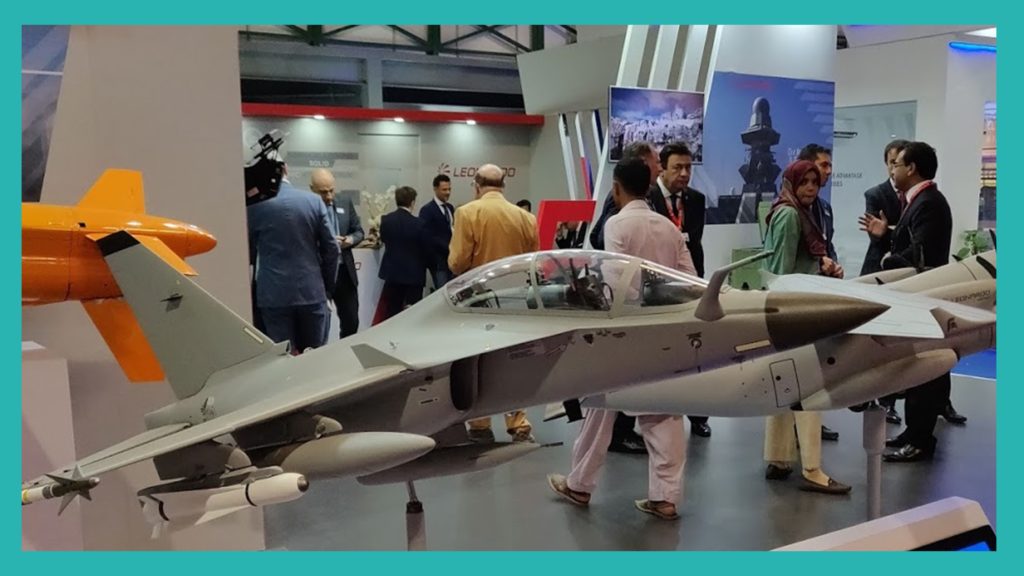
At IDEAS 2018, the Italian defence giant Leonardo displayed a mock-up of its M-346 Master LIFT aircraft,while the Aviation Industry Corporation of China (AVIC) displayed a mock-up of its L-15. One of the PAF’s key requirements is that the LIFT include an afterburning engine.
This was a recent decision. In the Ministry of Defence Production’s (MoDP) annual yearbook for 2016 to 2017,the PAF did not list a LIFT as part of its procurement plans in 2017-2018.
It is not entirely clear why the PAF is seeking a new platform for LIFT. In theory, it could use the currently in-development JF-17B – i.e., a twin-seat fighter-trainer with an afterburning engine – for the role. But as per British aviation journalist Alan Warnes, the PAF does not intend to use the JF-17B for LIFT.
Thus, a different platform is reportedly a must.
Quwa had inquired about the apparent LIFT requirement with numerous PAF officials. The basic rationale provided to Quwa was that the K-8 was “sufficient” for the fighter-conversion unit (FCU) course. However, the PAF is “exploring” a dedicated trainer with an afterburning engine because there are certain attributes – such as increased payload, flight characteristics, etc – that such platforms provide.
One PAF official had emphasized that at this time, the PAF was using the FT-7/FT-7PG as an intermediary step between the K-8 FCU course and JF-17/F-16 operational conversion units (OCU).In other words, it is not as if pilots were moving from FCU straight to JF-17/F-16OCU; the new LIFT could replace the FT-7/PG.
Leonardo was unable to comment (non-disclosure clause with the PAF), though its display at IDEAS only displayed systems that would be of interest to Pakistan – i.e., M-346, AW101, AW159, Kronos land-based and ship-based radars, and the Grifo-E active electronically-scanned array (AESA) radar.
When Quwa asked AVIC about the L-15, an AVIC representative said that it was “trying” to position the L-15 to the PAF, though it would be “too early” to comment further. Likewise, representatives of the Czech industry would not comment on whether the Aero Vodochody L-159 is also in the running.
Don't Stop Here. Unlock the Rest of this Analysis Immediately
To read the rest of this deep dive -- including the honest assessments and comparative analyses that Quwa Plus members rely on -- you need access.