Heavy Industries Taxila (HIT), the Pakistan Army’s (PA) primarily supplier of armoured solutions is reporting progress in its effort to both modernize and indigenize its product portfolio.
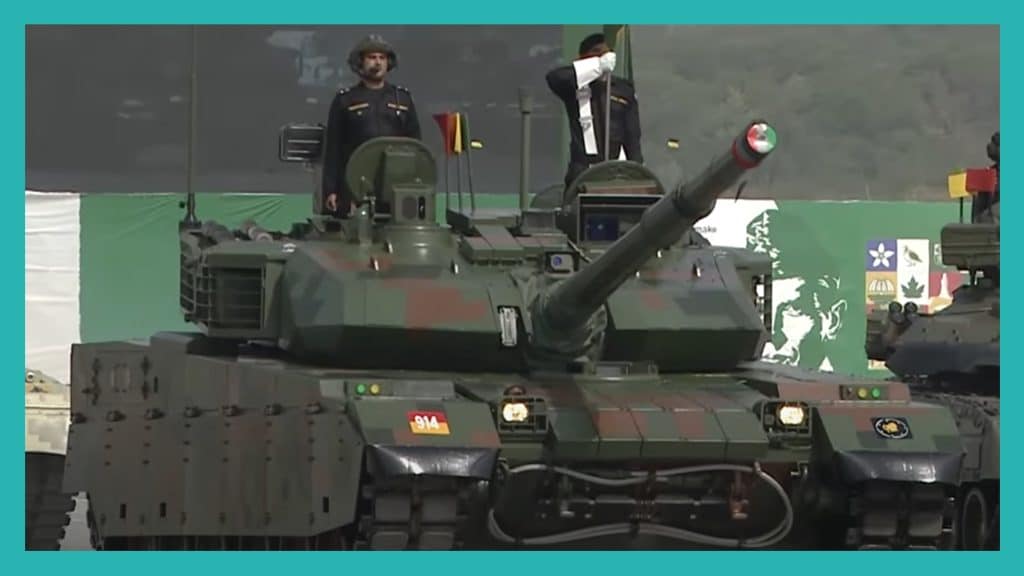
HIT’s flagship project is the Haider main battle tank (MBT), a locally assembled variant of the NORINCO VT-4 MBT from China. As of 2023, HIT has been making inroads at taking on more of the Haider’s production work, with the tank’s gun system already being sourced from domestic inputs. Efforts at localizing more of the VT4 are underway, albeit gradually, with electronics seemingly being the next focus area.
However, HIT says it is eager to expand its portfolio of indigenous solutions. Recently, it crossed a number of key milestones, such as producing its own in-house fire control system (FCS) for tanks and complete gun systems for towed and self-propelled artillery. In fact, recent local news footage covering HIT facilities show apparent work on changing or upgrading the PA’s M109-series self-propelled howitzers using these newly developed gun inputs. There is also an original artillery program in development.
Overall, like the Pakistan Air Force (PAF) and Pakistan Navy (PN), the PA is moving towards leveraging locally designed original solutions, albeit with some key differences. The most notable difference is that the PA’s starting point is to use off-the-shelf platforms (like the VT4), but in tandem, commission HIT to gradually localize the inputs so that, potentially, an original (but still related) design could emerge. With this work in mind, could the PA’s indigenization push drive HIT to design its own complete armoured vehicles?
Haider Main Battle Tank
Officially inducted in 2020, the VT4 is the PA’s latest MBT, joining the al-Khalid-series, T-80UD, and al-Zarrar series of tanks. Pakistan signed a contract with China’s NORINCO in late 2018 or early 2019 for 176 VT4 at a cost of $859 million USD. Designated the “Haider,” the PA envisaged inducting the VT4 as a mainstay tank – not a limited off-the-shelf acquisition. Subsequently, HIT revealed its efforts to co-produce the VT4 under license so as to support the PA’s plans to induct the Haider at scale.
By 2023, HIT was fully engaged in co-producing the Haider with Chinese support. Footage from local news media showed that HIT was welding the VT4’s turret and chassis, albeit with Chinese steel and composite inputs. However, HIT also revealed that it was producing certain key subsystems indigenously, notably the entire gun system for the Haider, i.e., the barrel, breech mechanism, elevation mechanism, etc. In addition, HIT announced that it was localizing the Haider’s electronic subsystems, including FCS, gun control system (GCS), and, potentially, optronics, like gun and commander sight systems.
One of the key drivers behind localization is the Advanced Research Development and Information Center (ARDIC), HIT’s internal research and development (R&D) bureau. According to HIT officials, one of ARDIC’s main functions is to examine and localize the components of a given system. For example, ARDIC officials say that they will study a component to determine its materials, chemical composition, and strengths and, in turn, create process sheets for local industry partners to use in reproducing those parts. If the domestic industry is unable to produce the part due to the unavailability of certain materials in Pakistan, ARDIC will then redesign the part with locally available materials/inputs.
It appears that ARDIC is playing a role in incrementally indigenizing the VT4. For example, footage from a local outlet, Abbtakk, show locally designed track parts and shock absorber parts for the VT4/Haider. It is possible that PA will continue commissioning ARDIC to indigenize more of the Haider, including its armour superstructures. Likewise, HIT may also leverage the work it has already done for the al-Khalid-I (Improved) – such as the electronics and solid state auto-loader (SSAL).
Should HIT succeed in localizing a significant bulk of the VT4, it could end up providing the PA an original and capable MBT at a relatively affordable price. Perhaps the goal would be to localize as much as possible, with the engine and transmission being the primary imports. Given that it has manufactured 1,800 tanks since 1992, HIT would ideally receive the funding to pursue domestic engine and transmission production. While costly, the PA’s orders should generate enough scale – both in quantity and long-term requirements – to amortize a high upfront cost, albeit over a period of several decades.
Artillery Gun Systems
One of the major advances HIT made in recent years was the local production of complete gun systems, starting with tank guns and now artillery guns. In fact, local media footage of HIT’s facilities indicates that work is underway to change or upgrade the M109A5’s 155 mm/39-caliber gun. In 2021, HIT disclosed that it was also developing an inhouse 155 mm artillery gun.
Don't Stop Here. Unlock the Rest of this Analysis Immediately
To read the rest of this deep dive -- including the honest assessments and comparative analyses that Quwa Plus members rely on -- you need access.