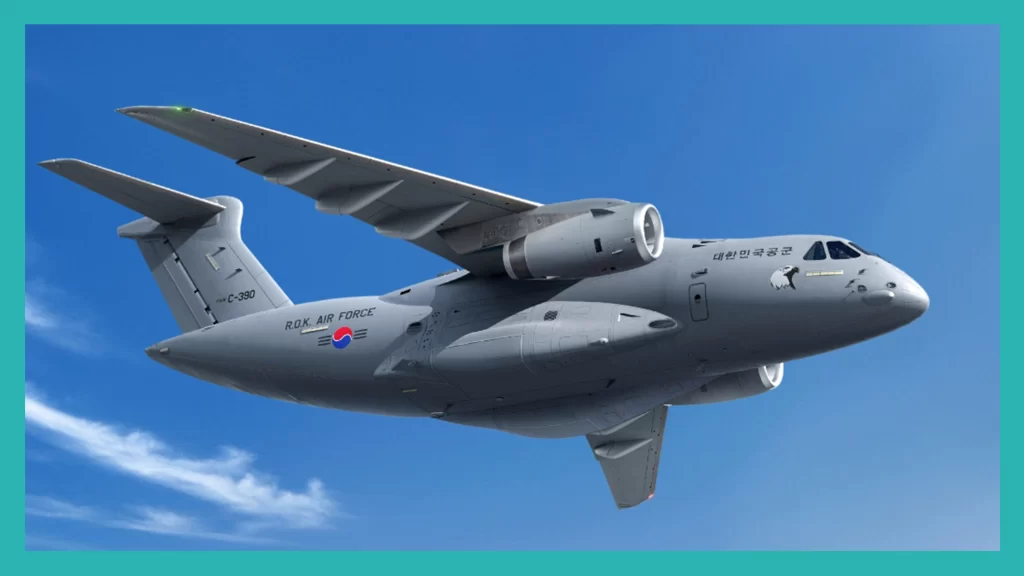
On 04 December, Embraer announced that it signed a contract with South Korea’s Defence Acquisition Program (DAPA) to supply the Republic of Korea Air Force (ROKAF) with an undisclosed number of C-390 Millennium transport aircraft. Details later emerged that the ROKAF will acquire three C-390s – alongside spare parts as well as training and logistics support – for $544 million USD.
Not only does the deal mark Embraer’s first C-390 order in the Asia Pacific region, but it adds another high-profile customer to the aircraft’s growing userbase. South Korea joins Portugal, Hungary, the Netherlands, and Austria. With early traction among NATO states and key US allies, the C-390’s commercial progress up to this point has been promising; is this the momentum Embraer needs to rival Lockheed Martin’s C-130J-30 in the market for replacing legacy Hercules aircraft?
Background
Building on its experience developing, and manufacturing executive jets and civil airliners, Embraer, Brazil’s aerospace giant, embarked on designing its first large-sized military aircraft. Development work began in earnest in 2009, with Embraer envisaging the C-390 as a multirole tanker-transport (MRTT). Embraer rolled out the first prototype in 2009 and, in turn, performed the C-390’s maiden flight in February 2015. The C-390 achieved full operational capability with the Brazilian Air Force (FAB) in March 2023, which currently operates four aircraft. The FAB had an original requirement for 28 C-390s, but recurring austerity measures forced it to cut its commitment to 22 aircraft.
With a maximum take-off weight (MTOW) of around 87 tons, the C-390 is powered by two IAE V2500-E5 high-bypass turbofan engines, each providing a thrust of 139.4 kN. The C-390 offers a lift capacity of about 26 tons and a ferry range of 2,000 km when at full load. In addition, the aircraft can also deploy a pair of Cobham pods to provide air-to-air refueling via the hose-and-drogue method.
Twin Jets versus Quad Turboprops
The Embraer C-390 and Lockheed Martin C-130J-30 are competing in one key market: the need to replace legacy Hercules variants, like the C-130B/E/H. Prior to the C-390’s availability, practically every air arm that operated a legacy C-130 had replaced its old Herc’s with the C-130J/J-30. Indeed, the adage of “only a Herc can replace a Herc” held true for decades as no other aircraft offered the right mix of useful lift, versatility (e.g., hot-and-high performance), and cost effectiveness (via a global userbase plus massive economies-of-scale from American orders) in one package.
However, Embraer is not coming at this market with another Hercules; rather, the company took steps to create a competing solution with its own unique strengths. Thus, the competition between the Millennium and Hercules is not only one between two comparable aircraft, but also, two distinct approaches to solving one problem. This is the competition between twin jet engines and four turboprop engines.
The C-390 does not have – and likely never will generate – the economies-of-scale behind the C-130. But Embraer took a key step in making the C-390 relatively cost-effective in spite of it being a new platform. It was through the section of two IAE V2500-E5s instead of turboprop engines.
The IAE V2500 is among the powerplant options of the Airbus A320. Thus, the engine benefits from a huge production run spanning thousands of units. Thus, many potential C-390 operators will, in some way, have a set up to support the C-390 (via their airlines’ A320s) in place already. If not, then the cost of establishing that maintenance and support set up should be relatively feasible thanks the engine’s extensive adoption, thus finding the requisite expertise, ground support equipment, and parts should not be difficult.
Being an airliner engine, the V2500 is also marketed as a quiet and fuel-efficient powerplant that provides significant range. Not only is this important from an operating cost standpoint, but this can also factor into the C-390’s dual role as a tanker-transport by providing efficient fuel management.
A military airlifter with the qualities of an airliner offers a unique advantage. First, the C-390 offers the lift capacity to ferry heavy equipment. Second, it has the efficiency of an airliner. So, if one wants to expand their air logistics network and leverage airliner-type scalability, the C-390 could be an intriguing fit, at least in theory. While the engine may not be an issue, the C-390’s durability to withstand heavy utilization still remains to be seen, as does Embraer’s ability to control the cost of spare parts. If Embraer is able to bring the efficiency and maintainability of airliners to the C-390, it could have a stronger case than the Hercules, at least if the criteria centered on expanding military air logistics at the lowest cost.
Don't Stop Here. Unlock the Rest of this Analysis Immediately
To read the rest of this deep dive -- including the honest assessments and comparative analyses that Quwa Plus members rely on -- you need access.