Though the Pakistan Air Force (PAF) relied on China and France for combat aircraft through the 1970s (via the Shenyang F-6 and Dassault Mirage III/5, respectively), it still sought new fighters from the US. While it did not succeed in this endeavour until the 1980s with the acquisition of the F-16s, the PAF spent a major part of the 1970s negotiating with the US for a suitable replacement for its North American F-86 Sabres.
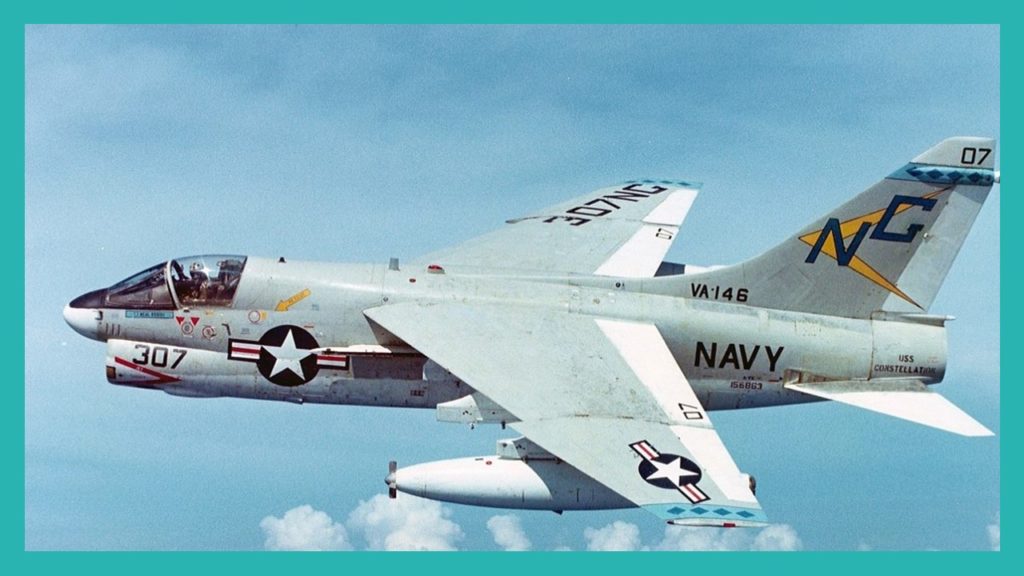
In 1974, the PAF shortlisted its options to the Northrop F-5 Freedom Fighter/Tiger and the Ling-Temco-Vought (LTV) A-7 Corsair II. It selected the A-7 Corsair II, and made a formal request to visit LTV Aerospace Corporation to evaluate the aircraft that same year.[1] By 1977, the US and Pakistan were working on a deal of up to 110 A-7s for $500 million US ($2.49 billion US today).[2]
However, the Jimmy Carter administration cancelled the potential deal on the grounds that the sale could destabilize the balance of power in South Asia. Washington also hoped to leverage the A-7 as a means to encourage Pakistan to scale back its then clandestine nuclear weapons program.[3] The US viewed the A-7 as a potent attack asset, one that should assuage Pakistan’s concerns of India’s nuclear program.
Interestingly, not only did the US keep its offer of F-5Es to Pakistan on the table (irrespective of Pakistan’s nuclear program), but to ensure India did not widen the gap too much, prevented Sweden from selling its JA-37 Viggen aircraft to the Indian Air Force (IAF).[4] The US also continued speaking to Pakistan on the sale of combat aircraft, but under the Carter administration’s stricter arms export framework, i.e., restricting access to systems equivalent in capability to those used by the US.
Through the 1970s, the US was consistently of the view that a natural successor to the PAF’s F-86s would be the F-5E Tiger II. By 1979, the US offered 40+ F-5Es for $450 million US (with the possibility of boosting the offer to 70-80 aircraft).[5] In addition, the US was also willing to entertain the possibility of selling AGM-65 Maverick air-to-ground missiles (AGM) with the F-5Es.[6]
It was unclear how talks were progressing for the F-5Es, but in lieu of its own advanced aircraft (e.g., the F-16), the US was also prepared to encourage other countries to provide financing support should the PAF request aircraft from them (e.g., France).[7] However, by 1981 the situation would change entirely with the US relaxing its export restrictions and, in turn, the PAF signing onto 40 F-16A/B Block-15s.
Quwa Plus
Go Beyond the Headlines on Pakistan’s Defence and Security.
Quwa Plus gives you deeper reporting, briefings, and analysis on Pakistan’s defence programs, foreign policy, national security, and regional strategy. Follow the developments that matter to professionals, analysts, and serious readers tracking Pakistan’s security landscape.