22070Views
Beyond Nuclear: Pakistan’s Quiet Shift to Mass-Produced Conventional Strikes Quwa Premium
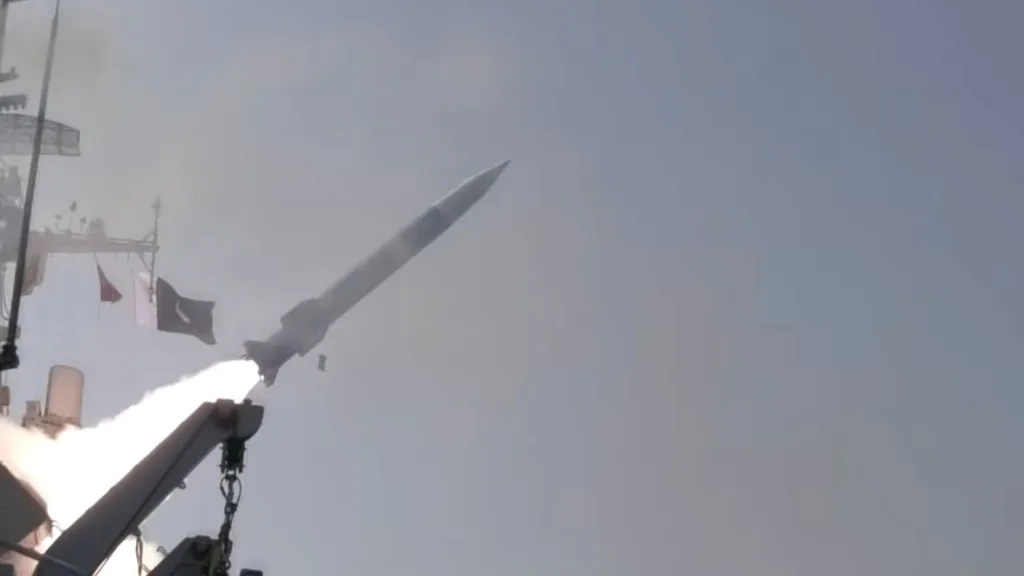
On 25 November 2025, the Pakistan Navy’s (PN) Director General Public Relations (DGPR) announced the successful test-firing of the SMASH (i.e., Supersonic Missile Anti-Ship), an anti-ship ballistic missile (ASBM).
The SMASH has a stated range of 300-350 km and can be deployed from the Zulfiquar-class (F-22P) frigate. Being an ASBM, the missile includes a terminal-stage seeker – either active-radar homing (ARH) or (as with other Pakistani anti-ship munitions, like the Taimur air-launched cruise missile) – imaging infrared (IIR) for engaging moving targets.
The SMASH is one part of the PN’s evolving munitions strategy, which also includes the Harbah NG subsonic anti-ship cruise missile (ASCM), the Zarb subsonic ASCM, and the CM-302 supersonic-cruising missile (SSCM).
The Harbah NG is deployed from two Azmat-class fast attack crafts (FAC) (i.e., PNS Himmat and PNS Haibat), while the CM-302 was inducted through the four Tughril-class (Type 054A/P) frigates. The Zarb, however, is the PN’s primary coastal/land-based ASCM system.
There are several major discussion points from this test. First, and the most obvious, is that the SMASH is a sign of the PN building an anti-access and area-denial (A2/AD) strategy anchored to long-range munitions, submarines, special mission aircraft, unmanned aerial systems (UAS), unmanned surface vessels (USV), and unmanned underwater vehicles (UUV).
Several analyses by Quwa discussed each of these aspects separately, and these can be found in the list of articles below:
- Unpacking Pakistan’s Naval UAVs, USVs, and UUVs
- Understanding the Design and Role of the Jinnah-Class Frigate
- Exploring Pakistan’s Hangor-Class Submarine and SWATS Boats
- Examining Pakistan’s Maritime Air Presence and Future Challenges
While the Pakistan Air Force’s (PAF) combat aircraft and the Pakistan Army’s long-range guided rockets drew the most attention in the May 2025 conflict, the PN’s relatively rapid quantitative and qualitative growth into a regionally impactful maritime power has not drawn the level of attention it merits. A future Quwa piece will tie these different aspects to build the complete picture of where the PN is heading and, for actionable perspectives, which reference points it could be using to develop its doctrine.
This article, however, will contend that Pakistan is seeking to scale its adoption of conventional ballistic missiles by integrating with China’s supply chain in the near term and indigenizing over the long term.
One sign of this is that the SMASH and Fatah 2, which represent the PN’s and PA’s respective missile programs, share a common platform. For example, both missiles appear to share a similar fuselage and aft-stabilizer configuration.
The stated ranges of each missile are more challenging to align. According to the PN, the SMASH has a stated range of 300-350 km, while the Fatah-2 has a stated range of 400 km. Furthermore, the ‘Abdali Weapon System’ – i.e., likely another derivative of this family (Fatah-3) but designed as a strategic/nuclear munition – has a range of 450 km. While different, the missiles do not vary significantly in their respective range coverages.
One common refrain against Pakistan’s munitions program is that they are simply procured off-the-shelf from China or ‘re-stickered’ Chinese products with a Made in Pakistan label. To be fair, the refrains are grounded in some facts, but in areas that are easy and tempting to conflate with the efforts of the National Engineering and Scientific Commission (NESCOM) to develop Pakistan’s indigenous munitions stack.
It is no secret that Pakistan is not an industrial power nor a key scientific R&D hub. Thus, one should expect even NESCOM to draw on Chinese technology inputs, but as one part of a chain feeding into an original design. In other words, the final product – with its performance, specifications, and feature set – would be designed by NESCOM, but, due to cost and domestic constraints, it will rely on both domestic and overseas (mainly Chinese) inputs.
The key point is to understand the difference between an ‘original design’ and an ‘indigenous system.’ Longtime readers of Quwa may recognize that this author uses these terms to refer to distinct things. A country could design its own original solution; however, an original design does not necessarily mean that it draws on indigenous inputs.
One example is the Saab Gripen. Saab designed the fighter but sourced many of its critical inputs from other countries, primarily the United Kingdom and the United States. Sweden was still involved in the areas where it had expertise and could scale for production, but ultimately, the Gripen leans on British and American inputs – e.g., the GE F404/414 turbofan engine, the Leonardo active electronically scanned array (AESA) radar stack, and BAE technology for the flight-control system – to fly.
Thus, this author contends that Pakistan’s critical programs, including its ballistic missiles, cruise missiles, loitering munitions, and others, all leverage a similar approach. The solutions (e.g., SMASH) are original in that NESCOM designed them, but it drew on a mix of domestic and Chinese inputs to bring those designs into a serviceable state. Furthermore, as Pakistan builds its conventional strike capabilities quantitatively, that dependence on foreign inputs will grow in the short term, as there is no other realistic path to scale up production to the necessary volumes without integrating foreign suppliers.
End of excerpt. You’ll need to login or subscribe to Quwa Premium to access the full article.
Existing Quwa Plus/Pro members can log in below
Note: Logged in members may need to refresh the article page to see the article.