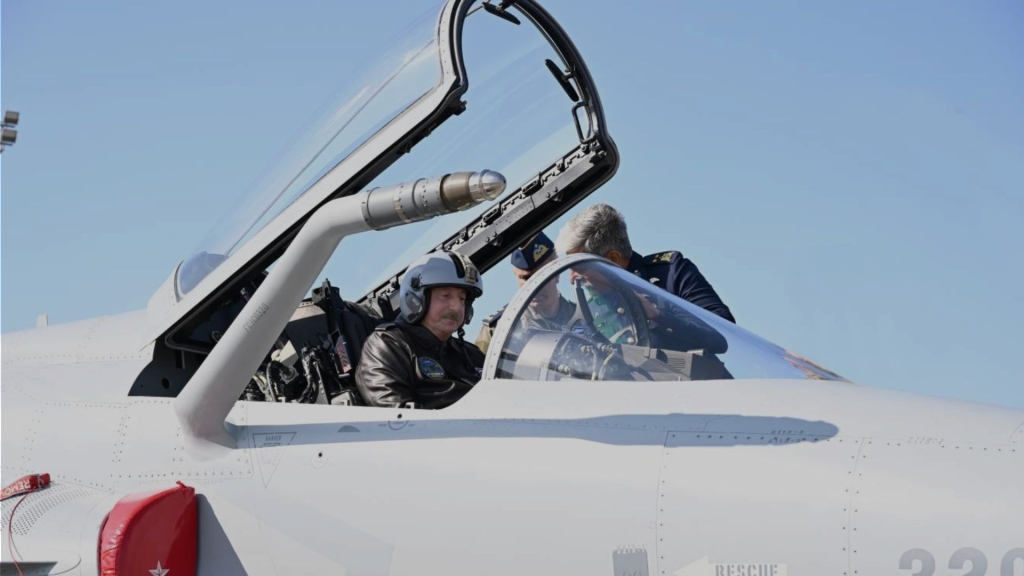
On 25 September 2024, the official website of the President of the Republic of Azerbaijan announced that the Pakistan Aeronautical Complex (PAC) JF-17C Block-III was “integrated into the arsenal of Azerbaijan’s Air Force.”
The statement indicates that Azerbaijan signed onto acquiring an unspecified number of PAC JF-17Cs. Currently, this press release is the only official statement surrounding this potential acquisition.
Before this announcement, there had been unverified reports of Baku signing a $1.6 billion US deal for an undisclosed number of JF-17s.
Neither Pakistan or Azerbaijan have confirmed those reports, but at the minimum, a JF-17 sale to the Azerbaijani Air Force is underway.
Stay up to date with the latest Pakistani defence news with reliable research and accurate forecasting
Click Here
There are also numerous less tangible, but important, factors as well. Indeed, if the goal was to acquire a more capable solution, Azerbaijan could have opted for the J-10CE. However, by opting for the Thunder, Azerbaijan could also leverage the PAF’s training infrastructure.
Given that the JF-17 is among the PAF’s mainstay fighters, its overall training curriculum feeds into the fighter. Thus, Azerbaijani pilots at different levels – from fresh recruits to experienced veterans – can ‘slot’ into this curriculum and develop as comparably as their PAF counterparts.
This approach would help the Azerbaijanis acclimate with not only the JF-17C directly, but the underlying doctrines that drove its design and development. The PAF leans closer towards the NATO approach rather than the Russian philosophies that had supported Azerbaijan up to this point.
In addition, the PAF regularly carries out or participates in multinational air exercises. Thus, it generates a high level of exposure to best practices from both the West and the East (via China). Azerbaijan can draw on this experience indirectly by using the PAF’s training apparatus, or directly by participating in these air exercises, especially those hosted by Pakistan and Turkiye.
There are even less tangible technology factors at play. For example, Pakistan can provide Azerbaijan a proprietary or bespoke tactical data-link (TDL) protocol. Not only would this be a key asset for the JF-17C, but Azerbaijan can scale it for use on other platforms, such as surveillance aircraft. Furthermore, Pakistan is also working on its own electronic warfare (EW) stack – i.e., both hardware and software. Again, the PAF can provide the Azerbaijan Air Force with a credible EW solution.
Basically, one cannot take inherently sensitive technology like network-enabled warfare subsystems and EW suites for granted. Knowing the hostility between Azerbaijan and Armenia, both Western and Russian suppliers alike could be hesitant towards giving Baku a decisive edge. Hence, sensitive technologies, like EW, TDLs, and ALCMs, could be off the table had Baku dealt with Western or Russian suppliers.
Join Quwa Plus
Get the latest defence news and analysis on South Asia and the Middle East.
Already a subscriber? Sign in