
On 30 May, China’s Xichang Satellite Launch Centre sent Pakistan’s newest communications satellite into orbit using its LM-3B satellite-launch vehicle (SLV). Designated the PakSat-MM1 (previously, it was known as the PakSat-MM1R), the new satellite will be ready for operations by the end of August 2024.
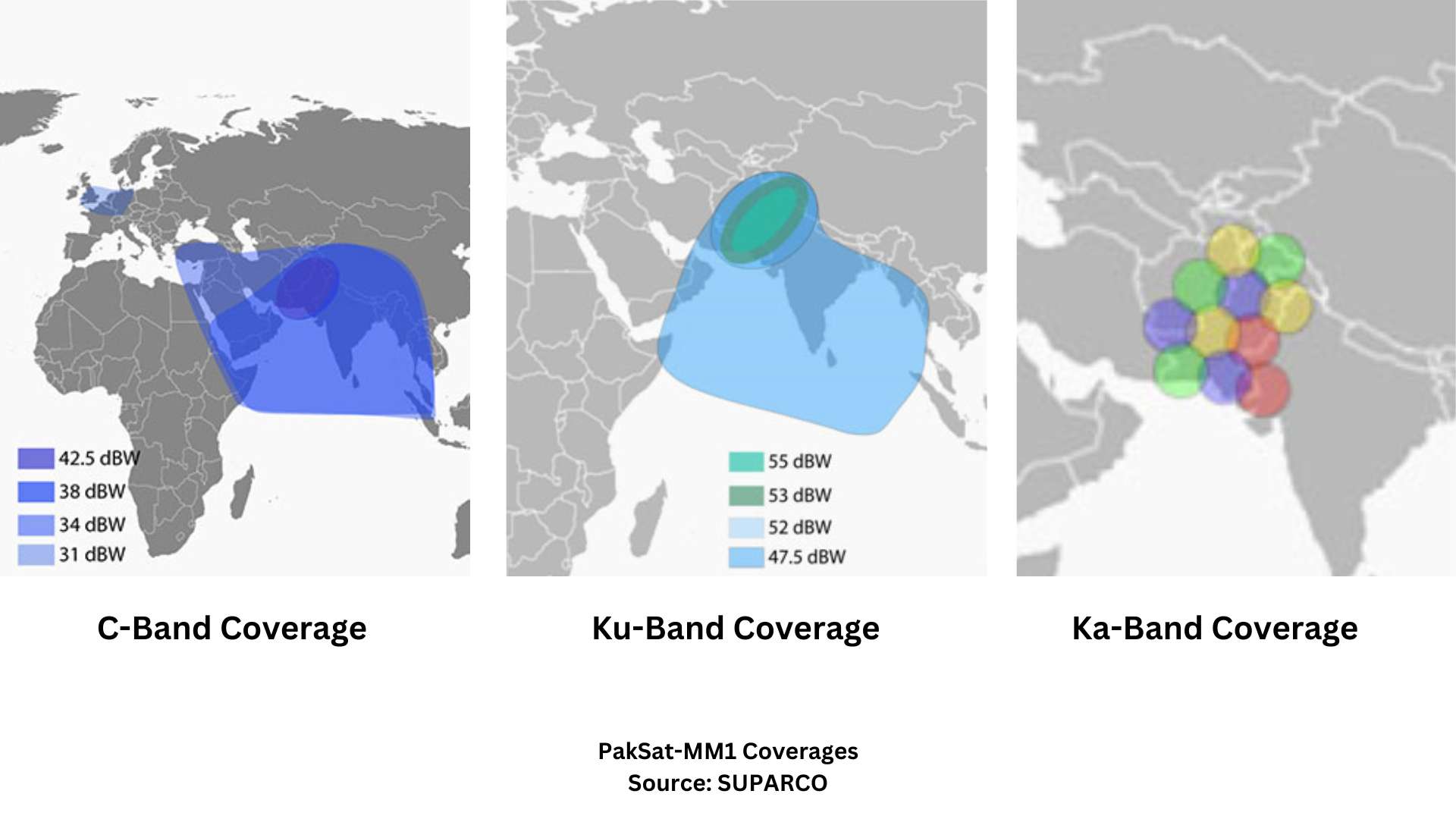
The PakSat-MM1 is reportedly equipped with 48 transponders split across C-band, Ku-band, and Ka-band units. The C-band transponders will primarily be used for TV/HDTV broadcasting in South Asia, the Middle East, the horn of Africa, and parts of the U.K., France, Germany, Belgium, and Netherlands. The Ku-band transponders provide coverage over all of Pakistan, India, the Arabian Sea as well as parts of the Arabian Peninsula and Bangladesh. The Ka-band transponders cover all of Pakistan and most of Afghanistan.
The PakSat-MM1 is also equipped with an L-band satellite-based augmentation system (SBAS) for use with the BeiDou Navigation Satellite System (BDS). This is reportedly the first overseas satellite with an SBAS suite supporting the BDS. Not only does this showcase Pakistan’s growing closeness to Chinese technology, but it also reflects Pakistan’s growing use of satellite navigation (SATNAV) in aviation, naval, and other applications. This is another step towards a cohesive national SATNAV strategy for civilian as well as conventional and strategic defence purposes.
Pakistan and China have both framed the PakSat-MM1 as a civilian satellite first and foremost, and this is certainly the case. However, this civilian satellite is also supported by a strategic undercurrent that desires satellite systems – i.e., SATNAV and satellite communications (SATCOM) – for military purposes. One can plainly see this growing SATNAV and SATCOM use in Pakistan’s growing arsenal of long-range drones as well as precision-guided munitions, such as glide bombs and cruise missiles.
Pakistan’s Space and Upper Atmosphere Research Commission (SUPARCO) bought the PakSat-MM1 in 2018. According to state-run Chinese media, the deal also involved a measure of transfer-of-technology, including a joint development venture and technical training for personnel. In fact, the current Minister of Planning of the Pakistani government, Ahsan Iqbal, mentioned that a homegrown satellite development, production, and launch/space centre program is on the roadmap.
Pakistan envisions producing its own series of satellites for communications, location/navigation services, and remote sensing/imaging in the coming decades.
Log in or subscribe to read the rest of the article
Timely Defence News with Verified Insights
Stay up to date with the latest Pakistani defence news with reliable research and accurate forecasting
Click Here
A Quiet SATCOM Asset?
Each of the Pakistani military’s service arms – i.e., the Army, Navy, and Air Force – are each increasingly relying on SATCOM. This is clearly apparent in their respective investments in long-endurance unmanned aerial vehicles (UAV), such as the Shahpar-series, Bayraktar Akıncı, and Bayraktar TB2.
There is a clear effort towards leveraging SATCOM to enable beyond line-of-sight (BLoS) operations along the country’s porous western border with Afghanistan, the eastern border with India, coastline, near shore as well as open waters. Pakistan views drones as a scalable way to grow its intelligence, surveillance, and reconnaissance (ISR) and strike capabilities compared to adding more crewed systems, especially special mission aircraft. Compared to the latter, drones can be acquired at lower costs and deployed for long-haul missions without risks to crew fatigue (as drone operators can be rotated on the ground) or crew loss.
In addition, a growing number of Pakistani assets ranging from surface warships to aircraft are using – or will use – SATCOM terminals. For example, the PN’s Tughril-class (Type 054A/P) frigate uses a Ku-band SATCOM terminal. Likewise, the Babur-class (PN MILGEM) corvette will likely use SATCOM terminals as well. Finally, Pakistan’s core network-enabled warfare systems – such as the Naval Information Exchange System (NIXS) – makes overt references to SATCOM connectivity. In effect, the Pakistani military’s plans to use SATCOM are already being implemented; therefore, a usable satellite is a must, and PakSat-MM1 is likely poised to play a key role in supporting those plans.
Join Quwa Plus
Get the latest defence news and analysis on South Asia and the Middle East.
Already a subscriber? Sign in