India Mulls Second Indigenous Aircraft Carrier
India’s Defence Procurement Board (DPB) is evaluating the Indian Navy’s (IN) request to potentially build a second Vikrant-class aircraft carrier. The proposed project could cost approximately $4.8 billion USD – or (₹40,000 crore INR). Cochin Shipyard Limited (CSL), which built India’s first indigenous aircraft carrier, INS Vikrant, would also construct the second potential ship.
Originally, the IN sought to build upon the INS Vikrant – i.e., Indigenous Aircraft Carrier (IAC) – with a larger, more sophisticated ship. Reports indicate that a proposed IAC II could leverage a catapult assisted take-off barrier arrested recovery (CATOBAR) system rather than the short take-off but arrested recovery (STOBAR) configuration of INS Vikrant (IAC-I). However, the former would have been more complex and, in turn, also costlier compared to the IAC-I design, which at this point is a matured and tested configuration.
To continue building its seaborne aviation strength, the IN opted to instead pursue a second Vikrant-class carrier, i.e., drawing more out of the existing research and development (R&D) overhead that was invested in IAC-I. The second Vikrant-class carrier would also be around 45,000 tons in displacement with a STOBAR configuration, though it is expected to carry a number of modifications compared to the INS Vikrant. It is a rational decision to pursue an existing design, especially one whose design issues were resolved instead of an untested and more complex system.
In July 2023, India’s Ministry of Defence’s (MoD) Defence Acquisition Council (DAC) also gave its greenlight to start negotiations for 26 Dassault Rafale fighters for the IN. However, the Rafale acquisition would only be the first component of the IN air combat growth; indigenous programs – notably the TEBDF – will play a major role, alongside indigenous carrier construction, to extend India’s strategic power projection. But with China seemingly moving full steam head with its own carrier ambitions, India’s programs could merit more urgency from New Delhi. The challenge will be in balancing the service arm’s ambitions with costing and other limitations, hence why building another Vikrant-class carrier is a prudent idea.
Turkey’s Roketsan Preps UAV-230 Missile for Production
Roketsan is preparing to begin the production of its new UAV-230 air-to-surface ballistic missile from 2024. The UAV-230 is based on Roketsan’s TRG-230, a 230 mm multi-barrel rocket system (MBRL). The UAV-230 relies on a GNSS-aided navigation system, though Roketsan did not mention whether there is a terminal-stage seeker in place. Reports suggest that a semi-active laser-homing (SALH) system could be added.
With a stated range of over 150 km (conditional on the altitude and speed of the launch platform) and a weight of 225 kg, the UAV-230 can be carried from a wide variety of systems, including drones. However, Roketsan is also marketing the UAV-230 as a surface-to-surface missile (SSM) that can be launched from ships, such as the MILGEM-series of corvettes and frigates, and land-based vehicles.
Though not a new concept, the UAV-230 can be an interesting solution for countries looking to add another dimension to their stand-off range strike capabilities. Generally, many militaries already leverage cruising missiles, especially subsonic designs, but a ballistic missile can open a pathway for supersonic engagement.
Interestingly, Pakistan’s JF-17 had marketed a similar capability via the CM-400AKG. However, the UAV-230 arguably carries a more unique quality in that unmanned aerial vehicles (UAV), like the Bayraktar Akıncı, can carry the missile. Pairing a comparatively slow-moving aircraft like the Akıncı with a supersonic ballistic missile is a unique combination, potentially positioning the drone as an asset for high-speed strikes.
It also makes for a scalable solution in that it can be used across airborne, sea, and land platforms, i.e., a common missile that can be used by an army, air force, and navy. Turkey may potentially use the UAV-230 as a basis for future adaptable ballistic missiles, potentially hypersonic designs.
Pakistan’s GIDS Reveals Indigenous Turbojet Engine
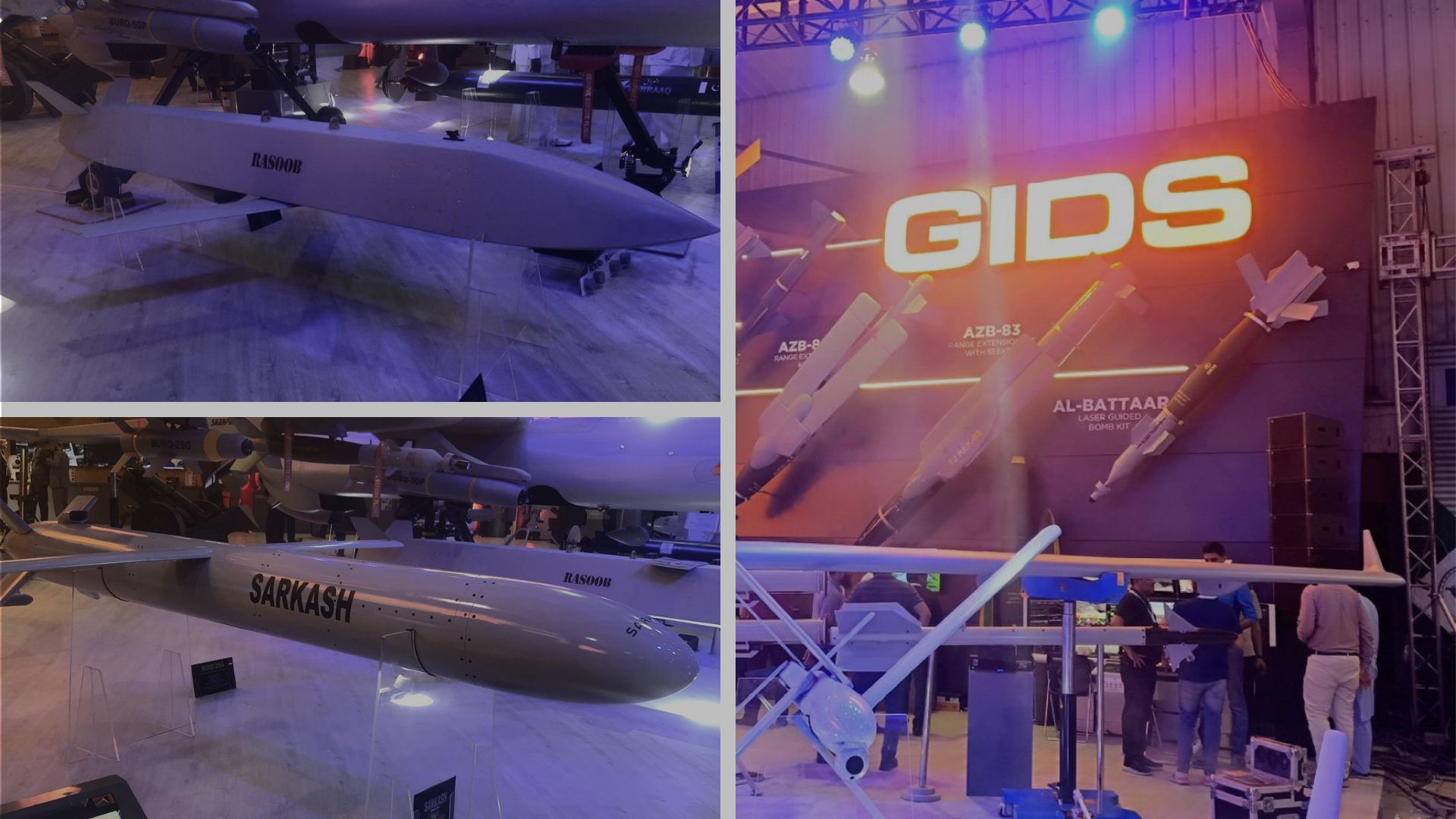
Global Industrial and Defence Solutions (GIDS), a conglomerate representing the country’s state-owned defence enterprises, revealed an indigenous miniature turbojet system, the NTJ-V1.
Don't Stop Here. Unlock the Rest of this Analysis Immediately
To read the rest of this deep dive -- including the honest assessments and comparative analyses that Quwa Plus members rely on -- you need access.