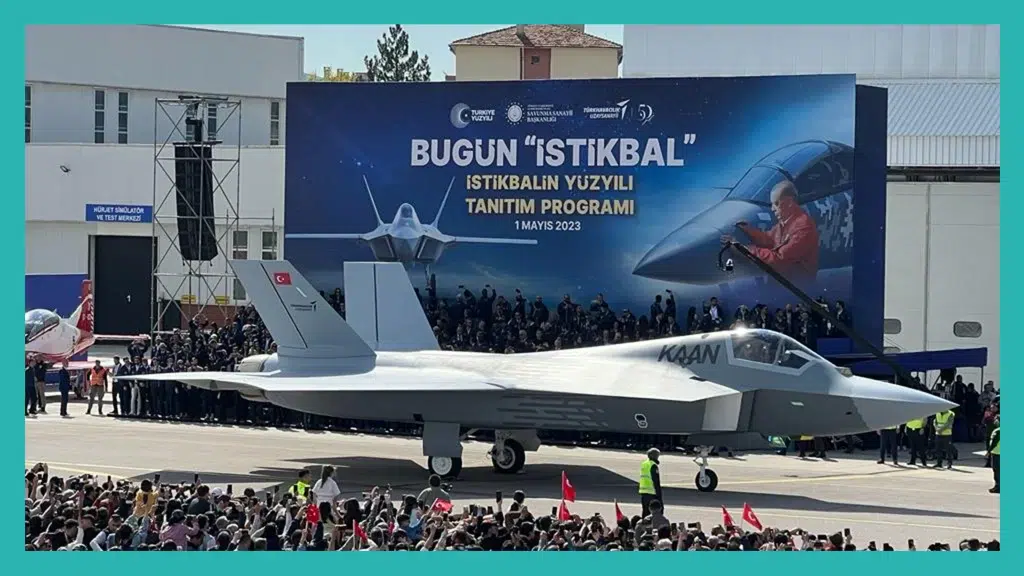
At the start of May, Türkiye officially named its next-generation fighter aircraft (NGFA) program, the MMU (Milli Muharip Uçak) as the “KAAN.”
The test pilot of the prototype Kaan, Gökhan Bayramoğlu, told Anadolu Agency, Türkiye’s state-owned news agency, that Turkish Aerospace Industries (TUSAŞ) successfully carried out the taxi tests and, in turn, is now validating the fighter’s control systems to bring them to flight-ready status.
In his speech, Turkish President Recep Tayyip Erdogan said that the Kaan was the “dream that the nation had been pursuing since the foundation of the Republic.” Indeed, Türkiye had originally aimed to test fly the Kaan in time for the country’s centennial or 100-year anniversary.
Though the Kaan did not reach that goal, TUSAŞ anticipates that the Kaan could fly relatively soon. Through an interview with Aviation Week, the MMU’s executive vice president, Ugur Zengin, said, “We have all the testing infrastructure and a very broad experience on testing the aircraft, so that gives us the confidence to fly as early as possible.” TUSAŞ expects to field seven flying prototypes of the Kaan.
The name is an apparent reference to the Turkish title, “Kaan or Khan,” that refers to ‘leader.’ While a clear sign of the Kaan’s significance to Türkiye as its flagship defence program, the name could also reflect the role of the fighter in Türkiye’s future integrated air warfare system.
The Kaan is a twin-engine fighter with ‘stealth’ or low observability (LO) design features to help mitigate its detectability on radar. It also features an internal bay for air-to-air and air-to-surface munitions as well as an assortment of sensors, such as an active electronically scanned array (AESA) radar, an apparent twin-array electro-optical tracking system (EOTS) and/or infrared search and track (IRST) system.
According to Bayramoğlu, the Kaan’s human-machine interface (HMI) system aims to reduce the workload for the pilot while also providing them with relevant information.
Join Quwa Plus
Get the latest defence news and analysis on South Asia and the Middle East.
Already a subscriber? Sign in