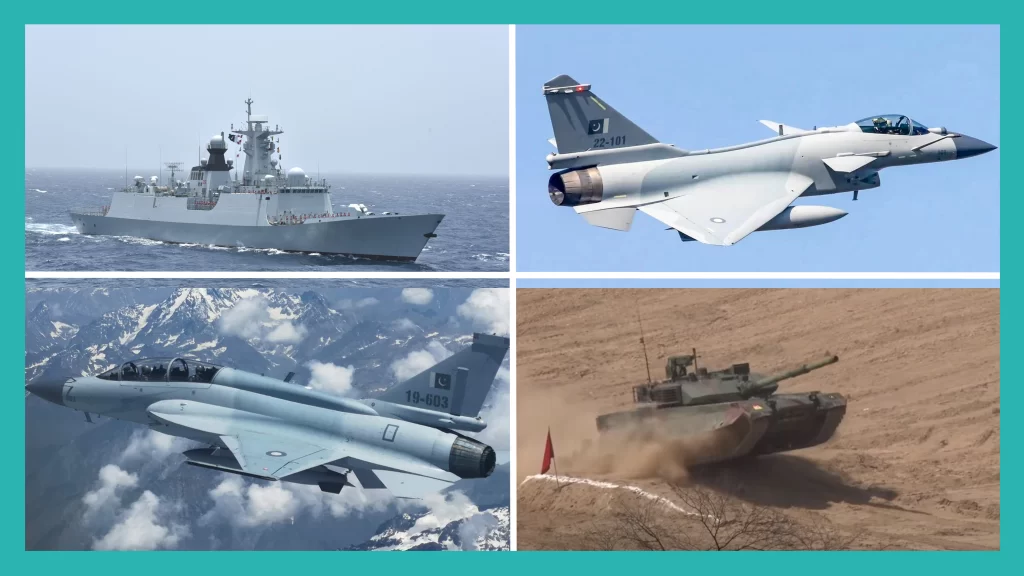
Through much of its history since Partition in 1947, Pakistan has had difficulty sourcing advanced weapon systems, especially those that could give it an edge against India. Traditionally, insufficient funding and a lack of supply-side access in the West were Pakistan’s main blockers.
However, the previous year has shown that one blocker – i.e., restricted supply-side access – is no longer a problem for Pakistan. On the back of its rise as both an industrial and technological superpower, China has developed modern weapon systems across every domain, be it land, sea, air, space, or cyberspace.
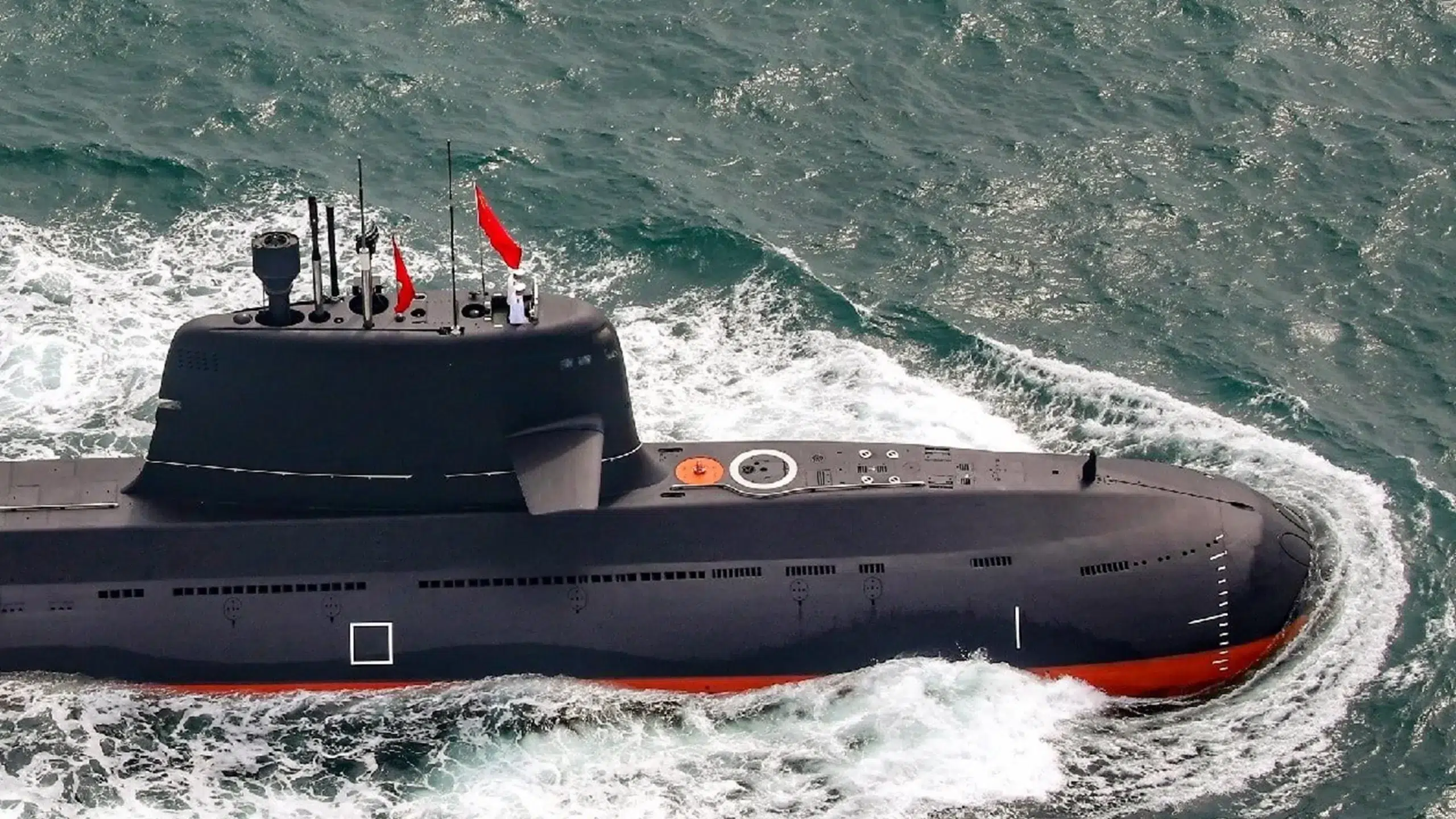
Finally, Pakistan has what it could consider a reliable supplier of qualitatively impactful weapons. In 2022, Pakistan inducted the J-10CE multi-role fighter, operationalized the SH-15 self-propelled howitzer (SPH), expanded the VT-4/Haider main battle tank (MBT) program, acquired the Tughril-class frigate, and made critical progress across the JF-17 fighter and Hangor submarine programs.
From introducing cutting-edge technologies to its fighters (like active electronically scanned array radars) to adding critical capability gains (like a long-range surface-to-air missile system), China provides Pakistan a source for armaments that can open qualitative gains that were previously locked behind sanctions and supplier-concerns about alienating India (the larger defence market).
As China’s defence product catalog grows, especially in terms of new technologies, Pakistan’s options for cutting-edge military hardware will grow. From a cost and availability standpoint, Pakistan does not have a better option than China, especially in the short to medium-term.
However, while China’s defence solutions may be more cost effective than Western systems, it is unclear if Pakistan has the fiscal strength to acquire what it needs. Granted, a number of Pakistan’s programs are progressing (e.g., the J-10CE), but the country’s defence requirements will grow.
The security environment in South Asia is advancing at a rapid pace, and from 2030, will likely usher many new technologies, like next-generation fighter aircraft (NGFA), directed energy weapons, and unmanned combat aerial vehicles (UCAV), among many others.
When it comes to arms procurement, there are three major elements in play. First, inducting the system and operationalizing it. Second, working through lifecycle costs (e.g., maintenance). Third, feasibly scaling and building the necessary quantity. Even one big-ticket procurement program, such as a new fighter, can produce a significant bill for the public exchequer, especially when it is completed as per the desired plan.
One thing to notice with Pakistan is that while the first and second elements of procurement generally do occur (i.e., induction and full lifecycle utility), scaling and building quantity is not always a given. Granted, Pakistan’s F-16 and AH-1F/S Cobra programs were curtailed due to sanctions. However, even if Pakistan could have acquired comparable alternatives (e.g., the Mirage 2000 in lieu of the F-16), it was unlikely to have expanded such a fleet to the numbers it required.
Quwa Plus
Go Beyond the Headlines on Pakistan’s Defence and Security.
Quwa Plus gives you deeper reporting, briefings, and analysis on Pakistan’s defence programs, foreign policy, national security, and regional strategy. Follow the developments that matter to professionals, analysts, and serious readers tracking Pakistan’s security landscape.
Join ($29.99/Year) Already a subscriber?Sign in