Today, much focus goes into the development and spread of new lightweight multirole fighter aircraft –e.g., the JF-17 Thunder, the Saab JAS-39 Gripen, the Korea Aerospace Industries (KAI) FA-50, the Hindustan Aeronautics Limited (HAL) Tejas, and, eventually, the Turkish Aerospace Industries Hürjet.
Why?
Because these fighters present cost-sensitive countries with new, modern air warfare capabilities at price points that are markedly lower than the top-of-the-line products available on the defence export market, such as the Dassault Rafale, Eurofighter Typhoon, or even new-built F-16 Block-70/72.
Not only that, but some of the current lightweight fighter options – most notably the JF-17 – are basically free of various supply-side restrictions. In fact, the JF-17 in particular is largely isolated from Western and, especially, American restrictions (at least from a technical standpoint).
Thus, the combination of cost-flexibility and/or supplier-flexibility makes these lightweight fighters strong options for many countries, especially in the developing world.
If options were limited to new-built aircraft for cost-sensitive and/or geo-politically challenged countries, then the lightweight fighter designs offer a viable pathway to modernization.
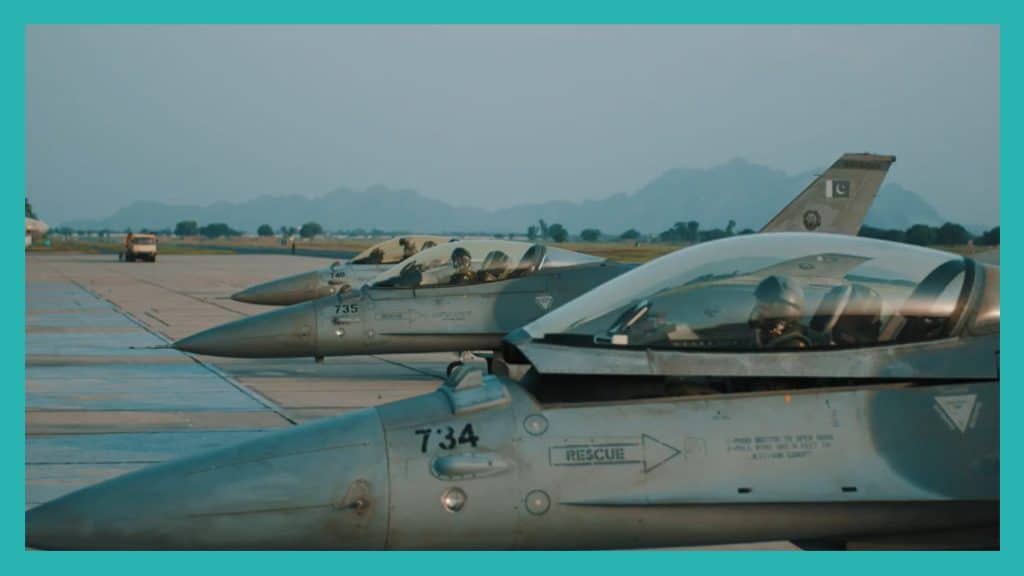
However, in this backdrop, used F-16s could deliver a unique proposition.
Why Used F-16s?
While it depends on the remaining life of the specific airframe, a used F-16 could offer a relatively capable and upgradable platform. Countries trust the capability aspect – e.g., range, payload, and other attributes – of the airframe. However, the question is: how much vertical room is left in a used F-16 in terms of the electronics suite, especially its radar and munitions compatibility options?
Well, it turns out, that vertical room is relatively ample, at least for the cost one can pick up these surplus or second-hand F-16s (which can range from anywhere from $10 million USD per airframe to around $25 million USD depending on the variant, airframe life, and other considerations).
For example, Top Aces, a privately-run air training company, acquired ex-Israeli Air Force F-16As and, in turn, upgraded them with active electronically scanned array (AESA) radars, Scorpion helmet-mounted cueing systems (HMCS), a tactical datalink (TDL) system, and electronic countermeasure (ECM) pod.
Don't Stop Here. Unlock the Rest of this Analysis Immediately
To read the rest of this deep dive -- including the honest assessments and comparative analyses that Quwa Plus members rely on -- you need access.