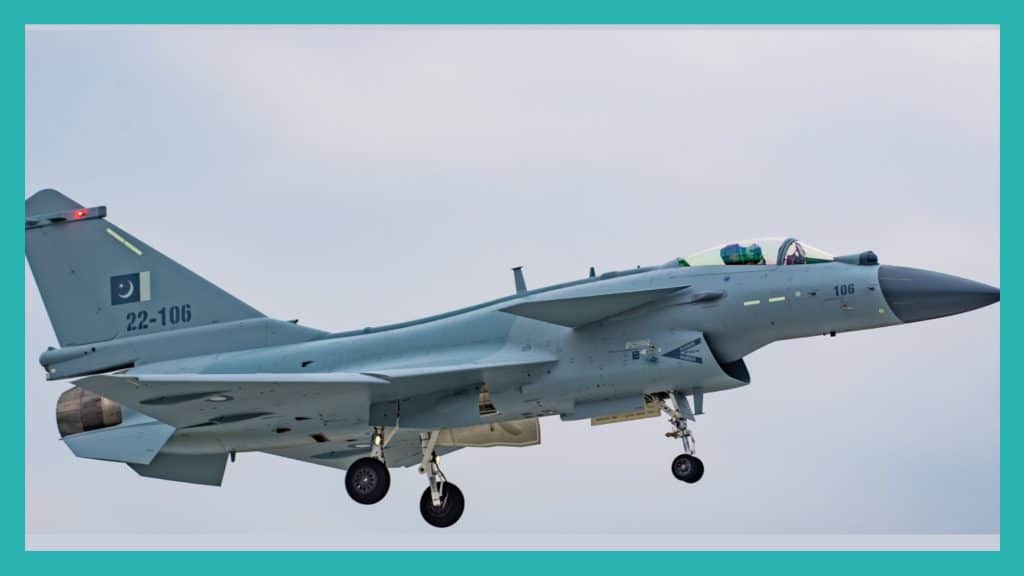
On 11 March 2022, the Pakistan Air Force (PAF) officially inducted the J-10CE “Dragon” ‘omni-role’ fighter. The initial batch comprised of six aircraft and joined the PAF’s No. 15 Squadron. The PAF held the induction ceremony of the fighter aircraft at Minhas Air Base in Kamra.
The PAF revealed that it signed the contract for the J-10CE – alongside training, ground support equipment (GSE), and munitions – with the Aviation Industry Corporation of China (AVIC) in June 2021.
Furthermore, the PAF added that the entire process from finalizing the deal to training to delivery took only eight months. This was a notable feat considering most modern fighter acquisitions take at least two years to materialize.
From the induction ceremony footage, one can confirm several key details about the PAF’s J-10CEs. First, the fighters are capable of deploying the PL-15E long-range air-to-air missile (LRAAM). Second, the J-10CEs can deploy the PL-15E using dual-ejector racks. The fighters are also configured with infrared search and track (IRST), the PL-10E high-off-boresight air-to-air missile (HOBS AAM), and in-flight refueling.
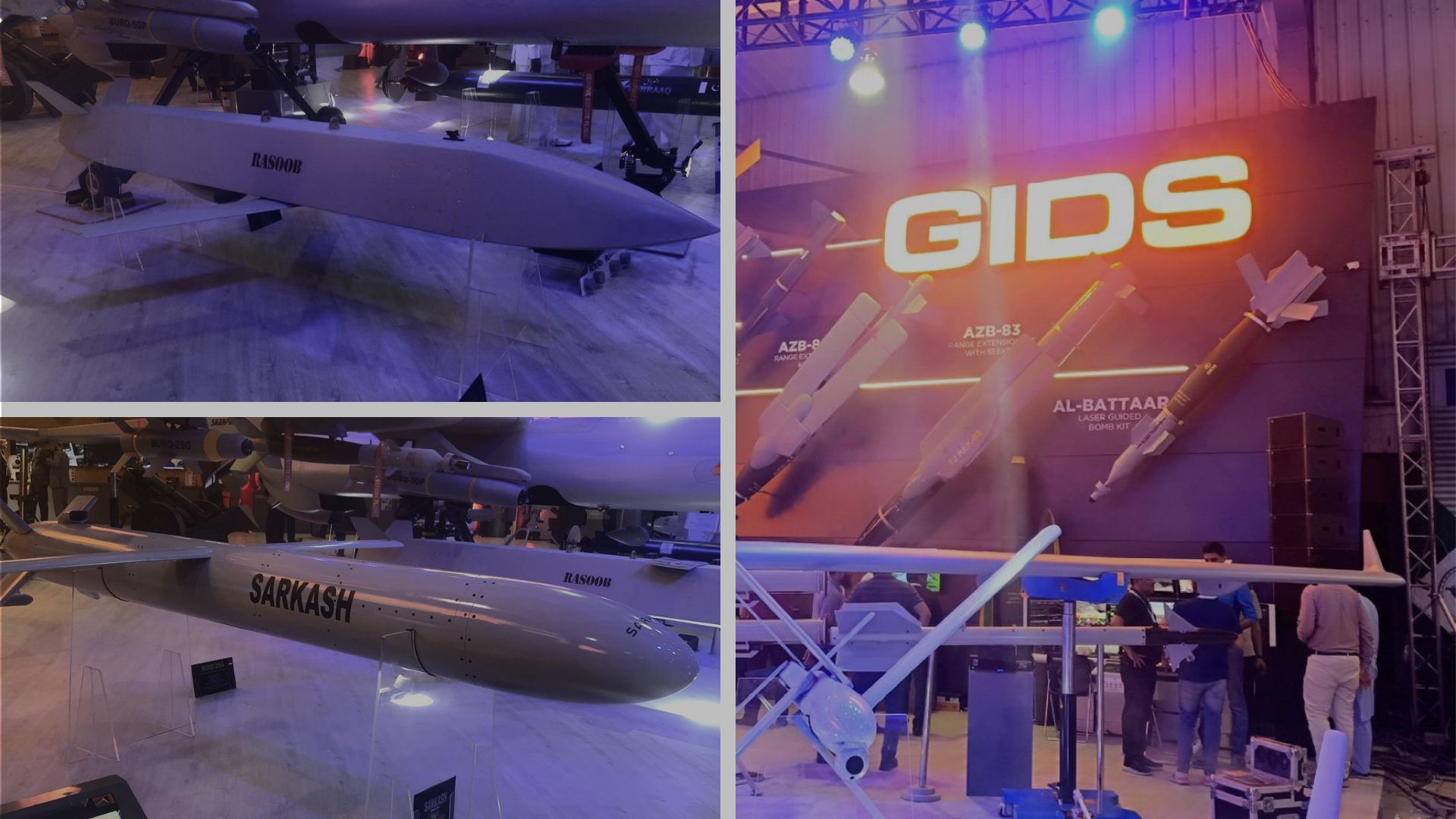
In his speech, the Chief of Air Staff (CAS), Air Chief Marshal (ACM) Zaheer Ahmad Babar, outlined the PAF’s J-10CE configuration. The fighters are equipped with active electronically scanned array (AESA) radars, an integrated electronic warfare (EW) suite, and network-centric warfare and sensor-fusion capabilities. The CAS also stated that the J-10CE was capable of deploying stand-off range weapons (SOW).
The PAF also highlighted several aspects of the J-10CE acquisition.
First, expediency was a key requirement of the order. The PAF had emphasized the need to receive these aircraft as early as possible, hence it lauded the eight-month timeframe. The PAF’s focus on expediency is also interesting in that it suggests the PAF wanted these aircraft as early as possible. It is unclear if this is in response to an impending threat from India, or the need to ‘catch up’ with an older requirement. In fact, the PAF wanted an off-the-shelf fighter for some time, but the lack of funding had shelved original plans.
Second, the PAF wanted to maintain a “first-shot” capability via new, longer-ranged LRAAMs. The PAF said that it inducted the PL-15. It is unclear if this is the export-grade PL-15E or the domestic variant of the PL-15 in use by the People’s Liberation Army Air Force (PLAAF). The conservative view is that the PAF is using the PL-15E, which offers a range of over 145 km. In any case, the J-10CE’s air-to-air missile range must be long enough for the PAF to consider it a “first-shot” capability.
Third, the PAF wanted the J-10CEs to enhance its ability to deploy a network-enabled warfare capability. This statement may suggest that the J-10CEs have a robust-enough bandwidth/data-transfer capacity for secure voice communications, video feeds, and radar/situational awareness sharing.
Fourth, the PAF termed the J-10CE as an “omni-role” fighter; this point indicate that the J-10CE is capable of undertaking both air-to-air and air-to-surface missions from within a single sortie.
Don't Stop Here. Unlock the Rest of this Analysis Immediately
To read the rest of this deep dive -- including the honest assessments and comparative analyses that Quwa Plus members rely on -- you need access.