
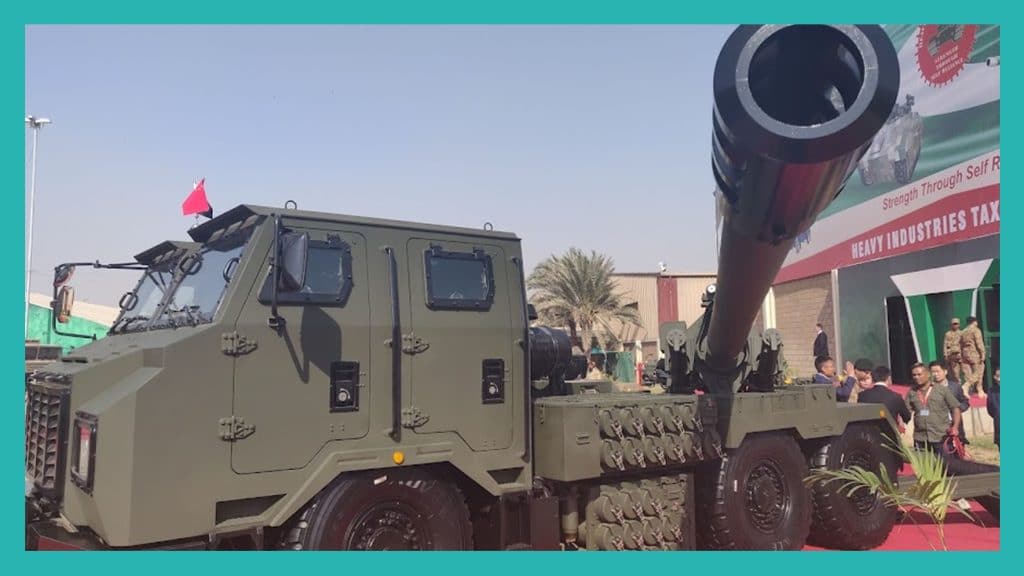
On 13 January 2022, the Pakistan Army (PA) started taking delivery of SH-15 self-propelled howitzers (SPH) from China’s Norinco Group. Publicly accessible export-import records show that Pakistan got 76 packages comprising of both vehicles and transfer-of-technology (ToT) equipment for its ammunition.
The SH-15 is a 155 mm/52-caliber SPH capable of firing extended range and guided artillery shells. These include HE ERFB-BB-RA (High-Explosive Extended-Range Full Bore Base-Bleed Rocket-Assisted)/VLAP (very long-range artillery projectile) rounds. VLAP rounds can offer a range of around 50 km. In terms of guided shells, the SH-15 can fire laser-homing, satellite-guided, and top-attack projectiles.
Not only does the SH-15 extend the range of Pakistan’s artillery coverages, but it also offers a vehicle with which the PA can undertake targeted strikes at a high volume. Guided shells are much more cost-effective than guided rockets (such as the 140 km-range Fatah-1), for example. Moreover, the SH-15 sets the stage for the PA to look at more advanced artillery shells, such as ramjet-powered projectiles.
However, the SH-15 is just one piece of the Army’s efforts to build its precision, stand-off range capability. Rather, Pakistan is building a family of assets through guided shells, guided rockets, and drones to build a varied and versatile strike capability from land.
SH-15: A Refocus on Artillery
The induction of the SH-15 marks the start of Pakistan’s refocus on modernizing artillery. The SH-15 itself is the Army’s first 155 mm/52-caliber gun, but, as noted above, it also supports an array of new capabilities such as VLAP shells and guided projectiles. In 2017, officials Ministry of Defence Production (MoDP) were quoted saying that the Army could acquire 500 wheeled SPHs. The fact that Pakistan will manufacture the VLAP shells under license indicates that a large 155 mm/52-caliber howitzer requirement is abound.
Operationally, Pakistan can leverage the SH-15’s mobility to rapidly deploy the asset. The SH-15’s chassis reportedly offers an effective level of off-road performance, which would enable the Army to employ the SPH in a diverse range of environments. However, for particularly demanding terrain, the Army could lean on its M109A2, M109A5 and M109L tracked SPHs. But it is unclear if Pakistan will upgrade its M109-series to handle 155 mm/52-caliber rounds. Though upgrading would be costly, it would enable Pakistan to use the M109s to deploy the longer-ranged and guided shells. Leonardo, which is among Pakistan’s key arms suppliers, offers an upgrade path for the M109-series that would unlock that capability.
It will be interesting to see if Pakistan standardizes across 155 mm/52-caliber. Heavy Industries Taxila (HIT) is developing its own in-house howitzer gun. The success of this project could allow the Pakistan Army to achieve several significant goals. First, it could potentially expand its guided, long-range shell capability to a service-wide level. In other words, units in all of the Army’s operational theatres will have the new attack capabilities. Second, Pakistan could potentially develop its own SPH using HIT’s gun. This would allow it to greatly expand its mobile artillery capability, but more cost-effectively than strictly importing.
The benefit of a wide-scale 155 mm/52-caliber adoption is that it would enable the Army to deploy long-range guided shells across all operational theatres. In turn, it can carry out precision-guided strikes at high-volume, which is the game-changing capability the Army is seeking.
In status-quo engagements (e.g., border skirmishes), the guided artillery element makes Pakistan a more dangerous conventional threat. With VLAP and other shells at its disposal, the Army could pivot its border-skirmish-tier strikes to specific outcomes. In turn, the specific outcomes could call for deprecating enemy capabilities without even escalating into a Swift Retort-type conflict. Alternatively, the Army could use its artillery to carry out deprecation measures aimed at strengthening or supporting bigger response vehicles (e.g., air strikes, guided rocket strikes, cruise missile strikes, etc).
Fatah-1: Guided Rocket Expansion
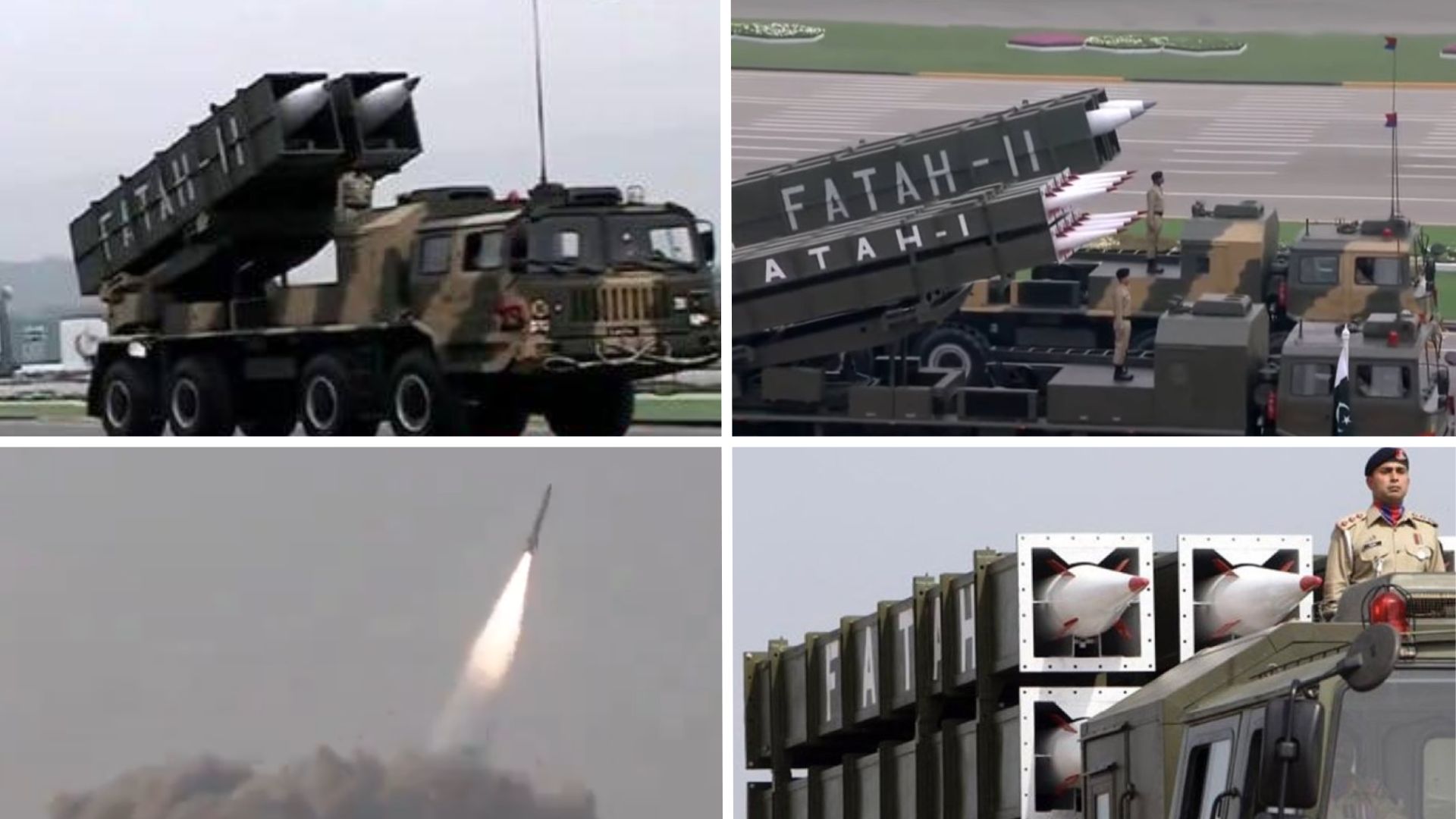
The Fatah-1 is an indigenously developed multiple launch rocket system (MLRS). It has an official range of 140 km. Based on available imagery, the Fatah-1 seems to be a large missile, potentially similar in size (or potentially larger) than the A-100. Pakistan also operates the A-100 MLRS.
Don't Stop Here. Unlock the Rest of this Analysis Immediately
To read the rest of this deep dive -- including the honest assessments and comparative analyses that Quwa Plus members rely on -- you need access.