
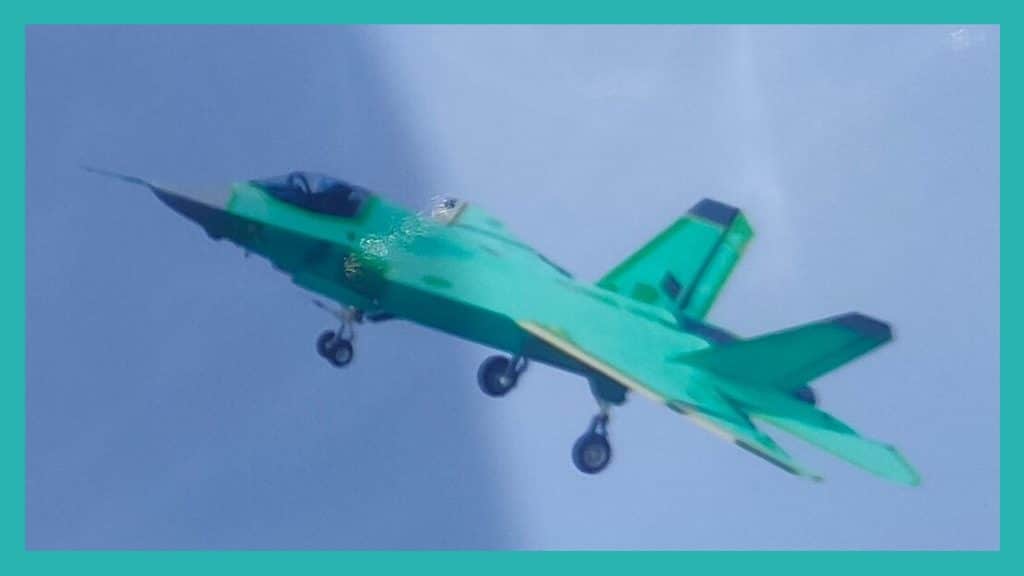
Last week, photos emerged of two new fighters from China’s burgeoning aerospace industry: the twin-seat variant of the Chengdu J-20, and, potentially, the carrier-borne J-XY (or J-35).
If the images are conclusive, they would signify two significant advances for China. First, the approaching availability of a twin-seat, stealthy combat aircraft. Second, a homegrown carrier-borne multirole fighter tailored for the specific needs of the People’s Army Liberation Navy (PLAN).
Twin-Seat J-20
The Chengdu J-20 was the first of China’s next-generation fighter aircraft (NGFA) out of the gate. The J-20 technology demonstrator flew in 2012. China officially debuted the J-20 at the 2016 Zhuhai Air Show. By 2018, reports had emerged of operational People’s Liberation Army Air Force (PLAAF) units receiving J-20 aircraft. Based on information from Chinese defence observers, it seems that the J-20 is not yet a mainstay asset like the J-10, J-11 or J-16-series of fighters, but it is percolating into a growing number of units.
The growing adoption of the J-20 could be driving the development of a twin-engine variant. Interestingly, one does need a twin-seater for training. To-date, NGFA users around the world (entirely F-35 users) have been content with simulators. With this variant of the J-20, China will be the first with a twin-seat NGFA.
However, it would be unwise to assume that training could be the sole role of the twin-seat J-20. Rather, the PLAAF could be looking at a wider array of mission scenarios. In fact, the PLAAF uses twin-seat variants of its Flanker-series – i.e., J-11BS and J-16 – for strike and electronic attack (EA) missions. It is possible that the twin-seat J-20 could potentially take on similar roles in the future.
It is worth noting that the J-20 seems to be in a size and weight class as the Flanker-series. It uses the WS-10-series turbofan engines, for example. The J-20’s range and payload are not known. However, even if the J-20’s payload and/or range are lower than that of the Flanker-series, it could still be one of the larger stealthy aircraft flying in the world. Though it would start with a focus on air-to-air, the J-20 could evolve into a strike and special mission (e.g., EA) aircraft in the coming years.
Alternatively, the twin-seat J-20 could open the door to new air combat concepts. Like the United States, China is heavily focusing on incorporating drones, sensor-fusion, and automation into its air missions. The twin-seater could facilitate the design and application of those concepts into more tangible outcomes. It could support testing and development, or potentially, support actual frontline operations.
Interestingly, China is treading on the path of being among the first to deploy such systems. It would be a country that is shaping what the future could look like and, in turn, defining the best practices. Ironically, it might put the rest of the world in the less familiar situation of potentially emulating the Chinese.
J-XY/J-35
Recently, a photo of an apparent FC-31 variant emerged online. Chinese defence observers suggest that the variant in question is the J-XY/J-35, the forthcoming carrier-borne fighter for the PLAN. The FC-31 is a demonstrator for a twin-engine, medium-weight multi-role fighter with stealthy design elements, such as an internal weapons bay and low radar cross-section (RCS) attributes, among others.
The Aviation Industry Corporation of China (AVIC) had pitched the FC-31 as a stealthy multirole fighter for the export market. However, the FC-31 did not catch a co-development/funding partner as intended. But AVIC’s Shenyang Aircraft Corporation (SAC) continued developing the platform on its own budget.
Don't Stop Here. Unlock the Rest of this Analysis Immediately
To read the rest of this deep dive -- including the honest assessments and comparative analyses that Quwa Plus members rely on -- you need access.