
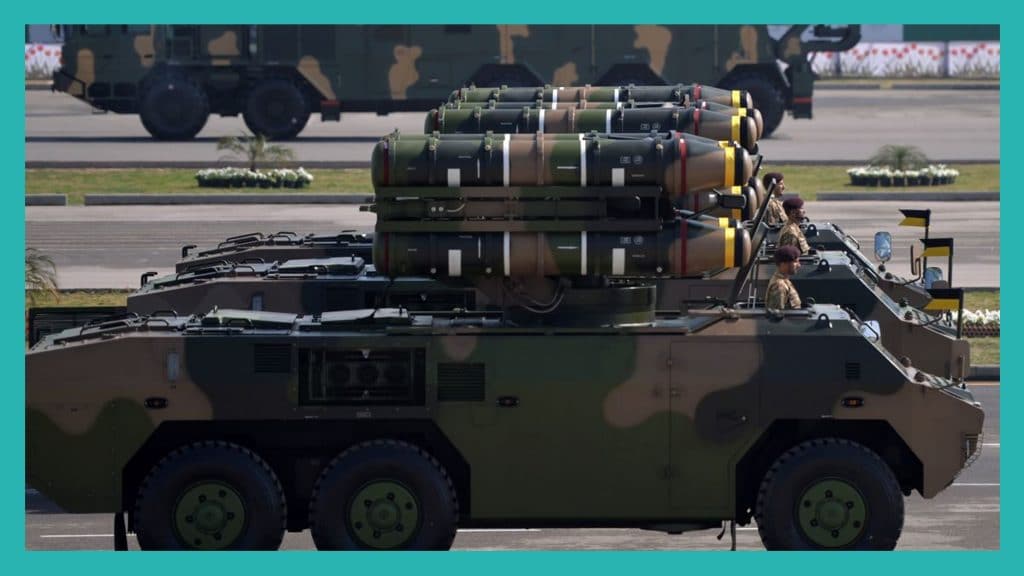
Last week, the Pakistan Army declared that it added the HQ-9/P long-range surface-to-air missile (SAM) system to its integrated air defence system. With a stated range of at least 100 km, the HQ-9/P closes the Army’s extensive air defence modernization efforts over the past five-plus years. Today, the Army deploys a multi-layered air defence network consisting of short-range, medium-range, and long-range SAMs plus its traditional staple of anti-air guns and man-portable air-defence systems (MANPAD).
Overall, the Army is employing its air defence system for protecting key installations and other high-value targets (HVT). The HQ-9/P creates a threat for targets flying at high-altitudes at long-range. However, even if these opposing aircraft fly under the HQ-9/P’s coverages, they would have to contend with the medium-range LY-80 and short-range FM-90 at those lower altitudes. Thus, the set-up is comprehensive, albeit in terms of defending fixed assets; but that only covers one part of the anti-air warfare (AAW) requirement.
The Pakistan Army still has one key area of its anti-air umbrella it needs to full – the acquisition of a mobile short-range air defence system (SHORAD).
The military dynamics of South Asia are advancing and, at least in India, they have reached a point where air power is an integral piece of land-based operations. The Indian Army’s ‘integrated battle group’ (IBG) concept, for example, incorporates utility and attack helicopters for close air support (CAS). These aircraft will carry a credible threat to Pakistani armour through anti-tank guided missiles (ATGM). In addition, the Indian Air Force (IAF) will deploy an area-wide anti-armour capability through the CBU-105 Sensor-Fuzed Weapon munition. Each CBU-105 carries 40 dual-infrared and laser-guided top-attack munitions (Skeets) that can independently target tanks, infantry fighting vehicles (IFV) and other armoured vehicles.
Combined, these airborne threats present a significant problem for the Pakistan Army’s formations both from a defensive and offensive standpoint. Ideally, the Pakistan Army and Pakistan Air Force (PAF) would collaborate to build a joint-air-and-land solution that could both counter and emulate India’s model.
For example, the Army and PAF could use JF-17s with air-to-ground missiles (AGM), anti-radiation missiles (ARM), and a stand-off range bomblet dispenser for area-wide anti-armour attacks. This way, Pakistan can have its own airborne, anti-armour capability to match the IAF Jaguar. In fact, JF-17s equipped for air-to-air can also help thwart the IAF Jaguar threat and threaten India’s attack helicopters.
It is unclear where Pakistan is at in terms of integrating its assets across service arms. However, if there is anything to take from the Army’s air defence investment, it seems the Army is taking primary ownership of handling airborne threats posed against its assets. Thus, the Army will focus on acquiring AAW systems that will protect its land-based formations through the acquisition of a mobile SHORAD system.
The earliest record of the Pakistan Army seeking a mobile SHORAD was in 2016. During the International Defence Exhibition and Seminar (IDEAS) in 2016, MBDA Italy promoted a variant of the Spada 2000-Plus, i.e., the SAM it sold to the PAF years earlier, to the Army. This variant of the Spada 2000-Plus was mounted to a truck, thus speaking to a mobile SHORAD requirement.
However, around this time, it seemed that the Pakistan Army was more focused on acquiring the Russian Pantsir-series. In fact, Pakistan’s then Minister of Defence Production (MoD), Khurram Dastgir Khan, had told Russian News Agency TASS that Pakistan was negotiating for an air defence system. Sources familiar with Pakistan’s defence procurement plans at the time confirmed to Quwa that the Army was in talks for the Pantsir. Local observers later claimed that a deal had been signed and that delivery was underway.
Evidently, the Pantsir did not materialize. However, the mobile SHORAD program was and remains a key requirement of the Army. The Army’s focus will move to alternatives, likely from China as the entirety of its air defence set-up comprises of Chinese products (i.e., FM-90, LY-80, and HQ-9/P).
Don't Stop Here. Unlock the Rest of this Analysis Immediately
To read the rest of this deep dive -- including the honest assessments and comparative analyses that Quwa Plus members rely on -- you need access.