
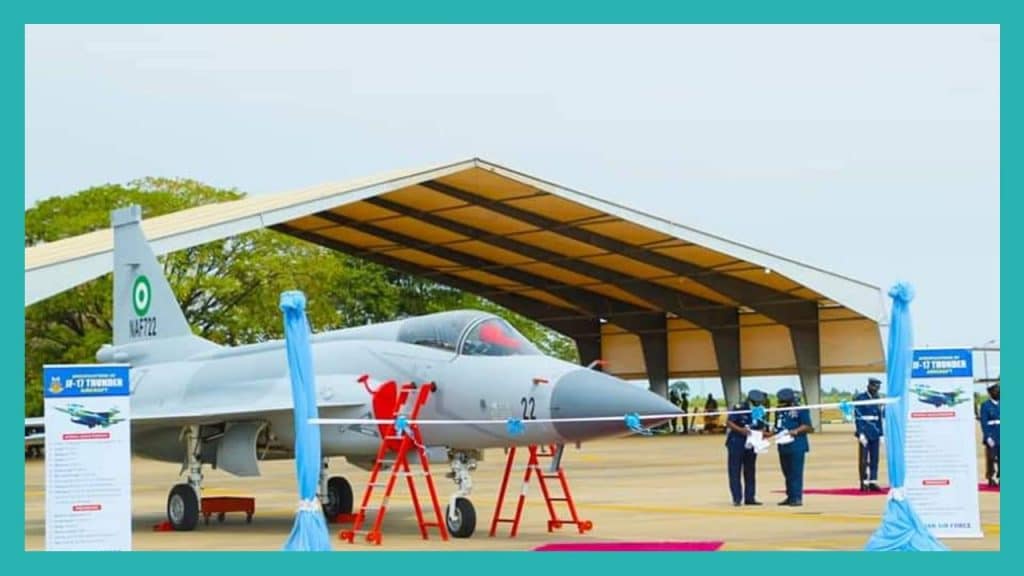
On 21 May 2021, the Nigerian Air Force (NAF) received three JF-17 Thunder combat aircraft from Pakistan Aeronautical Complex (PAC). The NAF celebrated the induction as part of its 57th anniversary.
Nigeria announced that it would acquire the JF-17 in 2016. Since 2016, the Nigerian government has been allocating payments for the fighter purchase as part of its annual budgets.
It appears that the price of the current JF-17 order is $184.3 million US.[1] In 2018, PAC told the Pakistani cabinet’s Economic Coordination Committee (ECC) that the Nigerian does not involve loans or financing.
Since Nigeria is paying for the aircraft in cash, it seems that it is ordering the JF-17s incrementally based on available funding. Thus, it is likely that Nigeria will follow up its order with additional batches, possibly of the JF-17 Block-III and JF-17B dual-seat variants.
Interestingly, NAF pilots mentioned the use-cases of the Aselsan ASELPOD advanced targeting pod. Based on this information, it seems that the NAF’s JF-17s are configured along identical lines as the Pakistan Air Force’s (PAF) JF-17s and, potentially, may benefit from the same update track in the coming years.
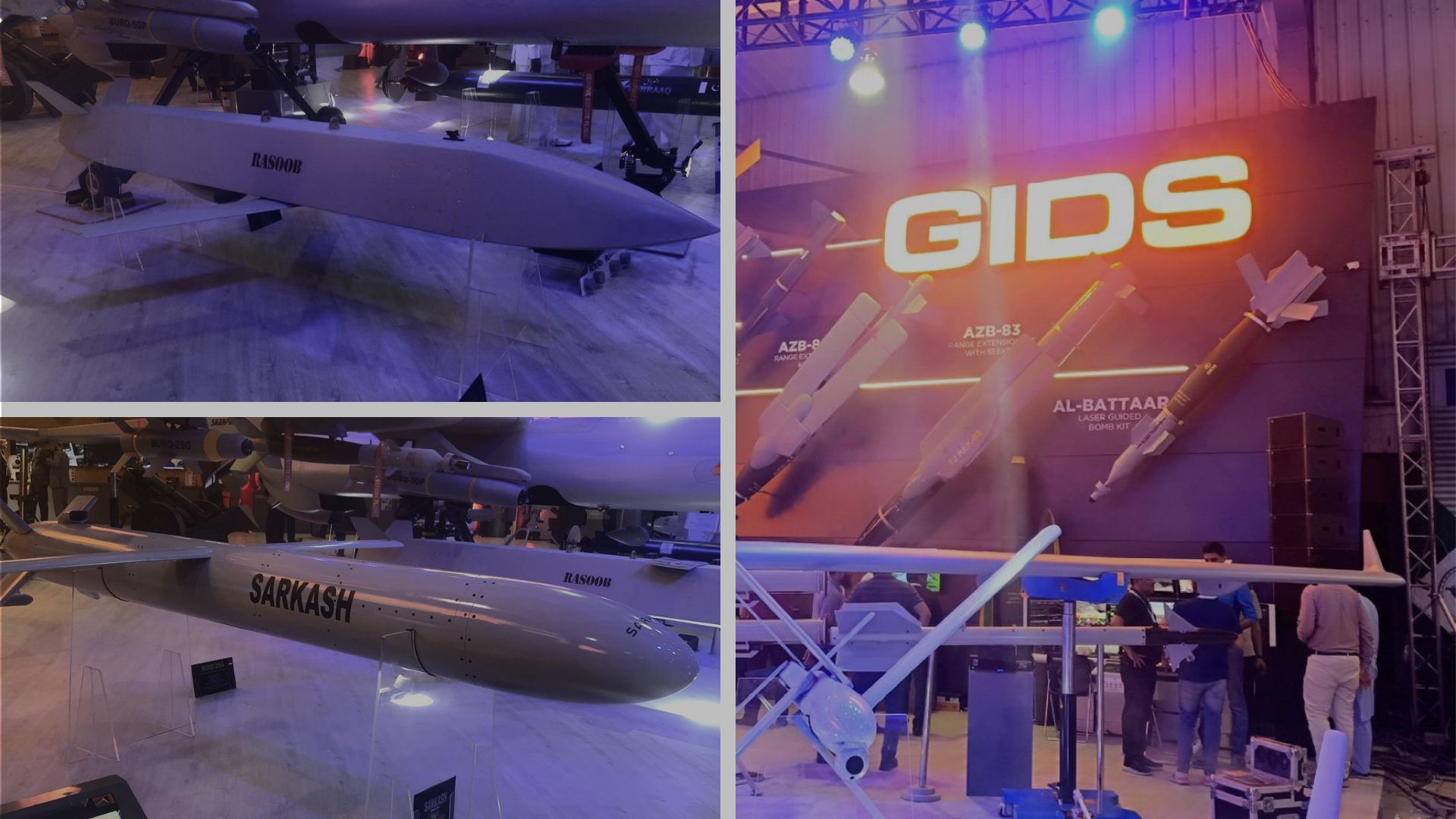
In this case, one can expect that the NAF’s JF-17s are also capable of using the SD-10 beyond-visual-range air-to-air missile (BVRAAM), PL-5E within-visual-range air-to-air missile (WVRAAM), C-802 anti-ship cruise missile (ASCM), the CM-400AKG air-launched rocket, and the Indigenous Range Extension Kit (IREK) stand-off-range precision-guided bomb (PGB) kit. PAC could be supplying the IREK to the NAF directly.
Overall, the JF-17 employs a compact inventory of munition types, but they check all of the main boxes in terms of capabilities. For example, the above offer long and short-range air-to-air capabilities, long-range anti-ship and surface attack coverage, and both satellite-aided and laser-guided bomb compatibility.
The ASELPOD also shows the importance of third-party weapons integration for potential export users. If, for example, Azerbaijan orders the JF-17, it may want to integrate the Roketsan SOM air-launched cruise missile (ALCM) to the platform. Moreover, PAC may bill Azerbaijan for the integration work, but may later make the SOM ALCM compatibility available to PAF and NAF JF-17s.
Finally, it seems that the PAF could upgrade the JF-17 Block-II and possibly Block-I with some of the Block-III’s subsystems, namely the KLJ-7A active electronically scanned array (AESA) radar. PAC is setting up an assembly line for the KLJ-7A, which suggests that the PAF could acquire the radar in sizable numbers for its older fighters. If the upgrade track for the PAF and NAF is similar, then the NAF could also receive the AESA radar and, possibly, other additions, such as helmet-mounted display and sight (HMD/S).
Based on these elements, the NAF may have received one of the most capable weapon packages available in Sub-Saharan Africa. Granted, the JF-17 may have some legacy design attributes (e.g., aerodynamically stable design), but the sum of capabilities (e.g., BVRAAM, ASCM, PGB, etc) is contemporary, and will see additional advancement on top of the Block-III program.
Don't Stop Here. Unlock the Rest of this Analysis Immediately
To read the rest of this deep dive -- including the honest assessments and comparative analyses that Quwa Plus members rely on -- you need access.