
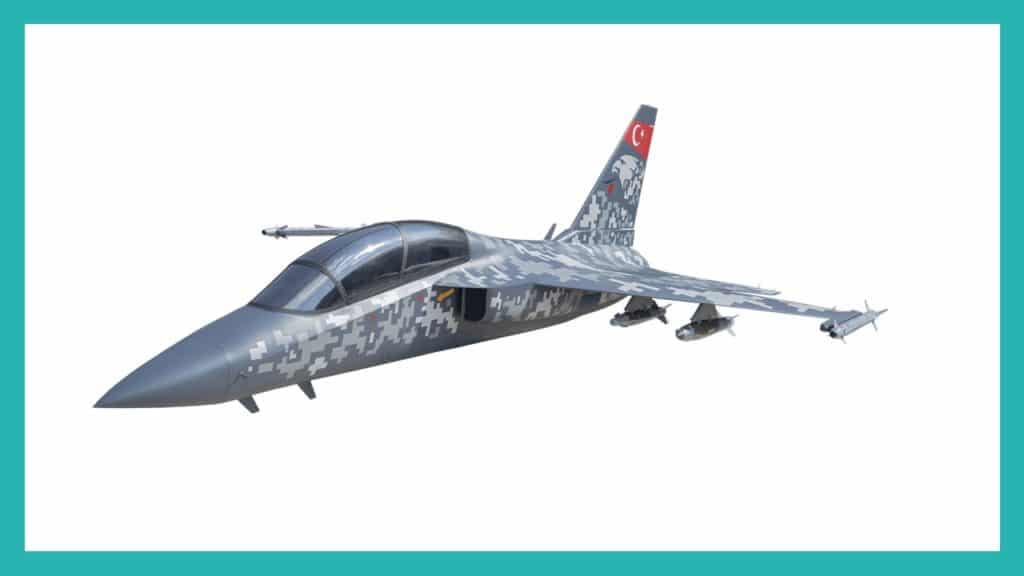
On 22 July 2017, the Turkish Presidency of Defense Industries (SSB) announced that the Turkish Air Force (TuAF) and Turkish Aerospace signed onto the development of the Hürjet, a next-generation trainer that TAI had been designing with internal resources as a potential replacement for the TuAF’s T-38 Talons.[1]
On 23 July 2019, i.e., two years after formally initiating the project, Turkish Aerospace announced that it finalized the ‘Preliminary Design Review’ (PDR) of the Hürjet. Turkish Aerospace intends to conclude the “critical design phase” of the Hürjet by the summer of 2020 and, in turn, complete the prototype by the end of 2021. Turkish Aerospace is expecting to conduct the Hürjet’s maiden test flight in 2022.
In its current design form, the Hürjet is a single-engine aircraft with the following specifications:
- Wingspan: 9.8 m / 32.1 ft
- Length: 13 m / 42.6 ft
- Height: 4.2 m / 13.7 ft
- Wing Area: 24m2 / 258.3 ft2
- Engine Thrust: 19,200 lbf / 8,709 kgf (85 kN)
Based on these specifications, the Hürjet is similar to the Korea Aerospace Industries (KAI) T-50 and the in-development Saab/Boeing T-7A Red Hawk. With the Hürjet, Turkish Aerospace is aiming for comparable performance and capabilities as these two training platforms:
- Service Ceiling: 45,000 ft
- Maximum Speed: Mach 1.4
- Range: 2,592 km
- Rate of Climb: 35,000 ft-per-minute
It is unclear if Turkish Aerospace finalized the engine selection, but in June 2019, the company had signed a letter-of-intent with Eurojet. Thus, it appears that the Eurojet EJ200 is a leading candidate.[2] However, it appears that the company had originally planned to use the GE F404.[3]
The GE F404 would not have been as surprising given Turkey’s longstanding relationship with GE (which has engine manufacturing investments in the country). However, the chill in US-Turkish defence industrial ties following Turkey’s departure from the F-35 Lightning II might impact the situation.
Moreover, selecting the EJ200 over the F404 could possibly position the Hürjet as a non-ITAR (i.e., free of subsystem with US export controls) option. In fact, an EJ200-equipped Hürjet would be the sole ITAR-free trainer aircraft option of the direct class of the T-50 and T-7A.
Freedom from ITAR could be critical. In fact, the need to secure a third-party export permit for the CTS800-4A turboshaft engine had put a question mark on the sale of 30 T129 ATAK attack helicopters to Pakistan.
So, if Turkish Aerospace intends to promote the Hürjet, an engine that is not bound by ITAR would help it secure sales for the fighter, especially in ‘less conventional’ markets such as Sub-Saharan Africa, Central Asia, Eastern Europe, and certain countries, namely Azerbaijan, Ukraine and Pakistan.
This is particularly important if Turkish Aerospace positions the Hürjet as a lightweight multi-role combat aircraft. Turkey can already supply a potent munitions set – including precision-guided bombs, land-attack cruise missiles, anti-ship missiles, and in time, air-to-air missiles – and electronics.
Don't Stop Here. Unlock the Rest of this Analysis Immediately
To read the rest of this deep dive -- including the honest assessments and comparative analyses that Quwa Plus members rely on -- you need access.