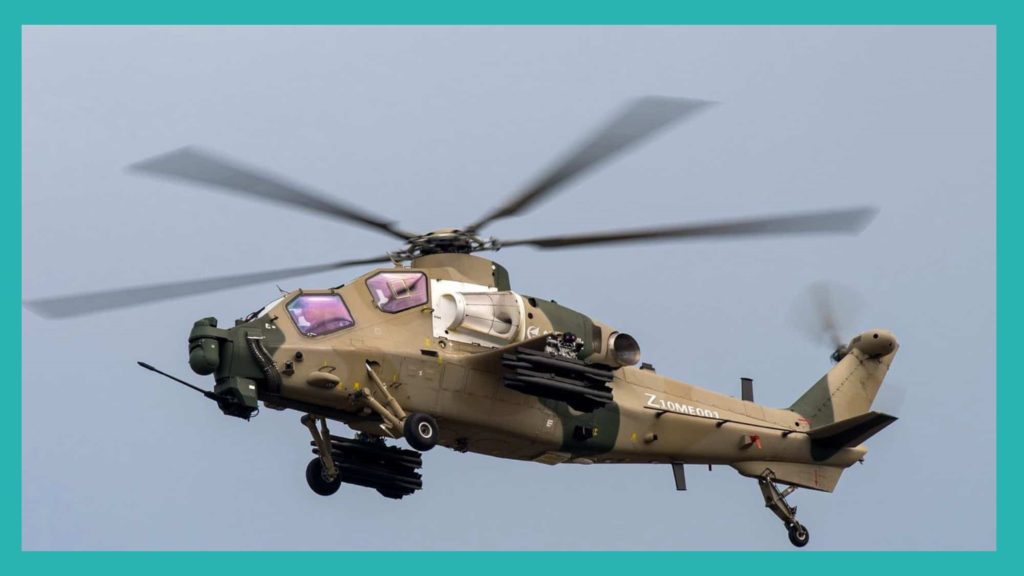
At Airshow China 2018, which took place in November in Zhuhai, Guangdong, AVIC (the Aviation Industry Corporation of China) officially unveiled the Z-10ME, an improved variant of Changhe Aircraft Industries Corporation’s (CAIC) Z-10 attack helicopter.
Incorporating a wide-array of improvements in its onboard electronics suite, weapons compatibility and to the airframe, AVIC is actively marketing the Z-10ME for export. Thus far, three Z-10s were extensively tested by the Pakistan Army Aviation Corps (PAA) in 2015 and 2016.
According to AVIC (via Shephard Media), the Z-10ME incorporates “sand filters for the engines, infrared suppressors, crash-resistant seats for pilots and bullet-resistant armour for the cockpit.”[1] In other words, increasing survivability and pilot/personnel-protection was a key impetus to improving the Z-10.
However, ‘iterative’ would understate the intended impact of these improvements. Besides adding to the Z-10’s defensive characteristics, the Z-10ME also brings new offensive capabilities as well.
These capabilities include compatibility with the CM-501XA miniature cruise missile, ET60 324 mm anti-submarine warfare (ASW) torpedo, and SW6 air-launched drone.[2] Like the Z-10ME, AVIC is marketing each of these munitions for export.[3] AVIC is also marketing HJ-10 and TL-4 anti-tank guided missiles (ATGM).[4]
In 2016, Quwa noted that the preceding Z-10 variant appeared underpowered for its apparent maximum take-off weight (MTOW) of 6,000 kg – it relied on the 956 kW WZ9 turboshaft engine.[5] Based on officially available information (via Shephard Media), it is unclear if AVIC/CAIC changed the engine.[6] However, some reports state that a 1,200 kW engine may have been installed, but this cannot be confirmed.[7]
There were no reports of the Z-10ME receiving a millimeter wave radar (mmW) either. If equipped with an mmW radar, the Z-10ME could independently target moving ground targets and, in turn, engage them with an active radar-guided air-to-ground missile (AGM), i.e., true fire-and-forget.
However, AVIC has access to both solutions — i.e., 1,200+ kW turboshaft engine and mmW radar – through programs such as the WZ16 and mmW radar suite for the Z-19-armed scout helicopter, respectively.
Thus, it would not be surprising if both solutions materialize in the coming years, but it is unclear if the Z-10ME will leverage them. On the other hand, the Z-10ME demonstrates AVIC’s willingness to upgrade the platform, and in relatively short-order. In fact, as its original Z-10s age, the People’s Liberation Army (PLA) itself might have incentive to see a significantly improved variant emerge.
The hypotheticals aside, one should not understate the value AVIC has brought to the platform via the Z-10ME. The defensibility aspect alone spans across three key areas: (1) desert operations, (2) defensibility against infrared-guided missiles and (3) pilot/personnel protection and survivability.
Don't Stop Here. Unlock the Rest of this Analysis Immediately
To read the rest of this deep dive -- including the honest assessments and comparative analyses that Quwa Plus members rely on -- you need access.