
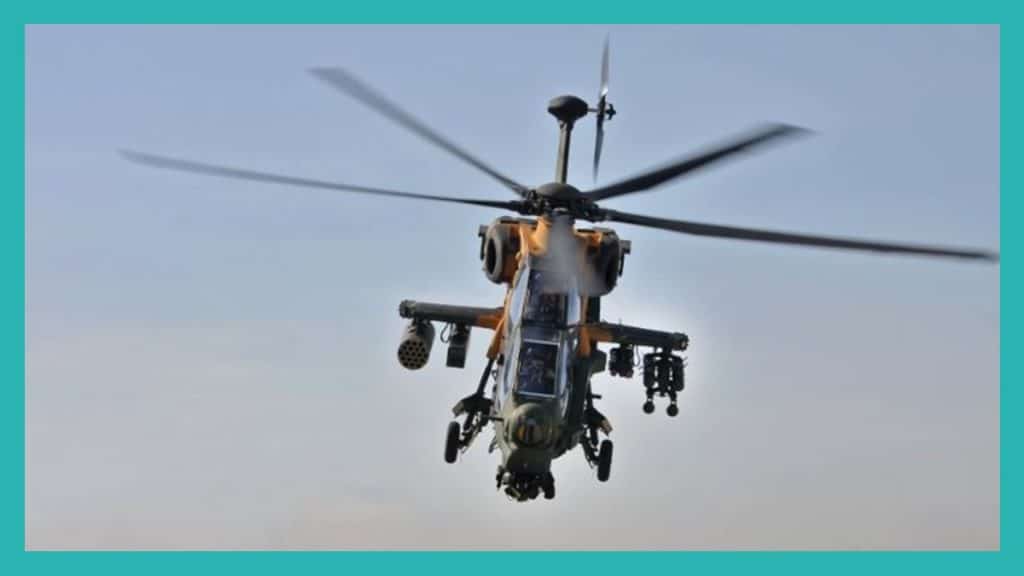
On 13 July, the Turkish Undersecretary of Defence Industries (SSM) Ismail Demir announced that Pakistan inked a contract for 30 T129 ATAK attack helicopters from Turkish Aerospace (TA), formerly known Turkish Aerospace Industries (TAI).[1] Following the SSM, TA also announced the deal, stating that it is “the largest export in the (sic) Turkish defence history.”[2] The signatures come following at least four years of on-and-off negotiations between Pakistan and Turkey on the ATAK.
Neither the SSM, TA or the Pakistan disclosed specifics regarding the ATAK contract, but Reuters reported that it was priced at $1.5 billion US and is scheduled for completion (i.e. delivery to Pakistan) in five years.[3] Turkey’s state-owned Anadolu Agency states that it is a “large contract package in terms of logistics, spare parts, training and ammunition.”[4] The latter indicates that Roketsan’s Mizrak (UMTAS)-series of anti-tank guided missiles (ATGM) and Cirit laser-guided rockets are being packaged into the program.
The signing concludes the Pakistan Army Aviation Corps’ (PAA) efforts to acquire a new attack helicopter to complement its forthcoming AH-1Z Viper helicopters from Bell Helicopter in the U.S. In 2015, the U.S. had approved the sale of 15 AH-1Z to Pakistan, of which Pakistan had signed onto 12. However, observers are uncertain if the helicopters will be delivered amid the current state of US-Pakistani defence ties.
Pakistan Army Aviation’s High-Altitude Capabilities
Of the Pakistan Army’s procurement efforts, the PAA has arguably succeeded in modernizing its high-altitude operations capabilities via the H125, AW139 and T129| Read More
The AH-1Z issue notwithstanding, the PAA had evidently intended to maintain a fleet of “heavy” (i.e. the 8-ton AH-1Z) and “light” (i.e. the 5-ton T129) attack helicopters, with the latter optimized for high-altitude operations and usage in hot-temperature environments. Moreover, the PAA also inducted four Mi-35M assault helicopters from Russia, providing it with a dual troop/supply-lift and air attack capability as well. But the T129 will certainly form the backbone of the dedicated attack helicopter fleet.
In terms of the “light” or mainstay attack helicopter requirement, the PAA had evaluated the T129 against the Z-10, developed and produced by Changhe Aircraft Industries Corporation (CAIC) in China.
It is unclear why the PAA did not proceed with the Z-10, especially when cost and financing are lesser obstacles in any big-ticket arms purchase from China. However, the PAA had repeatedly emphasized the need for credible high-altitude close air support (CAS) capability, such as in January when its commander, Major Gen. Nasir D. Shah outlined how its AH-1F/S “cannot be employed effectively in high-altitude operations above 8,000 ft.”[5] It is likely that the T129, which excelled in high-altitude flights during its tests in Pakistan in 2016, was chosen in significant part due to the PAA’s high-altitude requirements.[6]
When TAI was marketing the T129 to Pakistan, the company had repeatedly raised the prospect of parts manufacturing and even assembly at Pakistan Aeronautical Complex (PAC) as a possibility.[7] However, the SSM, TA or Pakistan’s Ministry of Defence Production (MoDP) have yet to comment on this issue, though to be fair, neither side has disclosed substantive details about the Pakistan ATAK contract aside from the basics. Nonetheless, co-production of the T129 and, more importantly, an opportunity for PAC to supply services to TA would be of interest to Pakistan from a foreign-currency savings standpoint.
Monthly Report: Review of Turkey’s Efforts to Sell the T129 ATAK to Pakistan
Don't Stop Here. Unlock the Rest of this Analysis Immediately
To read the rest of this deep dive -- including the honest assessments and comparative analyses that Quwa Plus members rely on -- you need access.