Pakistan’s Minister of Defence (MoD) Khurram Dastgir Khan was quoted by the Russian News Agency RIA Novosti that Pakistan had begun negotiating with Russia for various big-ticket armaments, including T-90 main battle tanks (MBT), Su-35 fighters and unspecified air defence systems. Speaking to RIA, Khan stated: “The air defense system is another kind of weaponry in which we are interested in … we are negotiating, and when we complete it, we will be able to announce it.”[1]
The aspect about Pakistan being interested in Russian air defence systems is not new, RIA had learned as much in February 2017 from an unnamed high-level Pakistani military official.[2] Though the official had noted the Almaz-Antey S-400 Triumf long-range surface-to-air missile (SAM) system, it was mentioned as an interesting Russian system more so than something Pakistan would procure. In fact, the official had cautioned that procurement would ultimately “depend on [Pakistan’s] budget”.[3]
SHORAD & VSHORAD
Though Pakistan has an obvious gap in terms of high-altitude air defence coverage, it is likely that Pakistan is interested in a wider selection of Russian SAM systems, particularly mobile short-to-medium-range and very short-range air defence (VSHORAD) systems.
Pakistan has largely built its short-to-medium-range SAM complement, which is officially dubbed as the Low-to-Medium Air Defence System (LoMADS). The Pakistan Air Force (PAF) began its LoMADS process by procuring 10 Spada 2000 Plus batteries with 750 Aspide 2000 missiles in 2007 (in a €415 million deal with MBDA Italy).[4] These have been inducted. The Pakistan Army opted for the LY-80 (HQ-16) manufactured by the China Precision Machinery Import-Export Corporation (CPMIEC) in 2015. Pakistan ordered nine HQ-16 batteries for $600 million, with the system formally entering service in March 2017.[5][6]
The Spada 2000 and HQ-16 offer engagement ranges of 25+ km and 40 km, respectively. One can assume that the LoMADS element has been addressed for the long-term through these two systems. During these programs, there have been reports of Pakistan seeking other SAM systems. In 2016, there had been reports of the Pakistan Army having a mobile SAM requirement, for which MBDA was reportedly pushing a mobile (i.e. truck-mounted) variant of the Spada 2000.[7] Moreover, the Pakistan Navy had even showed interest in the Denel Dynamics Umkhonto (range: 20 km) in 2016.[8]
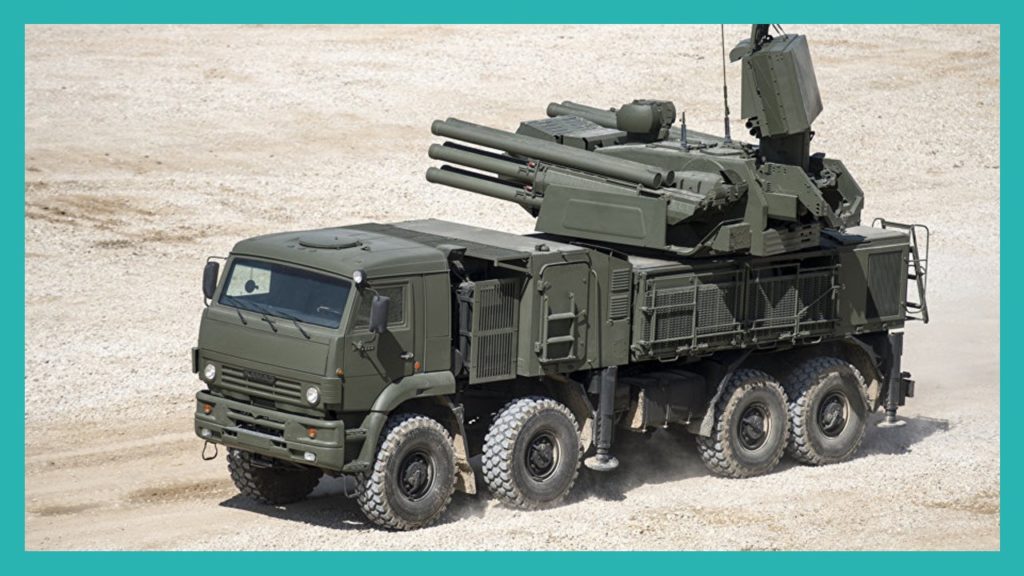
The common-treads between the mobile Spada 2000 and Umkhonto are comparable range (20-25+ km) and mobility, which can be had by integrating the missile firing-unit to an 8×8 truck. But these reports are from 2016, so it is uncertain if they are still in motion, but Russia certainly has experience in developing a series of mobile short-range air defence systems (SHORAD). The Pantsir S1 is the most notable example in that it has a range that is directly comparable to the Spada 2000 and Umkhonto (i.e. 20 km) while also being mobile, particularly through an 8×8 truck (like the others) and a tracked armoured vehicle.
For the Pakistan Army, a Pantsir S1-like system could accompany its armoured/mechanized formations, thus providing a valuable low-level coverage net to defend against attack helicopters. In fact, the Pakistan Army had even expressed interest in the Aselsan Korkut self-propelled anti-air gun (SPAAG), backing the notion that an effort is in play to bolster low-level air defence coverages with forward-deployed units.[9] It is plausible that Russia’s mobile SHORAD and VSHORAD are of interest to the Army, it can look to package multiple requirements – i.e. SAM, SPAAG and VSHORAD missiles – to draw Russian interest.
Though not as marquee as a long-range SAM system, such as the S-400, the option to pursue these Russian SAMs would be of interest to Pakistan. First, at some point in recent years an active requirement was as late as 2016 for such systems (at least enough to generate interest from the industry). Second, it could be a comparatively low-cost program, i.e. Pakistan could potentially sustain through cash payments. In fact, the cost to service and maintain these systems will likely be less than supporting the Su-35 or S-400, thus adding to its feasibility of reaching Pakistan.
With the MoD citing the T-90 MBT – especially within the context of the ongoing trials involving the VT4 and Oplot MBTs – the procurement of mobile SHORAD and VSHORAD would signal a clear move to boost the Army’s mechanized element. In fact, the Pakistan Air Force (PAF) had established Bholari – i.e. its new air base in Sindh – to station nearby close air support (CAS) assets for the Army. Given Bholari’s proximity to the combat area, the JF-17 – while short-legged – is an appropriate platform CAS in this area: a single centreline fuel tank would leave four under-wing stations for air-to-surface ordnance, which can general purpose bombs, a bomblet dispenser and – in case of high-altitude air coverage – air-to-air missiles (AAM).
Thus, a SHORAD and VSHOARD purchase should not be underestimated, it could serve an important role in shoring-up the Army’s capacity to execute an effective armoured-thrust (or interdict one), especially if it involves thwarting aerial threats integrated in the opposing force. However, it would be interesting to see to what extend Russia wishes to be complicit in building such capacity, especially if the Army seeks T-90 MBTs to basically form the offensive element of that force. In fact, the T-90 would be surprising due to its offensive intent but the fact that the Army might be predisposed to its existing MBT suppliers and al-Khalid MBT partners Ukraine and China. Ultimately, these specific air defence systems might be the goal.
Don't Stop Here. Unlock the Rest of this Analysis Immediately
To read the rest of this deep dive -- including the honest assessments and comparative analyses that Quwa Plus members rely on -- you need access.