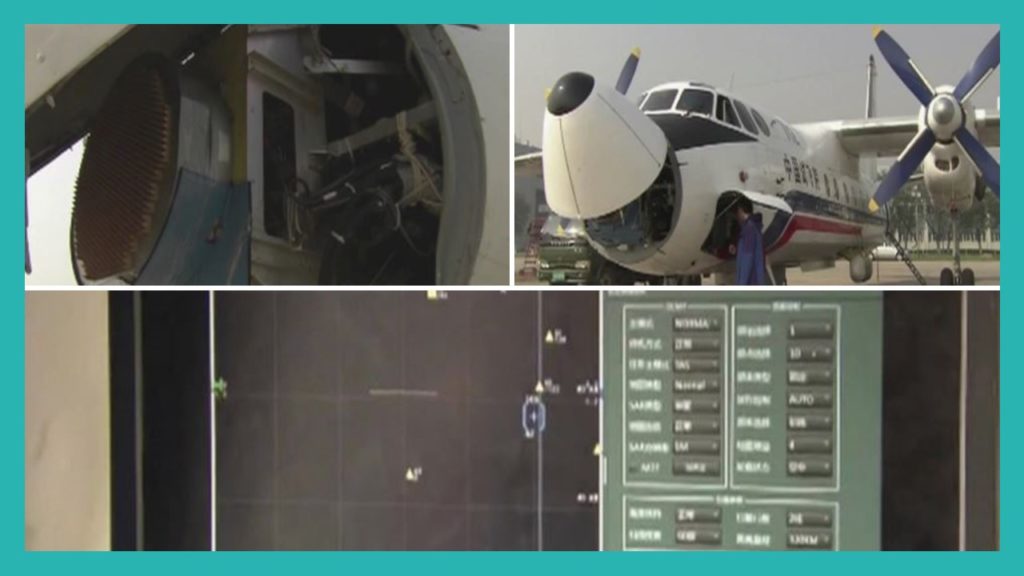
Hu Mingchun, the head of the Nanjing Research Institute of Electronics Technology (NRIET), told the China Daily that NRIET’s new active electronically-scanned array (AESA) radar, the KLJ-7A, will be integrated onto to the JF-17 Thunder multi-role fighter.[1] This would imply that the Pakistan Air Force (PAF) selected NRIET to supply the AESA radar for the forthcoming JF-17 Block-III – the previous PAF Chief of Air Staff (CAS) had stated that the Block-III’s design was finalized, which means the subsystem selection has been frozen.
Overall, the PAF selecting the KLJ-7A would not be surprising. First, the KLJ-7A had the fewest obstacles in the way of delivering the Block-III into an operational factor. Second, this could involve a long-term play for securing sensitive Chinese technology for Project Azm, the PAF’s next-generation fighter program.
The KLJ-7A’s Value to the JF-17 Block-III
In general, an AESA radar’s improvements stem from its use of multiple transmit/receive modules (TRM). In contrast to mechanically-steered radars, which can transmit in one frequency per pulse, an AESA radar can leverage multiple TRMs to transmit in multiple different frequencies simultaneously. This shields the AESA radar from electronic warfare (EW) jamming in that if one of its frequencies are jammed, the radar can still undertake its detection, tracking and targeting functions.
However, because these TRMs are fixed, an AESA radar generally has a relatively limited field-of-view (FOV), usually 90-120°.[2] Comparatively, this is new technology, so its applications are still evolving, with innovation emerging to rectify its limits (e.g. the mechanical swashplate of the Raven ES-05, enabling it to have a wider FOV). Practically, multiple JF-17 Block-IIIs will engage – alongside airborne early warning and control (AEW&C) support – in a mission, so the limited FOV is not a decisive inhibitor (relative to the gains).
The KLJ-7A was formally revealed during Air Show China 2016. In terms of specifications, Henri Kenhmann of East Pendulum learned that the KLJ-7A uses 1,000 TRMs and has a stated maximum air-to-air detection range of 170 km, but it is unclear if this is for targets with 5m2 radar cross-section (RCS) or 3m2 RCS. However, the KLJ-7A could track 15 targets and engage four simultaneously.[3] It is likely that the KLJ-7A is using gallium arsenic (GaA)-based TRMs; not only are the manufacturing processes for these established, but the much-improved gallium nitride (GaN) TRM is a very recent entry in the market. The sole airborne GaN AESA radar available is the Saab Erieye Extended Range for AEW&C, all other applications of the TRM are for land and sea-based air surveillance and air defence radars.
Compared to the KLJ-7A, the KLJ-7 of the Block-I has a detection range of 75 km for 3m2 RCS targets. [4] The KLJ-7V2 that is onboard the Block-II reportedly has a range of 110 km for 3m2 RCS targets.[5] NRIET said that the KLJ-7A provides a range improvement of 55% – if this is in reference to the KLJ-7V2 and its reported range of 110 km for 3m2 RCS targets, then the 170 km detection range should be for 3m2 RCS targets.
For the PAF, these are key technical improvements, but the KLJ-7A selection also confirms that the radar is sufficient for fulfilling the PAF’s requirements. This is important because the inability to secure another fighter platform positions the Block-III at the center of the PAF’s defensive strategy against a plethora of high-performance fighters in the Indian Air Force (IAF) and Indian Navy (IN). Granted, the Block-III will not be superior to many of these platforms, but the objective is to create a credible threat to the Rafale et. al; fitting the JF-17 with broadly analogous subsystems is a start, though the key rests in the JF-17’s inherent advantages of being low-cost and procurable in high quantities (i.e. sustain attrition and outnumber).
Why the KLJ-7A?
For the PAF, the benefit of acquiring the KLJ-7A runs beyond simply its technical performance, though an essential aspect, it is not alone. First, China is the most accessible path in terms of cost-effectiveness and regulatory/government obstacles. In 2007, the PAF had sought to equip the Block-I/II with Thales’ RC400 radar and MBDA’s MICA beyond-visual-range air-to-air missile (BVRAAM). However, the ill-fated program – reportedly valued at $1.2 billion US[6] – collapsed, most likely because of Paris prioritizing a more lucrative Rafale sale to India. The risk of repeating such an episode (over the Vixen 1000E), be it due to concerns of the UK (where Leonardo’s Selex division is located) or inability to find compatible munitions, would delay the Block-III’s entry as an operational asset. With the KLJ-7A, that is not a concern as the Block-III can use the PAF’s existing SD-10 BVRAAM and C-802 anti-ship missile (AShM) stocks.
Second, the issue of cost-effectiveness is more than just the cost of the radar, but the cost of integration, testing and qualification. The Aviation Industry Corporation of China (AVIC) has a commercial interest in exporting the JF-17 as well as the KLJ-7A. It would be easier for the PAF to draw upon joint-funding for the requisite engineering costs of integrating the KLJ-7A to the JF-17. Ease also extends to simply leveraging AVIC’s internal development processes – i.e. it is easier for NRIET to collaborate with the Chengdu Aircraft Corporation (CAC) than it is for CAC to be roped in with Leonardo (or vice-versa). With the design frozen, the Block-III program is effectively in the process of materializing into a prototype for testing; the PAF is evidently looking to compress the lead-time ahead of bringing the fighter into full operating capability.
Third, leveraging China’s research and development (R&D) depth and economies-of-scale. Supporting the cost-effectiveness of the KLJ-7A is the fact that Chinese TRMs are being used in many domestic programs, from AEW&C through current and next-generation multi-role aircraft. In a sense, embarking on the NRIET path for AESA radar could future-proof the JF-17 by better positioning the PAF to request next-generation AESA radars from China, which could plausibly involve GaN-based TRMs and other innovations. However, the key is China’s scale, which supports a rapid iterative cycle by amortizing the prior R&D overhead on a relatively frequent basis. For the PAF, it would mean improving the JF-17 on that same cycle.
Don't Stop Here. Unlock the Rest of this Analysis Immediately
To read the rest of this deep dive -- including the honest assessments and comparative analyses that Quwa Plus members rely on -- you need access.