On 23 February, Saab rolled-out the first of three GlobalEye Swing Role Surveillance System (SRSS) special mission aircraft for the United Arab Emirates (UAE). Integrated to the Bombardier Global 6000, the SRSS’ marquee system is Erieye ER airborne early warning and control (AEW&C) system. The Erieye Extended Range (Erieye ER) uses an S-band active electronically-scanned array (AESA) radar equipped gallium nitride (GaN)-based transceiver modules (TRM), which both double the radar’s power-efficiency and provide a reported range improvement of 70% over the preceding Erieye AEW&C system.[1][2]
In addition to the Erieye ER, the GlobalEye/SRSS also incorporates a ground surveillance suite comprising of the Leonardo Seaspray 7500E active electronically-scanned array (AESA) radar and FLIR Systems Star SAFIRE III electro-optical and infrared (EO/IR) turret. The Seaspray 7500E provides an instrumented range of 320 nautical miles (i.e. 592 km) for surface surveillance.[3] It also includes synthetic aperture radar (SAR) with ground-moving target indication for building situational awareness on land.[4]
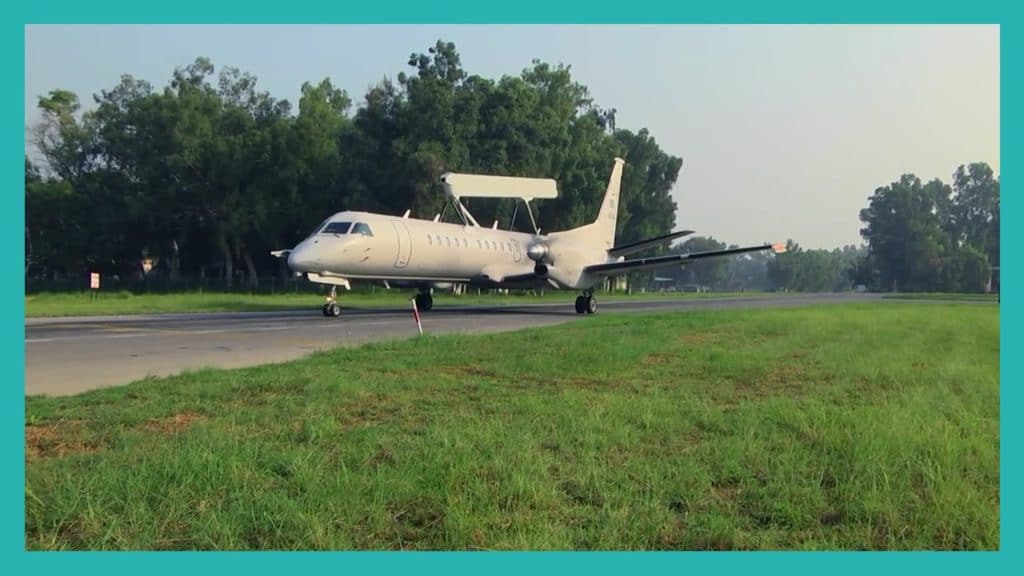
The Pakistan Air Force (PAF) operates the preceding variant, i.e. the gallium arsenide (GaA)-based TRM-equipped Erieye, providing an instrumented range of 450 km. There is no doubt that the Erieye ER is a substantial improvement over the Erieye, and with the PAF having three additional AEW&C systems on order from Saab, one might ask if the PAF is procuring the newer and much improved system. This is very unlikely considering the added costs of raising a new logistics chain and the high price of the Erieye ER.
The news of the PAF procuring three additional Erieye AEW&C comes from the journalist Alan Warnes, who cited PAF Chief of Air Staff Air Chief Marshal Sohail Aman.[5] The first was to be delivered in December 2017, with the remaining two in 2018. The intent is likely to scale the existing infrastructure overhead – i.e. which seemingly includes a depot-level maintenance, repair and overhaul (MRO) site for the Saab 2000 – and to bring the Erieye AEW&C fleet to the originally planned force of six aircraft (pre-2005 earthquake).
However, although the PAF will not benefit from the Erieye ER’s range advantage, Pakistan is adding the other elements of the GlobalEye/SRSS, such as enhanced surface surveillance, through other platforms. Thus, while Pakistan’s application differs – i.e. diffusing capability instead of concentrating it – the goal of enhancing the country’s intelligence, surveillance and reconnaissance (ISR) coverage is in place.
Cost Analysis: Erieye vs. Erieye ER/GlobalEye
While there is no doubting the substantial range improvement provided by the Erieye ER, it must be noted that Pakistan is able to afford the preceding Erieye. The following breakdown of each system’s pricing will show that not only is the Erieye more affordable, but it is now relatively affordable for the PAF.
In 2015, the UAE signed a $1.27 billion order with Saab for the GlobalEye/SRSS.[6] Saab did not disclose the specific number of SRSS on order, but Aviation Week reported that the deal included two new-built systems integrated to the Bombardier Global 6000 and two upgrade kits for the UAE’s existing Saab 340-based Erieye AEW&C.[7] However, Aviation Week noted that the Saab 340 will be fitted with “new sensors and mission systems”, but “the sensor suite for the Global 6000s will be different.”[8] Considering that the GlobalEye is equipped with three different sensors – i.e. the Erieye ER, Leonardo Seaspray 7500E AESA radar and the Star SAFIRE 380HD electro-optical/infrared (EO/IR) turret – it is unclear how the Saab 340 will differ. However, in January 2017 the UAE ordered a third GlobalEye from Saab for $238 million.[9]
Although the unit-price of each complete GlobalEye system is $238 million, the UAE’s follow-on order does not include the supporting logistics, training and maintenance infrastructure cost. These costs were incorporated into the initial $1.27 billion order. Thus, the all-inclusive cost of each GlobalEye system is comfortably higher than $317.5 million (i.e. $1.27 billion divided by four), likely much higher as the cost of upgrading the Saab 340s – especially with dissimilar sensor and electronic suites – is also a factor.
Thus, Pakistan would have to pay in the range of $300 to $350 million per GlobalEye system, which – when applied into a requirement of two or three aircraft – would be $600 million to $1.05 billion U.S in total. When there is an outstanding requirement for new multi-role fighters or potential need of long-range surface-to-air missiles, it is unlikely that the PAF will part with $500 million to $1 billion for ISR aircraft, even if these aircraft are Erieye ER. This is assuming that such funds are even available for a start.
Don't Stop Here. Unlock the Rest of this Analysis Immediately
To read the rest of this deep dive -- including the honest assessments and comparative analyses that Quwa Plus members rely on -- you need access.