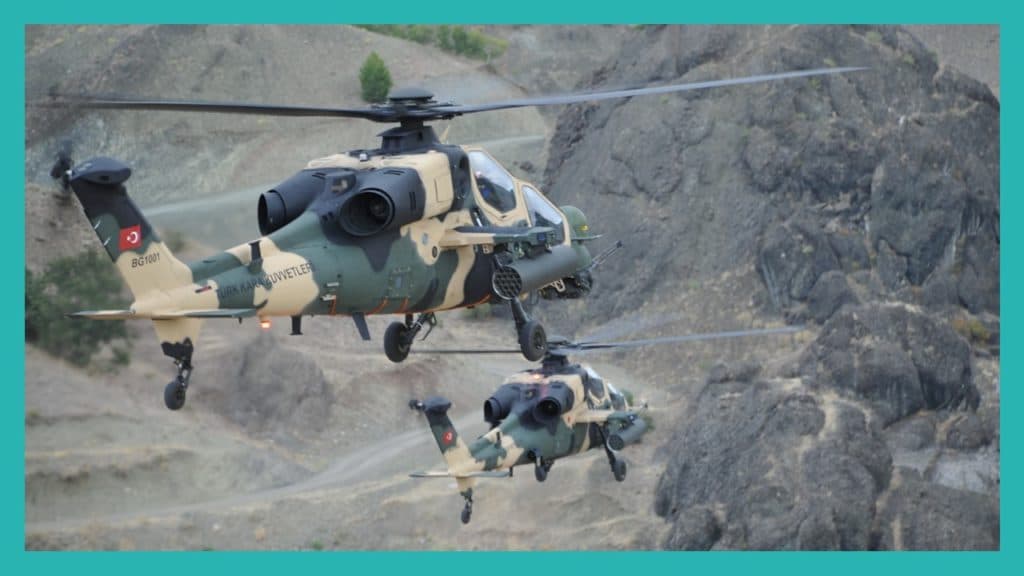
On his official visit to Turkey in November 24-26, 2017, Pakistan’s Minister of Defence Production (MoDP) Rana Tanveer Hussain stated that a potential Pakistani purchase of T129 ATAK attack helicopters from Turkish Aerospace Industries (TAI) was “90 percent complete” and that Pakistan would be reviewing the available financing options.[1] Reports of Pakistan beginning contractual negotiations for 30 T129s emerged in June 2017.[2] The reported value of the deal is $1.5 billion US.[3] Currently, Pakistan is at the cusp of inking the contract, which – if brought to fruition – would be among Pakistan’s big-ticket defence procurements. Pakistan chose the T129 as its ‘plus one’ attack helicopter to complement the Textron Bell Helicopter AH-1Z Viper, 12 of which were ordered in 2015.[4] The objective, though tentative, was to have the AH-1Z and T129 collectively supplant the Pakistan Army Aviation Corps’ (PAA) aging AH-1F/S Cobra helicopters.
Quwa’s Monthly Report for January 2017 will detail the entirety of the T129 evaluation, selection and – if a deal is inked – procurement process. This report will document the essential details while also analyzing the selection of the T129. Besides the technical merits of the T129 (and the alternative attack helicopters), this report will also examine the economics of the deal – i.e. the cost, the supposed value of the apparent production element and how Pakistan might fare with alternatives. Note, the details regarding the AH-1Z and T129 are tentative due to the current conditions of US-Pakistani defence relations. The information is drawn from open sources, which are referenced/cited in this report. This report’s objective is to both document the facts of the program as well as highlight the operational requirements driving Pakistan’s decisions, relevance to the domestic industry, the contributors to the cost and determine the necessary actions for increasing the T129’s economic value for Pakistan.
The outline of this report is as follows: First, reviewing the PAA’s ‘plus one’ attack helicopter requirement, determining the role of attack helicopters in the Army and examining the potential “hi/lo” combination of the AH-1Z and T129. Second, a technical overview of the T129 detailing its specifications, subsystems, current and future capabilities and armament options. Third, reviewing the prospective Pakistani contract, including a breakdown of the pricing using open-source information. Fourth, a discussion of offsets (as it appears to be a factor in the T129 deal) and an analysis of its economic value to Pakistan.
The Pakistan Army’s ‘Plus-One’ Attack Helicopter Requirement
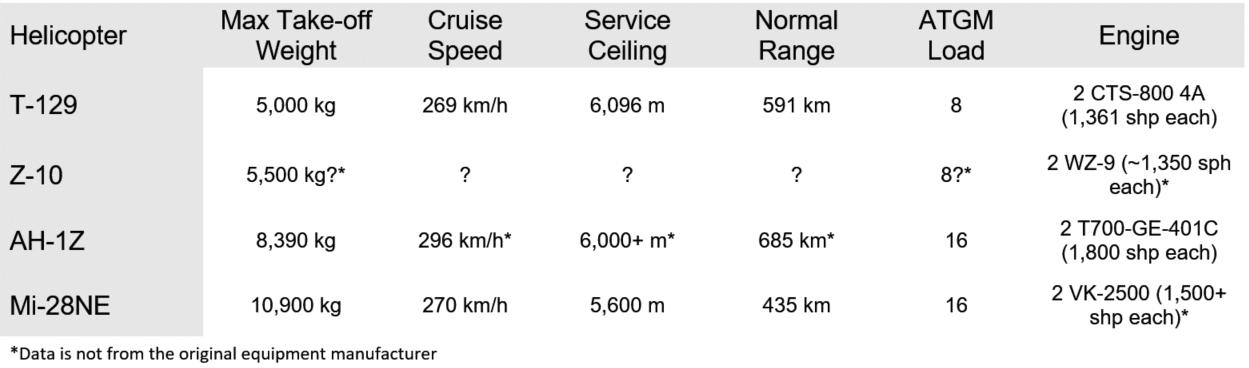
In 2015 and 2016, the Pakistan Army signed orders for four Russian Helicopters Mi-35M and 12 AH-1Z Vipers from Textron Bell Helicopters, respectively. In 2016, the Pakistan Army also evaluated two other attack helicopter platforms in the TAI T129 and the Changhe Aircraft Industries Corporation (CAIC) Z-10. China had sent three Z-10 to Pakistan, which had been spotted in use through 2016 in various operational environments, including Pakistan’s desert areas. The T129 was evaluated in Pakistan for a shorter period – i.e. several days – in May 2016. Through these evaluations, it was apparent that the PAA was seeking a second dedicated attack helicopter platform to complement the AH-1Z. In fact, the Z-10 and T129 shared the same weight class of maximum take-off-weight (MTOW) of 5,500 kg and 5,000 kg, respectively, both markedly lighter-weight than the MTOW of the 8,390 kg AH-1Z.
Thus, a “hi/lo” combination with the AH-1Z and another aircraft was potentially on the PAA’s roadmap. On 31 January 2018, the PAA Commander – Maj. Gen. Nasir D. Shah – had outlined to the IQPC Military Helicopter Conference in London, UK, that the PAA required “a platform that is suitable for operations in a dusty environment, that can fly in extreme high temperatures while suitably configured, can operate in low visibility, that demonstrates ease of maintenance and logistic support, and where depot-level maintenance can be transferred.”[5] Shah added that the PAA’s current AH-1F/S Cobra fleet, while effective for close air support (CAS) operations, “cannot be employed effectively in high-altitude operations above 8,000 ft.”[6] Based on Shah’s statements, it appears that the PAA requires an attack helicopter for use in all key operational environments, not just the desert – where it would provide CAS for the Pakistan Army’s armour formations – but high-elevation/hot-and-high conditions as well.
The aforementioned conditions were included in the examination of the T129 in May 2016. According to TAI, the PAA examined the T129-P6 in a sequence of scenarios. First, the PAA tested the P6’s durability in hot-temperature environments, namely by placing it in a hangar in Quetta overnight in temperatures of at least 48° C. Furthermore, the PAA’s tests resulting TAI not having access to the T129’s ground-support equipment (GSE), hence the helicopter had to operate through the tests as-is. Following its overnight stay in Quetta, the P6 was flown at 14,000 ft at 23° C. Finally, TAI was required to fly the T129 non-stop from Quetta to Multan, i.e. a distance of 480 km.[7] It was based on this performance that the Pakistan Army had reportedly selected the T129 ATAK for its ‘plus-one’ requirement.
Pakistan certainly required a versatile helicopter (from an environment compatibility standpoint), but the issue of quantity is unclear. If the T129 is to be a factor on Pakistan’s ‘Eastern Front’, then 30 helicopters – even with 12-15 AH-1Z – could be a relatively small force for providing robust CAS coverage. Combining its planned AH-64E and Light Combat Helicopter (LCH) fleets, India could operate upwards of 200 attack helicopters in the heavyweight and lightweight classes. Although Pakistan cannot match such a force 1:1, it can plausibly increase its fleet from the projected 45 to in-excess of 50. In any given period, it is unlikely that every single helicopter will be operable, some will be on the ground for scheduled maintenance and, especially if the counterinsurgency (COIN) operations persist, repair. Increasing the fleet number ensures that a minimum required number for conventional operations is in place, and it is difficult to see Pakistan limiting its required minimum to fewer than 40 helicopters.
The option to increase will exist due to the support and maintenance infrastructure required to sustain the AH-1Z and T129 – the infrastructure can be scaled to smoothly add new aircraft of those two types. On the other hand, the reality of high procurement cost and potentially limited long-term utility for CAS – at least as the workhorse asset – could also be an issue. India is not short of fiscal strength, at least when it comes to building effective short-range air defence (SHORAD) capabilities to thwart helicopter usage by Pakistan. Likewise, Pakistan can also emphasize SHORAD for defensibility against attack helicopters. The use of armed drones could also emerge as a CAS option to augment attack helicopters.
Overview of the TAI T129 ATAK
The T129 ATAK is a variant of the AgustaWestland A129 CBT, itself an upgraded variant of the Italian A129 Mangusta. However, the T129 incorporates major changes, such as the inclusion of two Light Helicopter Turbine Engine Company (LHTEC) CTS800 turboshaft engines, each providing a thrust output of 1,361 shp. Besides the engine, the T129 incorporates “new avionics, visionics [electro-optical sensors] and weapons, modified airframe, uprated drive train and new tail rotor.”[8] The changes did not structurally change the platform from being a lightweight platform, but maintaining a MTOW of 5,000 kg, the uprated engines do offer a greater thrust-to-weight ratio. However, the changes did demonstrate the T129’s viability in hot-and-high conditions, a key requirement of the PAA. For Pakistan, this would indicate that the T129 would see use in the Northern Areas and Kashmir, which primarily feature artillery and infantry. In this respect, the T129 would be analogous to India’s LCH, which will also be deployed (thanks to its viability in hot-and-high and high-elevation conditions) in the same environment.
Don't Stop Here. Unlock the Rest of this Analysis Immediately
To read the rest of this deep dive -- including the honest assessments and comparative analyses that Quwa Plus members rely on -- you need access.