
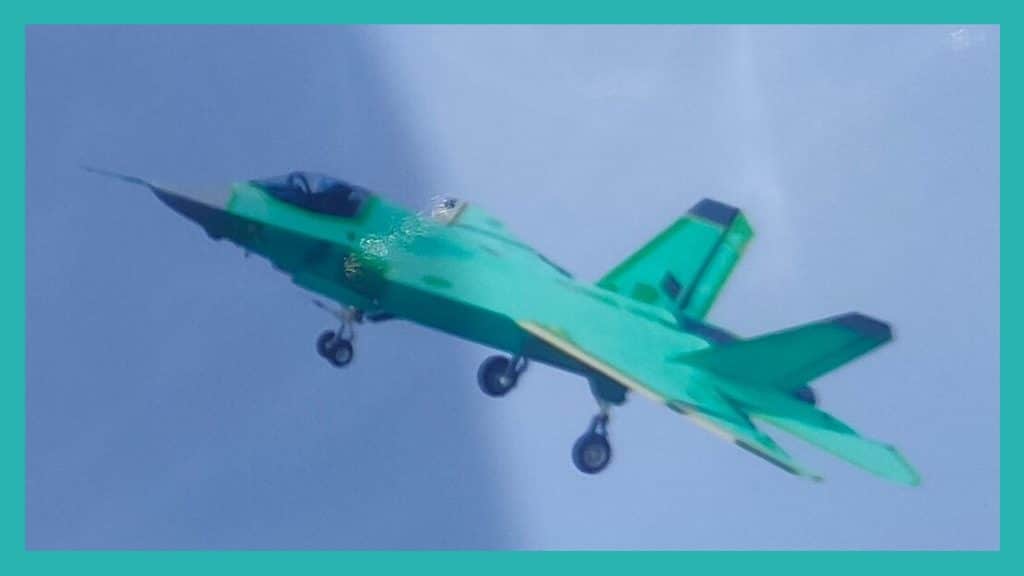
Last week, photos emerged of two new fighters from China’s burgeoning aerospace industry: the twin-seat variant of the Chengdu J-20, and, potentially, the carrier-borne J-XY (or J-35).
If the images are conclusive, they would signify two significant advances for China. First, the approaching availability of a twin-seat, stealthy combat aircraft. Second, a homegrown carrier-borne multirole fighter tailored for the specific needs of the People’s Army Liberation Navy (PLAN).
Twin-Seat J-20
The Chengdu J-20 was the first of China’s next-generation fighter aircraft (NGFA) out of the gate. The J-20 technology demonstrator flew in 2012. China officially debuted the J-20 at the 2016 Zhuhai Air Show. By 2018, reports had emerged of operational People’s Liberation Army Air Force (PLAAF) units receiving J-20 aircraft. Based on information from Chinese defence observers, it seems that the J-20 is not yet a mainstay asset like the J-10, J-11 or J-16-series of fighters, but it is percolating into a growing number of units.
The growing adoption of the J-20 could be driving the development of a twin-engine variant. Interestingly, one does need a twin-seater for training. To-date, NGFA users around the world (entirely F-35 users) have been content with simulators. With this variant of the J-20, China will be the first with a twin-seat NGFA.
However, it would be unwise to assume that training could be the sole role of the twin-seat J-20. Rather, the PLAAF could be looking at a wider array of mission scenarios. In fact, the PLAAF uses twin-seat variants of its Flanker-series – i.e., J-11BS and J-16 – for strike and electronic attack (EA) missions. It is possible that the twin-seat J-20 could potentially take on similar roles in the future.
It is worth noting that the J-20 seems to be in a size and weight class as the Flanker-series. It uses the WS-10-series turbofan engines, for example. The J-20’s range and payload are not known. However, even if the J-20’s payload and/or range are lower than that of the Flanker-series, it could still be one of the larger stealthy aircraft flying in the world. Though it would start with a focus on air-to-air, the J-20 could evolve into a strike and special mission (e.g., EA) aircraft in the coming years.
Quwa Plus
Go Beyond the Headlines on Pakistan’s Defence and Security.
Quwa Plus gives you deeper reporting, briefings, and analysis on Pakistan’s defence programs, foreign policy, national security, and regional strategy. Follow the developments that matter to professionals, analysts, and serious readers tracking Pakistan’s security landscape.