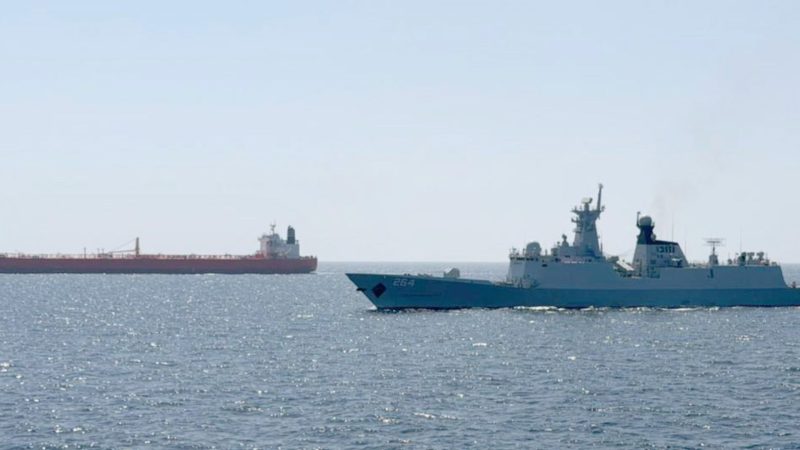
According to the Pakistani government, sea freight services cost Pakistan $4.6 billion USD in hard currency outflows. Pakistani officials and government publications state that 90% of the country’s trade flows through the sea, indicating that the expense is critical as it facilitates Pakistan’s exports.
Securing the sea lanes driving that trade became one of the Pakistan Navy’s (PN) most pressing priorities, leading to the investment in offshore patrol vessels (OPV).
As discussed in a previous Quwa analysis, the OPVs are the focal point of the PN’s growing maritime security capabilities – and for a reason of increasing importance.
Since 2024, the Government of Pakistan has endeavoured to expand the Pakistan National Shipping Corporation (PNSC), starting with a lease for three ships for USD $139 million, following the induction of two Aframax oil tankers in 2019. Plans are also underway to procure 12 additional vessels to expand the PNSC’s fleet to 30 by 2026 and 60 by 2028-2029.
Considering how Pakistan’s merchant navy had only nine ocean-going vessels in 2015, embarking on a 6X-plus increase in fleet size over 15 years is significant growth. Now, for the PN, the concern is two-fold: not only does 90% of Pakistan’s trade flow through the seas, but most of that trade may one day be managed by the PNSC and, potentially, Pakistani private freight companies.
Within this context, Quwa estimates that the PN could invest in expanding its OPV fleet beyond the initial plan. In 2020, the PN leadership stated that it was in talks to add six OPVs to its then-fleet of two Yarmouk-class (Damen OPV 2200) ships, and that these would be of ‘larger tonnage’. Then, in 2022, the PN contracted Damen Group for two OPV 2600s. Thus, based on earlier statements, the PN could potentially acquire four additional OPVs, bringing the total to eight ships.
Get access to this article and all other Quwa content today.
Click Here
Related Reads
- Offshore Patrol Vessels (OPV) Will Play a Key Role in the Future of the Pakistan Navy Fleet.
- Extending Deterrence: How the Hangor-Class Reshapes Pakistan’s Maritime A2/AD Posture
- The COTS Advantage of the Pakistan Navy’s Sea Sultan LRMPA
- After a Decade of Growth, the Real Test for Pakistan’s Navy Has Begun
However, with the expansion of the PNSC, this author believes that there are grounds to grow the OPV fleet to at least 12 ships. Ultimately, the PNSC ships in particular would be an issue of sovereign control; the PN is directly responsible for their security. A growth of this magnitude in the merchant navy will necessitate a substantial increase in the PN fleet.
Irrespective of whether it being peacetime or wartime, the mandate of the OPV fleet would be to protect the merchant fleet; in wartime, that role magnifies in importance and, perhaps, explains why the PAF sought a design that could absorb wartime capabilities, e.g., anti-ship warfare (AShW), anti-air warfare (AAW), and anti-submarine warfare (ASW).
Don't Stop Here. Unlock the Rest of this Analysis Immediately
To read the rest of this deep dive -- including the honest assessments and comparative analyses that Quwa Plus members rely on -- you need access.