Rheinmetall showcased its RCWS320C-UAS counter-drone weapon station, SSW40 squad support weapon, FV-014 loitering munition, and an integrated interconnection concept for light forces at Enforce Tac 2026 in Nuremberg, Germany, which concluded on February 25.
The German defence group’s exhibit spanned both counter-unmanned aerial system (C-UAS) effectors and tactical strike drones, presenting them within a unified command-and-control (C2) architecture.
Counter-Drone and Strike Systems
The RCWS320C-UAS is a modular, NGVA-compliant remote-controlled weapon station designed for vehicles, unmanned platforms, or fixed sites. It integrates sensor fusion, automated targeting, and hard-kill and soft-kill options through the SEOSS-320 vision system, enabling engagements out to 600 metres.
The station is armed with a Dillon Aero M134D minigun firing at 3,000 rounds per minute and provides 230-degree horizontal and 90-degree elevation radar coverage.
Complementing the RCWS320C-UAS is the SSW40, a 40 mm x 46 mm medium-velocity squad support weapon effective to 900 metres. The SSW40 uses airburst munitions to defeat drones and targets behind cover, with series production planned for 2026.
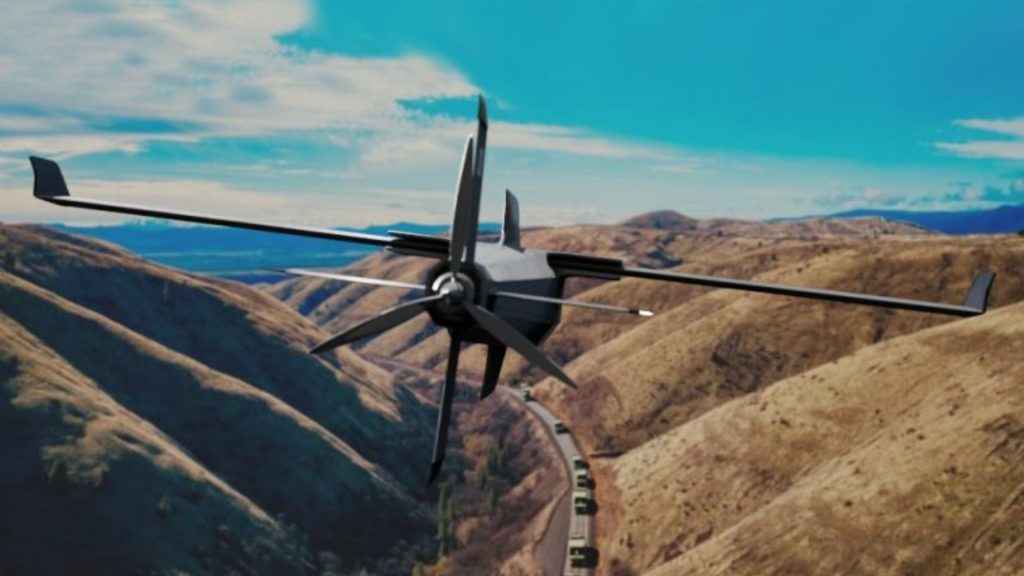
On the strike side, the FV-014 is a portable tactical loitering munition combining reconnaissance and precision strike in a single airframe. The system is operator-controlled to minimize collateral damage.
Networked Interconnection for Light Forces
The centrepiece of Rheinmetall’s Enforce Tac presence was its interconnection concept for light forces and territorial defence, demonstrated at Hall 10, Stand 426.
The concept integrates the Gladius Light soldier system with the Smart Mobile Observation Kit (SMOK) – featuring electro-optical (EO) sensors, a pan-tilt head, and TacNet battle management integration – alongside unmanned aerial vehicles (UAVs).
The sensor layer includes the SCM 300 EO system and the ASN 100 acoustic sensor, both of which operate passively to maintain a low signature for covert operations. These sensors feed into TacNet, which tasks the RCWS320 and other effectors for rapid threat engagement.
In this vein, the architecture enables small units to detect, classify, and respond to hybrid threats – including drone swarms – through a single networked kill chain.
The Integrated Asymmetric Warfare Stack
Rheinmetall’s Enforce Tac exhibit is significant for what it signals about the counter-drone and loitering munition market. The company is assembling an integrated asymmetric warfare stack – combining attack and defence under a common C2 layer.
There is an operational logic to this approach. Shared sensor networks, common datalinks, and a unified battle management system compress the observe-orient-decide-act (OODA) loop, enabling faster threat response while reducing personnel requirements.
A loitering munition operating on the same C2 backbone as the C-UAS sensors can be retasked in near real time using the same situational picture that drives defensive engagements.
However, the commercial driver is arguably equally significant. Many key growth markets – in the Middle East, Southeast Asia, and Latin America – lack both loitering munitions and C-UAS capabilities at scale.
For vendors, this creates an opportunity to offer a turnkey offensive-defensive package rather than selling point solutions that the customer must integrate independently.
Turkey’s defence sector has moved furthest in this direction. STM‘s KARGU loitering munition now incorporates an RF seeker payload designed to detect and neutralise enemy drones, blurring the line between attack and defence in a single platform.
Roketsan‘s EREN high-speed loitering munition has been tested aboard the Bayraktar Akinci for air-to-air engagements against Shahed-type kamikaze UAVs, while Aselsan‘s KORKUT and GÖKBERK laser systems anchor the dedicated C-UAS layer.
In January 2026, STM secured its first European export of KARGU and ALPAGU loitering munitions integrated into a NATO customer’s battle management and C2 architecture – demonstrating the full-stack integration that Rheinmetall is now pursuing.
China is scaling loitering munition production – with plans to manufacture over one million units annually by 2026 – and developing C-UAS systems such as the China Aerospace Science and Industry Corporation‘s (CASIC) ‘Light Arrow’ and ‘Sky Shield’ laser families. That said, Chinese vendors appear to be exporting these as individual systems rather than integrated packages.
Given these dynamics, one can see Pakistan’s defence industry heading in a similar integrated direction.Global Industrial & Defence Solutions (GIDS) unveiled its Blaze series of loitering munitions at IDEAS 2024 – ranging from the 75 km-range Blaze 25 to the turbojet-powered Sarkash with a 1,000 km range.
Pakistani vendors are separately developing electronic warfare-based C-UAS systems using cognitive software-defined radio (SDR) technology. The Pakistan Air Force (PAF) is also pursuing directed energy weapons (DEW), including high-energy laser (HEL) and high-powered microwave (HPM) systems.
Thus, the building blocks for an integrated Pakistani asymmetric warfare stack are emerging across multiple organizations. One could see GIDS or the National Engineering and Scientific Commission (NESCOM) drawing these threads together into an exportable solution for Middle Eastern and Latin American markets.