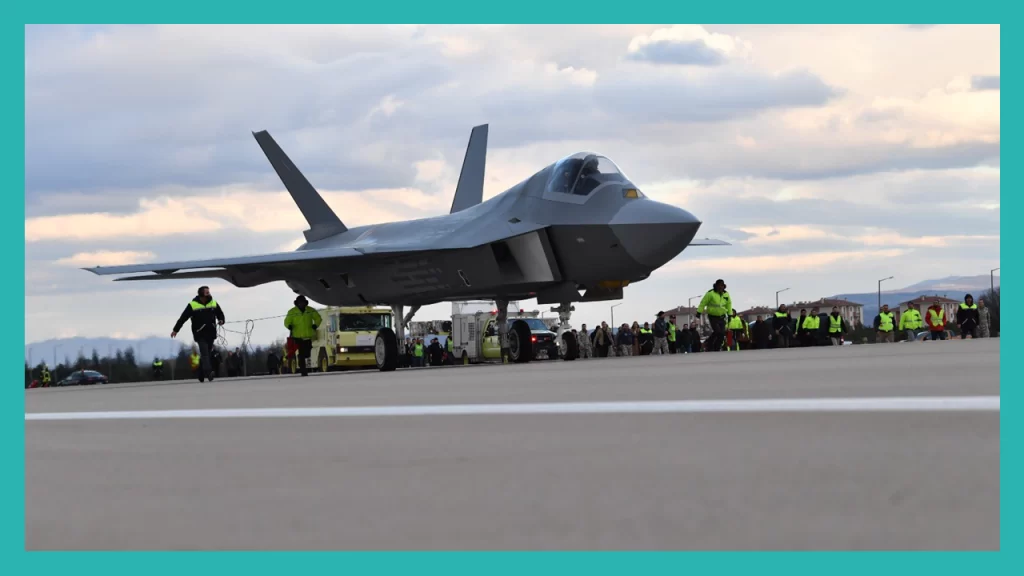
On 02 August, the Turkish Deputy Minister of Defence, Celal Sami Tüfekçi, announced that officials from Türkiye and Pakistan will meet by the end of the month to discuss the latter’s potential entry into Türkiye’s next-generation fighter aircraft (NGFA) program, the KAAN.
Tüfekçi revealed the news during the launch ceremony of the Pakistan Navy’s (PN) fourth MILGEM Babur-class corvette, PNS Tariq. Currently, the MILGEM – which includes four corvettes plus the jointly-designed and produced Jinnah-class frigate – is the flagship defence program between Türkiye and Pakistan. But this could potentially be eclipsed by Pakistan one day joining the KAAN fighter program.
Tüfekçi also revealed that 200 Pakistani engineers and other technical personnel are providing support to the KAAN program. This is likely in reference to the Pakistani staff working for Turkish Aerospace Industries Inc.’s (TUSAŞ) office at the National Science and Technology Park (NSTP) from 2019.
A Pivot from ‘Project AZM?’
The Pakistan Air Force (PAF) had formally launched an in-house NGFA known as “Project AZM” in July 2017 under its ‘Kamra Aviation City’ initiative. Moreover, the PAF established an ‘Aviation Research, Innovation and Development’ (AvRID) Secretariat to lead Project AZM.
Though AvRID had ostensibly carried out some preliminary design work, it became apparent that Project AZM was losing steam among the PAF’s top decision-makers, including the Chief of Air Staff (CAS). In fact, by 2019, then PAF CAS, Air Chief Marshal (ACM) Mujahid Anwar Khan, said that the PAF could collaborate with overseas partners provided the design was free of ITAR restrictions. Other PAF officials, including the Chairman of Pakistan Aeronautical Complex (PAC), stated that the Turkish TF-X could align with PAF needs.
Ultimately, the PAF’s initial idea of pursuing Project AZM as an in-house project was riddled with ‘red flags’ from the start. Generally, countries initiate programs of this nature to mobilize their existing expertise in key areas, such as engines, aerostructures, and aircraft design, among many others. While a new project can catapult a country’s technology base, there needs to be base to develop in the first place.
Pakistan lacked any such technology base; so, in the best-case scenario, it would have had to import each of the critical inputs (e.g., turbofan engines) to drive the program. However, to even take on that project, Pakistan would have needed credible in-house design and development capabilities. This would not have been possible as Pakistan, especially the PAF, lacked that capacity.
Get Timely Pakistani Defence News
Unmatched depth on the JF-17, Project Azm, Hangor submarine, Babur, Fatah, and more. Be the first to know about Pakistan's next-gen UAVs, USVs, and emerging platforms.