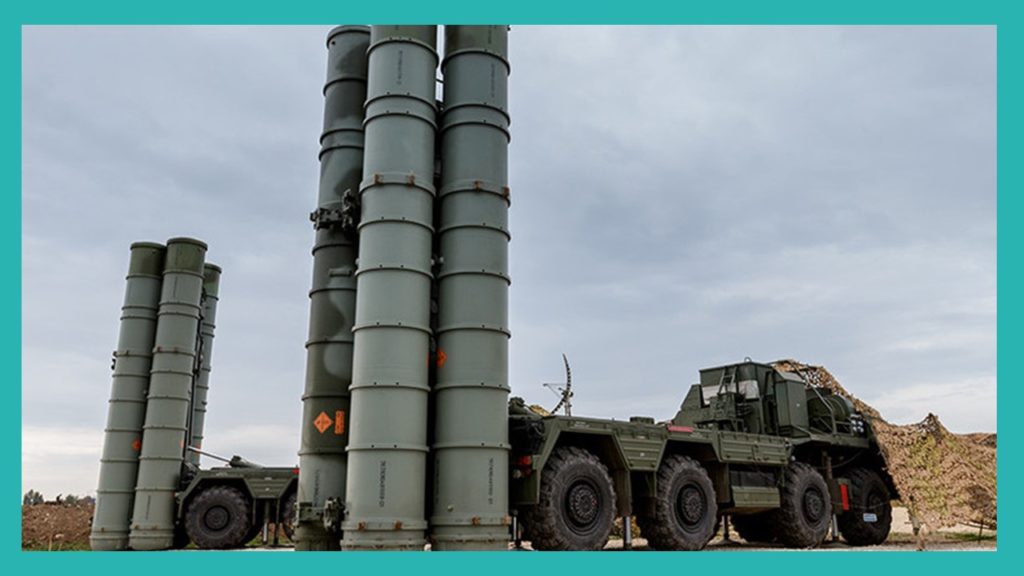
On 05 October, New Delhi inked a $5.5 billion US contract with Russia’s Rosoboronexport for the purchase of Almaz-Antey S-400 Triumf long-range surface-to-air missile (SAM) systems. The purchase comes in the midst of Washington passing the Countering America’s Adversaries Through Sanctions Act (CAATSA), new legislation aimed at curbing Russia by restricting US allies from purchasing major Russian goods, notably armaments and natural resources.[1] Nonetheless, citing its strategic interests New Delhi greenlit the deal.
There are at least three major issues to consider when examining this purchase. First, the impact of the S-400 on Pakistan, especially in terms of how it will influence (and, in all likelihood, constrain) its offensive capabilities. Second, how Washington will navigate its bilateral relations with India in light of New Delhi’s long-established, and strategically important, relationship with Moscow. Third, the S-400’s emergence as a popular big-ticket export item for Moscow, one that is seeing countries – which would otherwise adhere to CAATSA – pursue the system, despite its high price tag and the risk of repercussions from the US.
In October 2016, India and Russia signed an intergovernmental agreement (IGA) to finalize the S-400. The deal, once finalized, would see India begin receiving the S-400 from 2020. India joins China and Turkey as a forthcoming S-400 user. Deliveries to China had begun in January 2018.[2] Turkey is preparing a site for a S-400 system, which it expects to begin receiving in 2019 (with operational readiness by 2020).[3]
The Impact of the Almaz-Antey S-400 Triumf in South Asia
Though known for its marquee, 400 km-range missile – the 40N6 – the S-400 is actually multi-layered, i.e. it covers short-to-medium and medium-to-long-range envelopes as well. This is done through the 250 km 48NG, 120 km 9M96E2 and 40 km 9M96E. In effect, the S-400 is a full-spectrum system, which is not only a versatile system, but it equips the S-400 to defend itself from low-level threats. These low-level threats will leverage coverage gaps resulting from the Earth’s curvature. However, the S-400 will cover these gaps through its low-level sensors and short and short-medium-range SAMs (e.g. 9M96E/E2).
Thus, not only is the S-400 a potentially effective system for its intended purpose (long-range air defence), but it is difficult to displace, much less neutralize, due to its multi-layered coverage. In addition, the S-400 can be shifted between sites by land thanks to truck-mounted launchers, radars/sensors and command, control and communication (C3) centres. This enables the S-400 user to shift and re-deploy the S-400 with relative ease, though the actual transport and re-activation process would mean a downtime.
It would be disingenuous to believe that the S-400 is not a game-changer of sorts in the region, especially when taken in collection with some of India’s other defence programs. The most obvious point is that with the S-400, India has the option of imposing a constraint on high-altitude flights on Pakistan.
By placing S-400 systems in proximity to the Pakistani border, India could extend its air defence umbrella into Pakistan by a factor of several hundred kilometres. Yes, by virtue of the Earth’s curvature, the S-400’s restrictions would be on high-altitude flights; the Pakistan Air Force’s (PAF) combat aircraft can still fly low in Pakistani territory. However, special mission aircraft – e.g. airborne early warning and control (AEW&C) aircraft – could be at risk when operating near the Indian border.
Get Timely Pakistani Defence News
Unmatched depth on the JF-17, Project Azm, Hangor submarine, Babur, Fatah, and more. Be the first to know about Pakistan's next-gen UAVs, USVs, and emerging platforms.