
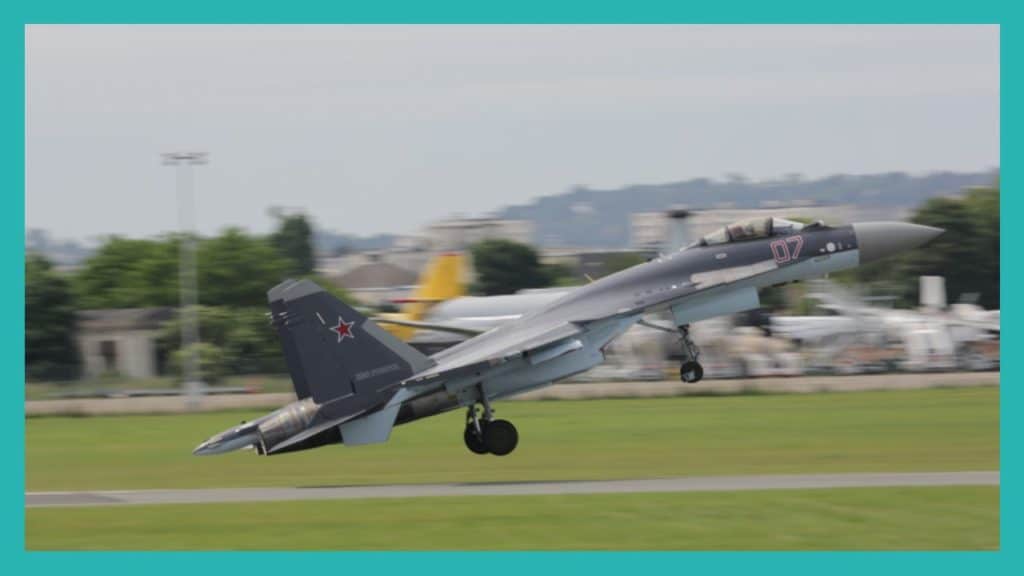
On 05 April, Pakistan’s Minister of Defence (MoD) Khurram Dastgir Khan confirmed to the Russian News Agency RIA Novosti that Pakistan had begun talks with Russia for the purchase of Sukhoi Su-35 Flanker-E multi-role fighters, T-90 main battle tanks (MBT) and air defence systems.
Of these, the Su-35 is arguably the leading draw of interest, especially since 2015 when reports emerged of the Pakistan Air Force (PAF) showing interest in the fighter.[1] Regarding the Su-35, Khan told RIA Novosti: “As for Su-35 fighters: maybe in the next few years we will be able to achieve this [agreements – ed.]. We are now at the initial stage of negotiations.”[2] To date, this is the highest-level statement from a Pakistani official on the matter. Prior to this was a statement in April 2017 from the previous PAF Chief of Air Staff (CAS) – Air Chief Marshal (ACM) Sohail Aman – calling for new fighter aircraft: “Pakistan definitely has to induct new aircraft. We have both Chinese and Russian options.”[3]
Thus, if the Pakistani MoD’s statements are reflective of the reality, then genuine traction has been made between Pakistan and Russia in negotiating for the Su-35. The MoD also qualified his statements by stating that although talks for the Su-35 were underway, it is a long-term (i.e. “next few years”) factor, provided negotiations succeed. For the PAF, the Su-35 would be a much welcome addition in not only enlarging its fleet of high-tech and high-capability fighters, but in enabling for key operational gains.
Deep Strike & Maritime Operations
For the PAF, the main areas where an imported platform is apparently necessary are in recapitalizing the PAF’s deep-strike capabilities and in enhancing its presence for maritime operations. Until 2016, the PAF had relied upon its Mirage ROSE-I/II/II and Mirage 5PA2/PA3 to carry the mainstay of duties in these areas, respectively. However, in the maritime space the Mirages are now complemented by the JF-17, which has joined the No. 32 Tactical Wing at Masroor Air Base under the No. 2 Squadron. This dynamic is discussed in greater detail in the Quwa Premium article, “RIBAT-2018 (Part 1): Improving PAF-PN Interoperability”.
However, while the JF-17 certainly provides the technology improvement – i.e. through a multi-role suite capable of deploying beyond-visual-range air-to-air missiles (BVRAAM), anti-ship cruising missiles (ASCM) and data-linking to offboard sensors such as airborne early warning and control (AEW&C) aircraft – it lacks the range and endurance necessary to sustain a persistent air presence at-sea, especially at the heart of the exclusive economic zone (EEZ) and distant sea-lines-of-communication (SLOC). The utility of the JF-17 diminishes at long-range, which necessitate air-to-air refueling (AAR) and/or fuel pods. AAR will make the deployment complex and risk-prone, while fuel pods will deplete stores meant for munitions.
Speaking to Quwa in March 2018, retired PAF Air Commodore – and once commander of the 32 Tactical Air Wing – Kaiser Tufail outlined that the PAF required a “fighter aircraft with a much greater range and patrol time, a very powerful anti-shipping and airborne intercept (AI) radar, and long-range supersonic attack weapons.” In other words, a fighter that can independently operate any area of the EEZ while also retaining enough in payload capacity for heavyweight munitions, such as supersonic-cruising ASCM. Tufail also added that “political constraints and the threat of recurring sanctions” render the Su-35 “as a possible choice for the interim period until a stealthy fifth-generation fighter becomes available to the PAF”.
The Su-35 is a twin-engine design powered by a pair of Saturn 117S turbofan engines. It has a payload of 8,000 kg spread across 12 external hardpoints. It has a ferry range of 4,000 km, while its combat radius is 1,500 km.[4] Sukhoi claims that the Su-35’s passive electronically-scanned array (PESA) radar, the Irbis-E, has an aerial detection range of 350 km for targets with radar cross-sections (RCS) of 3m2. It can track up to 30 targets and simultaneously engage eight of them.[5] Thus, the promised specifications measure to the PAF’s apparent requirements, especially if the Irbis-E can be paired to Chinese CM-302 supersonic ASCM, thus providing the PAF with an analogous capability to the BrahMos-equipped Su-30MKI.
For the PAF, the objective is centered on deterrence, i.e. to dissuade India from attempting to cut Pakistan off from its trade routes through a maritime exclusion zone (MEZ). For Pakistan, the hope is to maintain enough aerial, sub-surface and surface assets – each equipped with long-range ASCMs – to make imposing a MEZ an infeasible and overly risky course. Thus, the constraints of a major fighter purchase – including the reality that the PAF is unlikely to order more than two squadrons – are less concerning (though still a weakness). The point is to meet a minimum threshold, i.e. to have the capability to readily inflict damage against surface ships and to interdict intruding aircraft, especially maritime patrol aircraft (MPA).
In terms of deep-strike, the goal would be to augment the 50-60-year old Mirage ROSE-I/II/III. As discussed in the Quwa Premium article, “Analysis: The Case for Pakistan Procuring the FC-31 Gyrfalcon”, the Mirage ROSE-series and the F-16 neatly complement one another: to the PAF, the F-16 excels in air-to-air thanks to the AIM-120C5 and Link-16 tactical data-link (TDL), while the Mirage ROSE can handle long-range strike via the Ra’ad-series of air-launched cruise missiles (ALCM) and H-2/H-4-series of glide-bombs. The Su-35 would essentially supplant the Mirage ROSE in that strike-oriented role and, perhaps, offer an added layer of air-to-air utility thanks to a much longer-range radar and ability to deploy BVRAAMs.
In general, the idea is that the JF-17 forms the “core” of the PAF fleet, managing the near-entirety of the PAF’s defensive air-to-air and short-range air-to-surface requirements. The sizable JF-17 fleet is supported by a smaller fleet of specialist assets – such as the air-to-air F-16 and air-to-surface Mirage ROSE – serving for long-range and/or offensive engagements. The Su-35 would serve in that specialist role.
Don't Stop Here. Unlock the Rest of this Analysis Immediately
To read the rest of this deep dive -- including the honest assessments and comparative analyses that Quwa Plus members rely on -- you need access.