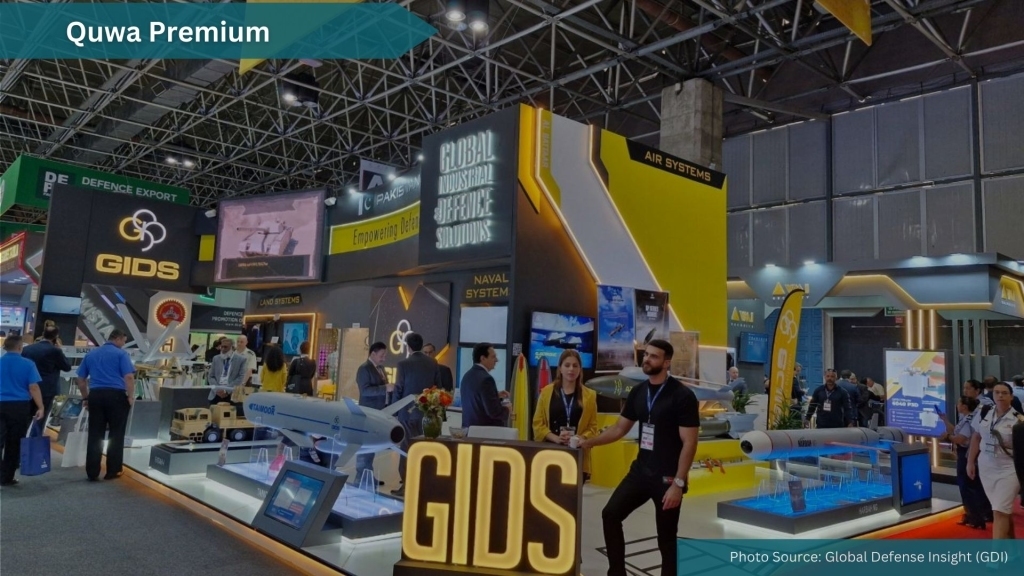
Pakistan’s Global Industrial and Defence Solutions (GIDS) was present at the 2025 Latin America Aerospace & Defence (LAAD) exhibition, which ran from April 01 to April 04, 2025, at the Riocentro Exhibition & Convention Center in Rio de Janeiro, Brazil.
At LAAD 2025, GIDS showcased its growing product portfolio, including:
- Fatah-I and II precision-guided surface-to-surface missiles (SSM),
- Taimur air-launched cruise missile (ALCM),
- Harbah NG anti-ship cruising missile (ASCM),
- AZB-series of precision-guided bombs (PGB),
- al-Battaar laser-guided bomb (LGB), and
- Blaze-series of loitering munitions, among others.
Editor’s Analysis: Barriers to Pakistan’s Defence Industry Growth
Pakistan faces challenges in establishing itself as a competitive defence supplier due to structural limitations in its industrial ecosystem.
Unlike leading arms exporters such as China, the U.S., or European nations, Pakistan lacks the same depth of vertically integrated production chains that control every stage from raw material processing to advanced manufacturing systems.
Quwa Plus
Go Beyond the Headlines on Pakistan’s Defence and Security.
Quwa Plus gives you deeper reporting, briefings, and analysis on Pakistan’s defence programs, foreign policy, national security, and regional strategy. Follow the developments that matter to professionals, analysts, and serious readers tracking Pakistan’s security landscape.
Join ($29.99/Year) Already a subscriber?Sign in