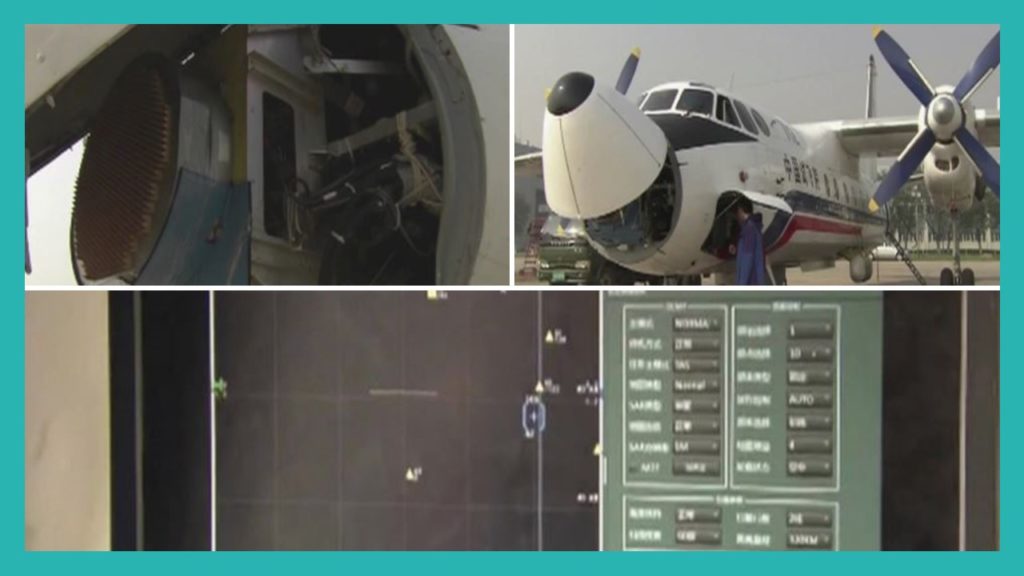
Hu Mingchun, the head of the Nanjing Research Institute of Electronics Technology (NRIET), told the China Daily that NRIET’s new active electronically-scanned array (AESA) radar, the KLJ-7A, will be integrated onto to the JF-17 Thunder multi-role fighter.[1] This would imply that the Pakistan Air Force (PAF) selected NRIET to supply the AESA radar for the forthcoming JF-17 Block-III – the previous PAF Chief of Air Staff (CAS) had stated that the Block-III’s design was finalized, which means the subsystem selection has been frozen.
Overall, the PAF selecting the KLJ-7A would not be surprising. First, the KLJ-7A had the fewest obstacles in the way of delivering the Block-III into an operational factor. Second, this could involve a long-term play for securing sensitive Chinese technology for Project Azm, the PAF’s next-generation fighter program.
The KLJ-7A’s Value to the JF-17 Block-III
In general, an AESA radar’s improvements stem from its use of multiple transmit/receive modules (TRM). In contrast to mechanically-steered radars, which can transmit in one frequency per pulse, an AESA radar can leverage multiple TRMs to transmit in multiple different frequencies simultaneously. This shields the AESA radar from electronic warfare (EW) jamming in that if one of its frequencies are jammed, the radar can still undertake its detection, tracking and targeting functions.
However, because these TRMs are fixed, an AESA radar generally has a relatively limited field-of-view (FOV), usually 90-120°.[2] Comparatively, this is new technology, so its applications are still evolving, with innovation emerging to rectify its limits (e.g. the mechanical swashplate of the Raven ES-05, enabling it to have a wider FOV). Practically, multiple JF-17 Block-IIIs will engage – alongside airborne early warning and control (AEW&C) support – in a mission, so the limited FOV is not a decisive inhibitor (relative to the gains).
The KLJ-7A was formally revealed during Air Show China 2016. In terms of specifications, Henri Kenhmann of East Pendulum learned that the KLJ-7A uses 1,000 TRMs and has a stated maximum air-to-air detection range of 170 km, but it is unclear if this is for targets with 5m2 radar cross-section (RCS) or 3m2 RCS. However, the KLJ-7A could track 15 targets and engage four simultaneously.[3] It is likely that the KLJ-7A is using gallium arsenic (GaA)-based TRMs; not only are the manufacturing processes for these established, but the much-improved gallium nitride (GaN) TRM is a very recent entry in the market. The sole airborne GaN AESA radar available is the Saab Erieye Extended Range for AEW&C, all other applications of the TRM are for land and sea-based air surveillance and air defence radars.
Quwa Plus
Go Beyond the Headlines on Pakistan’s Defence and Security.
Quwa Plus gives you deeper reporting, briefings, and analysis on Pakistan’s defence programs, foreign policy, national security, and regional strategy. Follow the developments that matter to professionals, analysts, and serious readers tracking Pakistan’s security landscape.
Join ($29.99/Year) Already a subscriber?Sign in