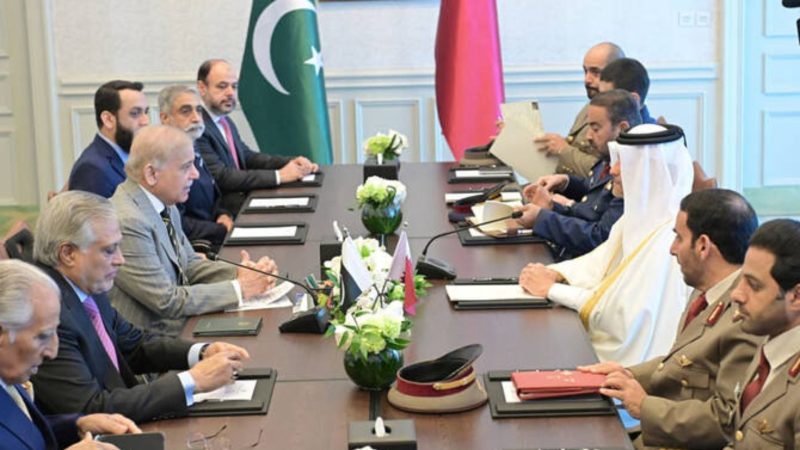


On 17 September, Pakistan’s prime minister, Shehbaz Sharif, and the Crown Prince of Saudi Arabia, Mohammed bin Salman, signed a bilateral defence agreement aimed at strengthening the military cooperation between the two countries.
In a joint statement, the two sides said that the “Strategic Mutual Defence Agreement” (SDMA) “aims to develop aspects of defence cooperation between the two countries and strengthen joint deterrence against any aggression.”
In addition, the SDMA also includes a statement that suggests that “any aggression against either country shall be considered an aggression against both.”
Get access to this article and all other Quwa content today.
Click Here
Related Reads
Historically, Pakistan was a key contributor of manpower and training to Saudi Arabia in the 1980s, with some accounts citing the presence of a Pakistani armoured brigade stationed in Tabuk from 1982 to 1988, alongside hundreds, if not thousands, of military advisers posted in other roles and regions. In his book, “Crossed Swords: Pakistan, Its Army, and the Wars Within,” Shuja Nawaz cites that up to 40,000 Pakistani troops and officers may have been posted to Saudi Arabia through the 1980s.
From its side, Riyadh had played a key role in financially supporting Pakistan, with aid at one point reaching today’s equivalent of USD $3 billion to $4 billion a year by 1988, with other reports alleging Saudi fiscal assistance for Pakistan’s nuclear program.
Today, aside from loan deferrals and rollovers, it is unclear to what degree, if at all, the Saudis are fiscally supporting Pakistan. However, the SDMA could potentially contain a formalized framework to facilitate such transfers, with Riyadh targeting specific benefits from not only the Pakistani military, but its defence industry and technology base.
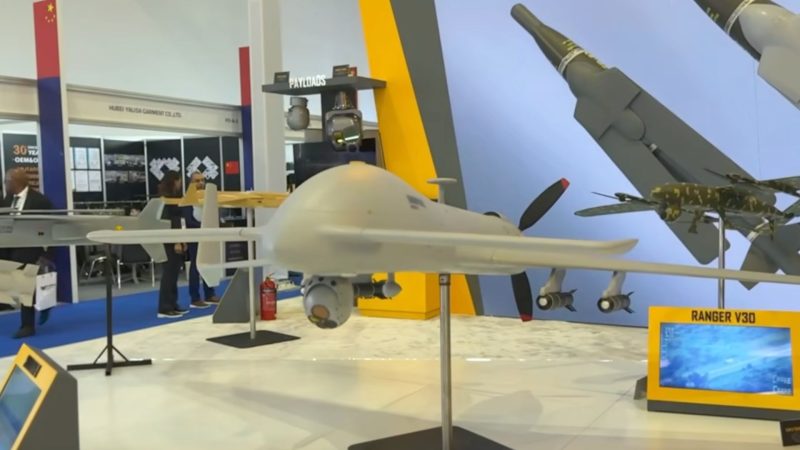
It is no secret that Pakistan has viewed Saudi Arabia as a key potential market for its defence industry’s growing portfolio of products. Many of these products will remain as concepts and designs unless given funding to accelerate development and/or scale up production (e.g., Group 4 and Group 5 drones, precision-guided munitions, etc). Thus, Pakistan could look to Riyadh for such funding and, in return, provide Saudi Arabia the knowhow to manufacture those systems locally.
Likewise, Rawalpindi could look to Riyadh for fiscal assistance for its next wave of big ticket arms procurement, which, ostensibly, involves items like the Chinese J-35 stealth fighter, HQ-19 terminal air defence system, and other wares. This would not be entirely unprecedented as, in the 1980s, Pakistan used Saudi funding to help finance its initial purchase of 40 General Dynamics F-16A/B Block-15 fighter aircraft from the U.S.
Don't Stop Here. Unlock the Rest of this Analysis Immediately
To read the rest of this deep dive -- including the honest assessments and comparative analyses that Quwa Plus members rely on -- you need access.